

You can get an AI roadmap approved in one meeting and still feel stuck the next morning. The board likes the direction, the leadership team likes the ambition, and then someone asks the question that matters: who is going to turn this into working change without creating a mess in operations, data, or compliance?
That’s the point where many teams start searching for the best AI consulting firms and realise the list isn’t the hard part. The hard part is separating glossy strategy talk from firms that can handle AI implementation services, governance, workflow redesign, and measurable adoption in practice. In Singapore and across Southeast Asia, that matters even more because many organisations are moving quickly, but not from the same starting point. If you need a practical starting point, Ekipa’s AI consulting services offer a useful reference for how firms structure support across strategy, delivery, and enablement.
| Firm type | What it usually does well | Best fit | Main risk |
|---|---|---|---|
| Global strategy house | Board-level AI strategy, operating-model design, executive alignment | Large enterprises that need broad transformation | Strong ideas, weaker handover if delivery ownership is unclear |
| Systems integrator | Build, integrate, and scale AI into existing technology stacks | Organisations with complex platforms and legacy systems | Can become too technology-led if business outcomes aren’t tightly defined |
| Boutique AI specialist | Deep expertise in a narrow set of use cases or models | Teams that need speed on a defined problem | May lack change-management depth or governance breadth |
| Hybrid advisory-delivery partner | Strategy, enablement, delivery, and capability transfer | Businesses that need execution plus internal uplift | Quality varies, so the team mix matters more than the pitch deck |

When Your AI Roadmap Stalls and You Need Outside Help
A CEO signs off the AI direction on Friday. By Monday, the question is whether the organisation can move from approval to delivery without getting stuck on governance, data gaps, and internal politics.
Outside help makes sense at that point. AI programmes usually fail at the handoff between ambition and execution, and a good consultant closes that gap by turning broad priorities into a sequence of decisions, owners, and delivery steps that can survive contact with operations.
The moment that separates strategy from delivery
If your organisation already knows which processes matter most, but no one can agree on the data, controls, or team structure needed to launch them safely, advice alone will not move the work. You need AI transformation consulting that maps approved use cases into accountable action. For companies that want a structured route from roadmap to action, Ekipa’s AI strategy advisory roadmap is a useful reference point.
The clearest sign you need outside support is simple. Your people keep using broad language like “pilot,” “innovation,” and “explore,” but nobody can say what gets built first, who reviews it, or how success will be measured. At that point, the consultancy is there to force decisions.
Practical rule: if a firm cannot explain how it moves from prioritised use case to working backlog to live process, it is not ready for serious delivery work.
Why Southeast Asian leaders feel this pressure first
In Singapore, the pressure is sharper because AI adoption is moving fast but unevenly. IMDA reported that AI adoption among all enterprises rose from 4.3% in 2023 to 14.7% in 2024, then to 23.5% in 2025. Among enterprises with at least 10 employees, adoption reached 34.6% in 2025. The same report shows that SME adoption more than tripled from 4.2% to 14.5% in 2024, while non-SME adoption climbed from 44.0% to 62.5%. IMDA’s enterprise AI data is a reminder that one-size-fits-all consulting rarely works here.
That means the partner has to fit the operating reality. A regulated enterprise needs controls, architecture, and delivery discipline. A smaller team may need practical enablement, safe adoption, and a way to start without building a department around one project. The best AI consulting firms understand that difference immediately.
What AI Consulting Firms Actually Do
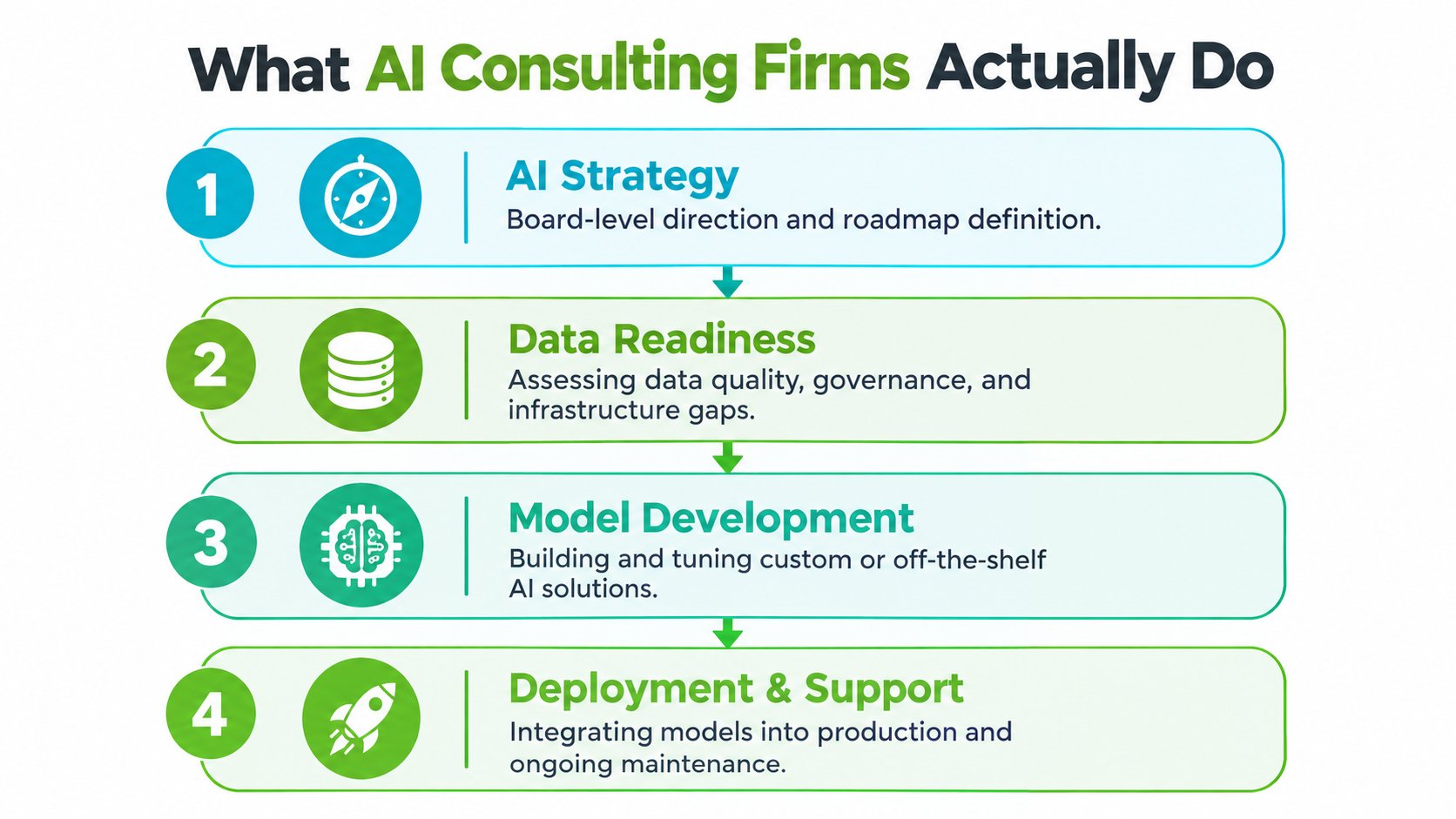
AI consultants do a lot of things badly described on websites. Strip away the jargon, and the work usually falls into four layers. If a firm can only talk about one of them, it’s probably not the right partner for a full business programme.
Four layers that matter
The first layer is AI strategy. Here the firm helps leadership decide which problems are worth solving, which are not, and what the organisation should fund first. Good strategy work is practical. It ties use cases to commercial outcomes, not just to technical fascination.
The second layer is data readiness and governance. Here the consultant checks whether your data, access controls, documentation, and internal ownership are fit for purpose. Singapore’s national AI governance reference point is the AI Verify Testing Framework, which gives organisations a way to assess responsible AI implementation against recognised principles. For regulated businesses, that matters because governance is not a slide; it’s an operating requirement.
The third layer is model development and integration. That includes custom builds, off-the-shelf GenAI enablement, workflow design, and connecting the system to your tools and internal data. In sectors such as banking, insurance, healthcare, telecommunications, and government-linked enterprises, the firm has to understand the reality of compliance, approvals, and auditability.
The fourth layer is deployment and support, and it is where many projects lose momentum. A serious firm stays involved long enough to test, monitor, adjust, and hand capability back to your team rather than disappearing after a polished presentation.
If the proposal stops at “discovery,” you’re buying insight, not implementation.
A useful engagement should also reflect the local reality. Singapore’s AI development has been backed by public investment, including S$1 billion for public AI research and development for 2025 to 2030, following a previous S$500 million tranche for 2019 to 2023. The country is part of a wider Southeast Asian opportunity that attracted US$30 billion in AI-infrastructure investment in the first half of 2024 alone, with regional GDP upside projected to be substantial. EDB’s regional AI infrastructure overview makes one thing clear: public investment is not the same as enterprise execution.
The Criteria That Matter When Comparing Firms
The phrase “best AI consulting firms” hides a trap. The right firm for a global bank is not the right firm for a mid-sized manufacturer, and the right firm for a fast-moving SME can still be wrong for a regulated enterprise with board scrutiny and audit requirements. Selection has to rest on fit, not fame.
Business understanding beats technical theatre
A strong consulting partner translates AI into your commercial language. It understands where value sits in your organisation, which processes are expensive or slow, and which team owns the pain. If a firm talks only about model types and not about cycle time, error rates, service levels, or adoption friction, it is not speaking your language.
That matters because IMDA’s 2025 results show that 87.6% of AI-adopting enterprises cited productivity or process improvement, while 44% reported cost reduction or resource optimisation. IMDA’s 2025 enterprise AI findings point to the standard buyers should apply: measurable business effects, not vague innovation language.
Implementation strength is the difference between decks and systems
Plenty of firms can create a roadmap. Far fewer can move a use case into production, monitor it, and keep it useful once the novelty wears off. That is the dividing line between an AI strategy consulting engagement and a real AI implementation services partnership.
Ask direct questions. Can they redesign a workflow? Can they connect to your data environment? Can they support versioning, rollback, and human review? If they cannot explain that clearly, they are not ready for enterprise delivery.
Governance and security are part of the product
In Singapore, governance is not window dressing. It is a practical issue, especially for regulated sectors and organisations with shadow AI concerns. An effective firm should be able to describe how it handles data classification, access control, human oversight, and incident response in everyday operations, not just in a policy document.
For a useful benchmark on how to vet service providers more rigorously, OGTool’s guide to vetting agencies is a reminder that scoping, proof, and operational fit matter more than presentation polish.
Measurable outcomes should be defined before the contract
Every engagement should begin with a baseline. Not because you need a spreadsheet for its own sake, but because nobody should be able to claim success later without evidence. Ask how the firm will measure time saved, reduced errors, lower processing costs, or better service performance before the first workshop ends.
Strong firms do not hide behind activity. They define what better looks like before the work starts.
For teams that want that accountability built into the delivery model, insist on a partner whose contract ties leadership decisions to executable work, not to a slide deck and a hope.
Firm Archetypes and Where Each One Fits Best
Start from your situation, not from a league table. Each archetype below brings a specific strength and a specific blind spot, so the right choice depends on what is stuck in your organisation and what outcome you need first.
| Your situation | First question to ask the firm | Dealbreaker answer |
|---|---|---|
| The board wants a clear AI direction, but teams are not aligned | Can you turn executive intent into a funded, sequenced programme? | “We can only provide the strategy deck.” |
| Your systems are old, messy, and tied to many platforms | How do you connect AI work to existing data and application estates? | “Integration is someone else’s problem.” |
| You have one defined use case and need it done fast | Who on the team will own delivery, tuning, and handover? | “We will assemble the team after kickoff.” |
| You need strategy, delivery, and internal capability in one engagement | How do you transfer knowledge while still owning the outcome? | “We work best as a pure advisory layer.” |
How to read the trade-offs
A global strategy house fits when leaders need a clean AI narrative, executive alignment, and a decision framework the board can back. It works best if the core problem is internal agreement. Ask where the delivery team sits, who owns implementation, and how much of the work stays with the same people after the proposal is signed.
A large systems integrator fits organisations with complicated estates, multiple platforms, and AI work that has to live inside existing infrastructure. The right question is simple. Can this firm handle the data estate, the approval chain, and the operational constraints without turning the engagement into a pure technology exercise? If the answer is vague, the work will drift.
A boutique AI specialist fits a narrow use case that needs speed and technical focus. Use this archetype when the problem is well defined, and you need sharp execution, not broad organisational redesign. Ask who covers governance, adoption, and the handover to your internal team. If they cannot answer that clearly, you are buying a tool build, not a business result.
A hybrid advisory-delivery partner fits teams that need outcome ownership and internal capability transfer in the same engagement. This is the strongest fit for many Southeast Asian organisations because it closes the gap between strategy and execution without leaving the company dependent on outside specialists. The key question is whether the actual delivery team has both consulting judgment and implementation depth.
Common Mistakes That Lead to the Wrong AI Partner
The wrong choice usually looks reasonable at first. That’s the problem. The pitch sounds polished, the credentials look strong, and six months later the organisation has workshops, documentation, and no meaningful production change.
Mistake one: Choosing brand prestige over delivery fit
Big-name consulting can be useful, but it’s not a substitute for fit. If a firm has strong boardroom presence and weak experience in your sector or region, you’ll feel the gap when the work gets real. The proposal may read well while the delivery team struggles with your operating constraints.
That’s why you should ask for evidence of similar engagements in the same regulatory or regional context. A famous name doesn’t tell you whether the team can work with your data estate, your managers, or your approval process.
Mistake two: Obsessing over model sophistication
A clever model that doesn’t solve a business problem is just an expensive distraction. Some buyers get pulled toward technical novelty and forget to ask whether the use case is important enough to change how people work. If the firm can’t connect the technology to a measurable operational outcome, keep looking.
Mistake three: Treating governance like paperwork
Governance that lives in a PDF but not in daily work won’t protect you. In Singapore, a meaningful proportion of business leaders have reported shadow AI usage and gaps in governance, which makes workflow design and manager training part of the solution, not an afterthought. A firm that only offers policy language probably won’t help when employees start using personal tools outside approved channels.
Mistake four: Accepting vague success criteria
If the firm can’t tell you what success looks like in operational terms, it’ll be hard to judge the result later. Push for concrete measures tied to business value. That includes cycle time, service quality, cost per transaction, or employee productivity, depending on the use case.
A 12-month engagement that ends with presentations and no live deployment is not a transformation programme. It’s an expensive delay.
Questions to Ask Before You Sign an AI Consulting Contract
Good questions expose weak firms quickly. Bad questions let everyone hide in generalities. The goal is to move the conversation from aspiration to evidence.
Strategy questions
Ask how they prioritise use cases. A strong answer will explain how they weigh business value, feasibility, data readiness, and risk. A weak answer sounds inspirational but doesn’t show how decisions are made.
Ask what metrics they want to baseline before work starts. If they don’t ask about current cycle time, error rate, cost, or adoption, they probably won’t measure improvement properly either.
Execution questions
Ask what happens after the pilot. You want a clear route into production, with staging, testing, approvals, and support. If they say “we’ll iterate” without naming who owns the live environment, that’s a warning sign.
Ask for one example of a project that reached live production and stayed in use. You’re looking for evidence of operational follow-through, not just a polished demo.
Governance questions
Ask how they handle data classification, access controls, human review, and incident response. A serious firm can explain this in plain language. If the answer sounds like a compliance brochure, the implementation may be shallow.
Ask how they reduce shadow AI rather than just banning it. Safe, approved workflows matter more than blanket warnings if you want actual adoption.
Capability-transfer questions
Ask what internal teams will be able to do after the engagement. You want documentation, training, coaching, and decision ownership handed back in a usable way. If the answer implies ongoing dependence, think carefully.
A useful test is to ask for technical acceptance criteria. That might include grounded-answer accuracy, retrieval precision, latency, cost per transaction, privacy controls, and incident-response procedures. The specific measures will vary, but the discipline should not.
Choosing the Partner That Closes the Strategy-to-Execution Gap
The strongest AI partner is the one that turns board approval into accountable delivery. In practice, that means a firm that can connect governance, data readiness, workflow redesign, and measurable execution without turning your organisation into a permanent consulting client.
That’s the right lens for Southeast Asia, especially in regulated environments. Larger enterprises need governed, integrated delivery. SMEs need practical enablement, safer ways to start, and a path to internal capability. The best AI consulting firms recognise that those are different jobs.
For organisations that want a partner model built around delivery discipline, Ekipa’s AI implementation services are relevant because they focus on moving prioritised use cases into working outcomes through structured execution. The point isn’t to buy advice and hope the rest sorts itself out. The point is to close the gap between strategy and the day-to-day work that makes AI useful.
If you’re choosing an AI partner right now, look past the pitch deck and test the delivery model, the governance thinking, and the handover plan. Ekipa helps Southeast Asian organisations build AI strategy, enable teams, and deliver working systems with training, coaching, consultancy, and production support. Visit Ekipa if you want a conversation about turning your AI roadmap into something your teams can run.