

A transformation can hit every launch milestone and still fail where it matters most, in the day-to-day work. The platform goes live. Training is done. Leaders announce success. But teams still fall back on old approval routes, managers keep their familiar workarounds, and the business results never fully show up.
That is where organisational change management earns its place. In Singapore and across Southeast Asia, new technology often lands in environments shaped by regulation, overloaded managers, and multiple transformation programmes running at once. Change works when people can do the job differently, with clear responsibilities, decision rights, and controls, not simply when they know a change is underway.
Why Most Transformations Stall After the Kickoff
The system is live. In the transformation war room, the project team reviews the launch dashboard: access is working, training has run, and the implementation is marked complete. But a department head still approves requests by email because the new workflow doesn’t fit how decisions are made. Staff enter information twice to satisfy separate reporting needs. The team is using the technology, but the operating model hasn’t caught up.
Many programmes lose momentum when leaders treat change management as the communications layer around implementation: explain the change, train employees, then move on. But employees also need to know which decisions have changed, who owns exceptions, how performance will be assessed, and what to stop doing. Without those answers, old habits and unofficial workarounds tend to survive the launch.
Singapore’s experience makes the distinction important. Workforce Singapore reported that it engaged more than 5,800 companies in job transformation and reskilling initiatives in 2023, and launched seven Jobs Transformation Maps, bringing the total to 16. Those maps examine how technology, automation, artificial intelligence, digitalisation, and sustainability affect jobs, skills, and work practices. The signal for change leaders is practical: transformation reaches into job design and everyday work, not just systems.
The test isn’t whether the change launched. It’s whether people can complete real work differently, safely, and consistently.
Before announcing a programme, map what will change in roles, workflows, decision rights, and accountability. A practical change management checklist can help teams spot readiness gaps before launch. For a useful perspective on the leadership behaviours behind transformation, see Ekipa’s six mindset shifts for successful organisational transformation.
What Organisational Change Management Actually Means
Organisational change management is the deliberate work of helping people move from current ways of working to new ones, while adjusting the organisation around them so the change can deliver its intended outcomes. It covers individual understanding and capability, but also the structures that determine how work gets done: roles, handoffs, decision rights, controls, measures, and leadership routines.
That definition gives executives and practitioners common ground. The technology or strategy defines what needs to change. Change management identifies who must work differently, what support they need, and what organisational conditions must be in place to make those new behaviours possible.
Choose a framework for the problem, not the label
Frameworks are useful when they help teams see a problem clearly. They become less useful when the organisation spends more time reciting steps than resolving blockers. Kotter’s eight steps can help leaders organise a broad transformation around urgency, sponsorship, and sustained change. ADKAR focuses on the individual outcomes people need, from awareness and desire to knowledge, ability, and reinforcement. Prosci connects individual adoption with an organised change process. Lean change takes an iterative approach, testing and adjusting interventions as teams learn.
| Framework | Core unit of change | Best fit | Common blind spot |
|---|---|---|---|
| Kotter’s eight steps | Organisation-wide leadership and momentum | Broad transformations needing visible sponsorship | Can feel too linear when work changes rapidly |
| ADKAR | Individual adoption outcomes | Diagnosing where a person or group is getting stuck | Doesn’t by itself redesign operating structures |
| Prosci | People-side activities across an initiative | Programmes that need a repeatable change-management process | Can become activity-led if outcomes aren’t tracked |
| Lean change | Small experiments and feedback cycles | Uncertain changes that benefit from iterative learning | Local experiments may not resolve enterprise governance |
Pick the model that fits the scale, regulation, and pace of the work, then connect it to operational decisions. A framework won’t decide who can approve an exception or how a team should handle a new control. Leaders and practitioners still have to make those choices.
For another perspective on connecting change leadership to organisational priorities, explore The OKR Hub’s guide to organisational change management.
Mapping Stakeholders by Influence and Readiness
A stakeholder list tells you who’s affected. A useful stakeholder map tells you who can enable, delay, or reshape the change, and what each person needs to do differently. That matters because a senior sponsor, a frontline employee, and a middle manager don’t hold the same levers. Sending all three the same update is easy to organise and rarely enough to move the work.
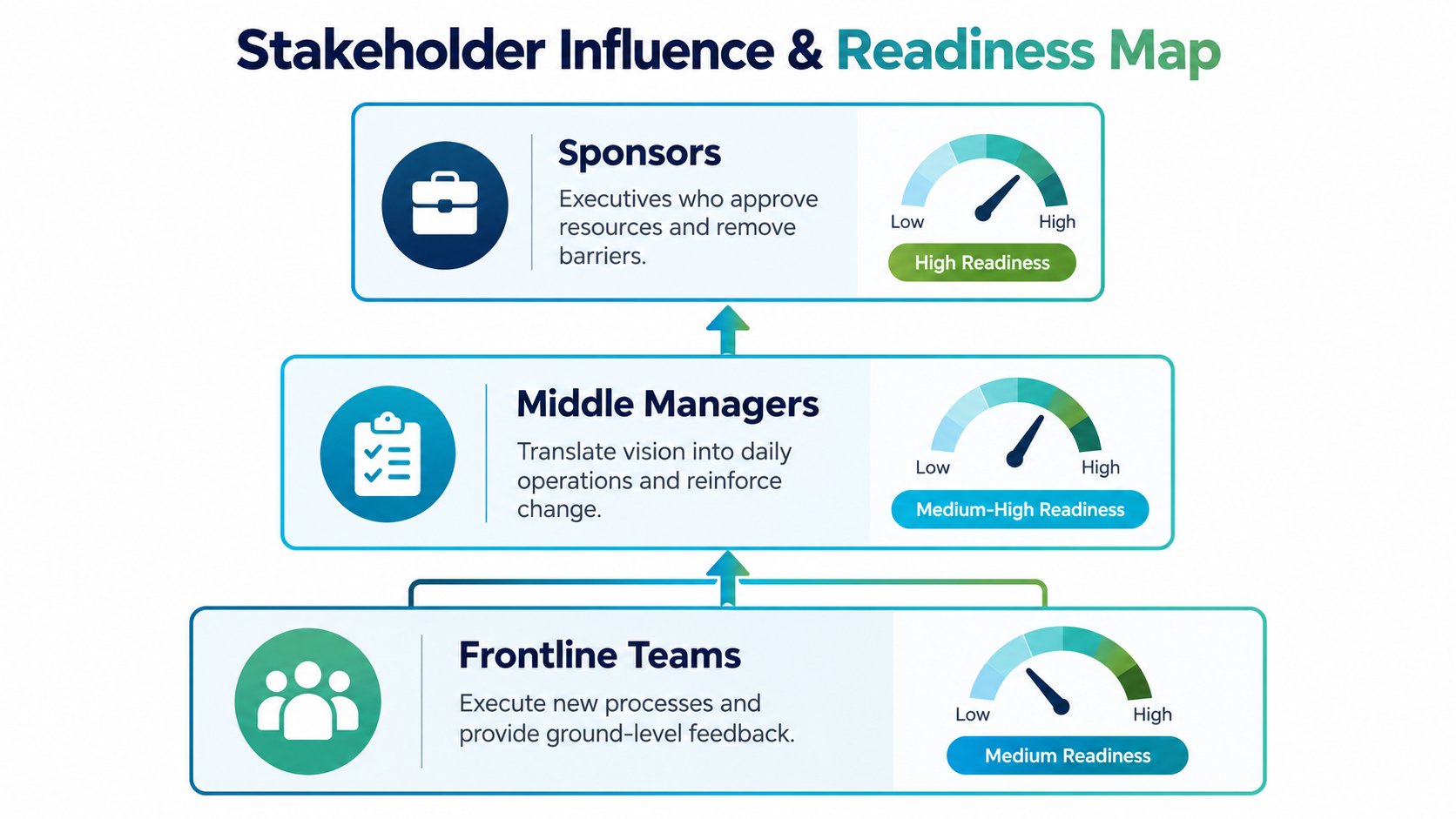
Start by mapping each group against two questions: how much influence do they have over whether the change works, and how ready are they to support it? Then identify the specific behaviour or decision you need from them. A sponsor may need to remove a policy barrier; a manager may need to change how work is assigned; a frontline team may need to follow a revised process and flag where it breaks.
Match engagement to the role
-
Sponsors: Ask them to make visible decisions, settle competing priorities, and remove barriers. A sponsor who appears only at launch sends a weaker signal than one who explains trade-offs and follows through.
-
Middle managers: Give them clear decision rules, space to raise operational concerns, and coaching on how to translate the change into team routines. Don’t ask them to reinforce a plan they can’t explain or influence.
-
Frontline teams: Involve people who understand the daily work in testing workflows and identifying exceptions. Treat their feedback as operational evidence, not as a vote for or against the change.
-
Informal influencers: Identify trusted colleagues whose views shape the wider team. Listen to scepticism closely; it may point to a real process defect, a workload concern, or a lack of clarity.
Keep the map to one page. Record the stakeholder, their influence, readiness, likely concern, the action you need, the owner of the engagement, and the next check-in. Update it when decisions or working conditions change, rather than treating it as a one-off planning exercise.
Building a Communication Plan That Drives Decisions
A communication calendar can be full and still fail to help employees act. The better question isn’t how many announcements people have received. It’s whether they know what decision to make when they encounter the new process, an exception, or a conflict with their existing workload.
Organise communication around those moments. Before a change, explain what is changing, why, who is affected, and what stays the same. At launch, provide role-specific instructions and a clear route for questions. During early use, report what the team has learned, what has been adjusted, and which issues need escalation. Keep each message focused enough to read quickly, especially for employees checking updates between tasks.

Give each audience a useful message
| Audience | Message they need | Useful channel |
|---|---|---|
| Executives | Decisions required, risks, and progress against intended outcomes | Steering discussions and concise decision notes |
| Managers | What to reinforce, what they can decide, and how to escalate issues | Manager briefings, practical guides, and coaching |
| Frontline teams | What changes in the workflow and where to get help | Team discussions, job aids, and in-workflow support |
Make communication two-way. Office hours, manager check-ins, and feedback channels help leaders hear where instructions are unclear, or the process doesn’t match actual work. Assign someone to review the feedback, route urgent issues to a decision-maker, and tell employees what happened to the concerns they raised. A channel that collects questions but produces no visible response quickly loses credibility.
For distributed teams, communication also depends on making participation easy across locations and working patterns. Ekipa’s advice on inviting people to engage when they’re working remotely offers practical ways to make that interaction more deliberate.
Training Enablement and Role-Specific Capability Building
An awareness session can explain why a programme exists. It can’t, by itself, prepare an employee to apply a new workflow under pressure, make a controlled decision, or spot when an AI-assisted output needs review. Treating those different needs as the same training problem often produces attendance records without reliable capability.
A more useful approach separates learning into three connected layers. Awareness gives people the context: what is changing, why, and where the change affects them. Role-specific training shows each group how to perform its tasks in the new process. Coached application gives people a chance to try the work, receive feedback, and resolve questions using realistic scenarios.
Train against the work people actually do
For a new approval workflow, don’t stop at a general presentation. Let approvers practise reviewing a request, handling an incomplete submission, documenting a decision, and escalating an exception. For AI-assisted work, include the intended task, permitted inputs, output validation, and the route to follow when the result is uncertain. A regulated role may need to practise retaining human oversight and recording the reasoning behind a decision.
| Enablement layer | Use it when | What to check |
|---|---|---|
| Awareness | People need context before the change affects their work | Can they explain what changes and where to find guidance? |
| Role-specific training | Tasks or responsibilities are changing | Can they complete the workflow, including common exceptions? |
| Coached application | The work involves judgement, handoffs, or unfamiliar decisions | Can they apply the process in a realistic scenario and explain when to escalate? |
Training should arrive close enough to implementation that employees can practise in the relevant workflow, rather than trying to recall a generic session later. Managers need their own preparation too: they should understand the process, the questions their teams are likely to ask, and the decisions they can make without waiting for senior approval.
Measure capability through observed practice, work samples, or scenario-based checks, then address gaps with targeted support. Completion records show who attended. They don’t show whether the new behaviour has become part of the job.
Measuring Adoption That Actually Predicts Outcomes
A training register can tell a steering committee who attended. A sentiment pulse can show how employees feel. Neither proves that people are using the new process correctly or that the change is delivering value. Adoption measures should show what people do differently and whether that behaviour improves the work.
Set a baseline before rollout. If leaders wait until after launch to measure cycle time, defects, or work volume, they may not know whether the change caused the result. Agree on a small set of measures with the people responsible for the process, and connect each one to an intended outcome.
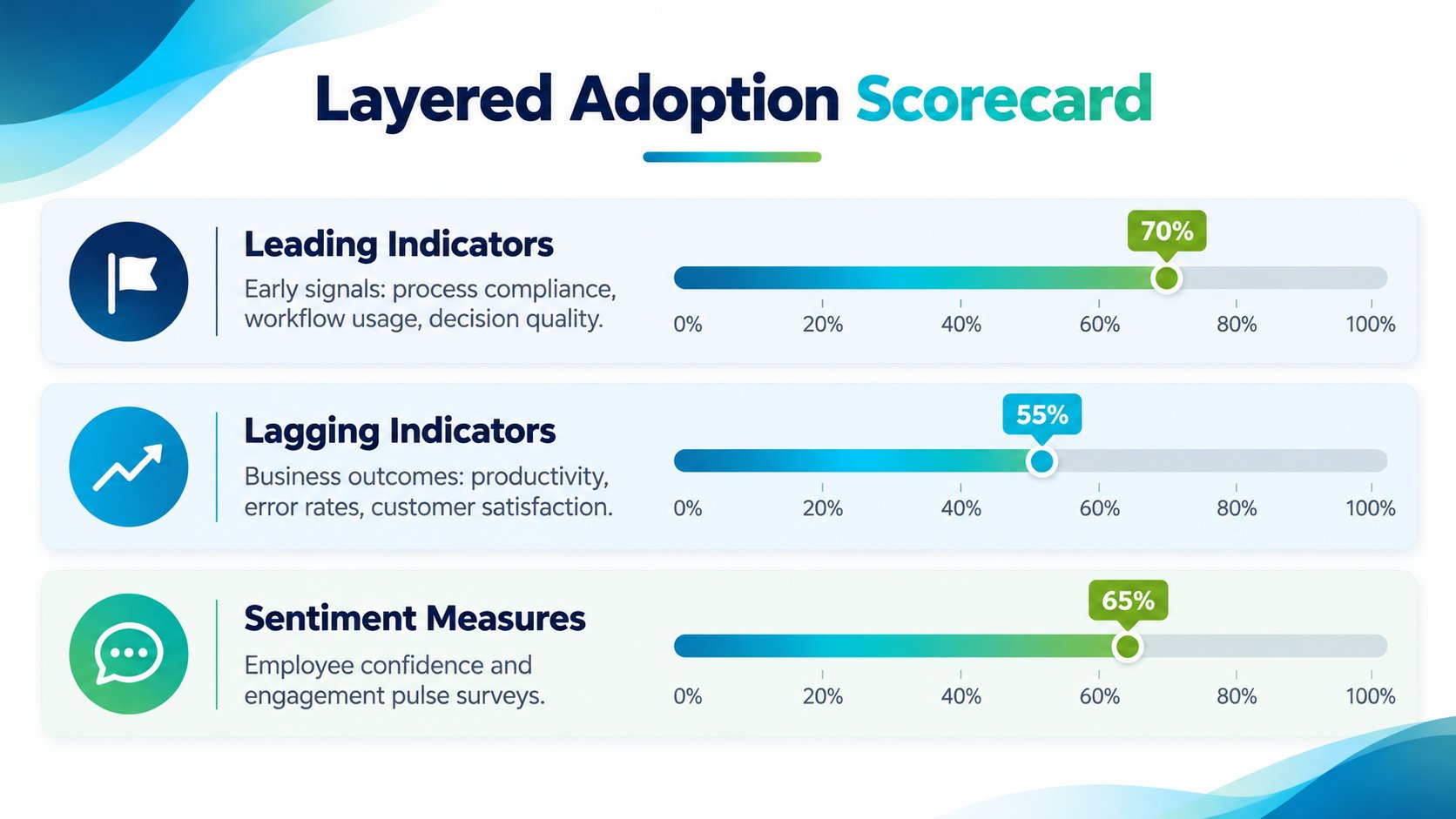
Build a scorecard across the work
-
Leading indicators: Track signals that show whether new behaviours are appearing, such as workflow usage, decision-cycle time, exception rates, or completion of required reviews.
-
Process-quality measures: Look at compliance with the new procedure, data-quality defects, and whether handoffs contain the information the next team needs.
-
Lagging outcomes: Check whether productivity, risk events, customer outcomes, or service quality are moving in the intended direction.
-
Sentiment and confidence: Use employee feedback to understand where people feel uncertain or overloaded. Treat it as context for the operational measures, not a substitute for them.
The right indicators depend on the change. An AI programme might track whether staff use approved workflows and validate outputs appropriately. An agile transformation might examine how decisions move through the work system and whether teams can complete agreed work without recurring bottlenecks. A data-modernisation effort might monitor data defects and the reliability of information used in decisions.
In Singapore, digital adoption is already widespread: a government report states that nine in ten enterprises had adopted at least one digital technology, and that the digital economy generated S$106 billion in value added in 2022, equal to 17% of nominal GDP, up from 13% in 2017. Those figures describe adoption and economic context, not whether each organisation has embedded new practices. Use a scorecard that combines behaviour, process quality, and outcomes, and discuss it regularly with the teams doing the work. For ongoing improvement, Ekipa’s guide to using agile retrospectives for continuous improvement offers a practical way to turn observations into adjustments.
Leading Through Change Saturation and Competing Priorities
When employees struggle with a transformation, leaders often reach for more communication or training. Sometimes those are the right fixes. But Singapore workforce evidence points to another possibility: people may already be carrying too much change to absorb the next initiative well.
In PwC’s Singapore survey, 58% of surveyed workers said they had experienced more change in the previous year, and 45% said they found it difficult to manage change. The survey also found that 50% believed AI had increased work complexity and 46% said it had increased their workload. These findings make it risky to assume that hesitation is resistance. A team may be willing to change and still lack the time, clarity, or capacity to take on another programme.
Make portfolio choices visible
Bring initiative owners and affected managers together to review the changes landing on the same teams. For each initiative, ask: what outcome does it serve, what work does it add, what can be delayed, and which decision-maker will resolve conflicts? Then sort the work into continue, sequence, pause, or stop.
The uncomfortable part is making a stop-doing decision. If every initiative remains active, managers have to resolve the collisions locally, often without authority to do so. Leaders should state what takes priority when requirements compete, who can approve an exception, and what work teams should defer.
Before asking a team to absorb more change, decide what the organisation will take off its plate.
Watch for duplicated work, incompatible deadlines, and managers who are expected to explain priorities they haven’t been given. In PwC’s survey, only 67% of Singapore respondents said they understood the skills they would need in the future. That’s a reminder to make future capability concrete: specify the skills, practice opportunities, and role changes linked to the programme rather than relying on a broad message about reskilling.
The practical leadership move isn’t to demand more enthusiasm. It’s to set priorities, equip managers to translate them, and give teams permission to raise overload before a missed deadline or control failure forces the issue.
A 90-Day Sequencing Pattern and Practitioner FAQs
A short sequencing plan can help leaders turn approval into organised work without pretending every programme follows the same timetable. Use the first month to understand the operating context, the second to mobilise people around real workflows, and the third to reinforce what works and adjust what doesn’t. Treat the sequence as a management rhythm, not a promise that transformation is complete at the end.
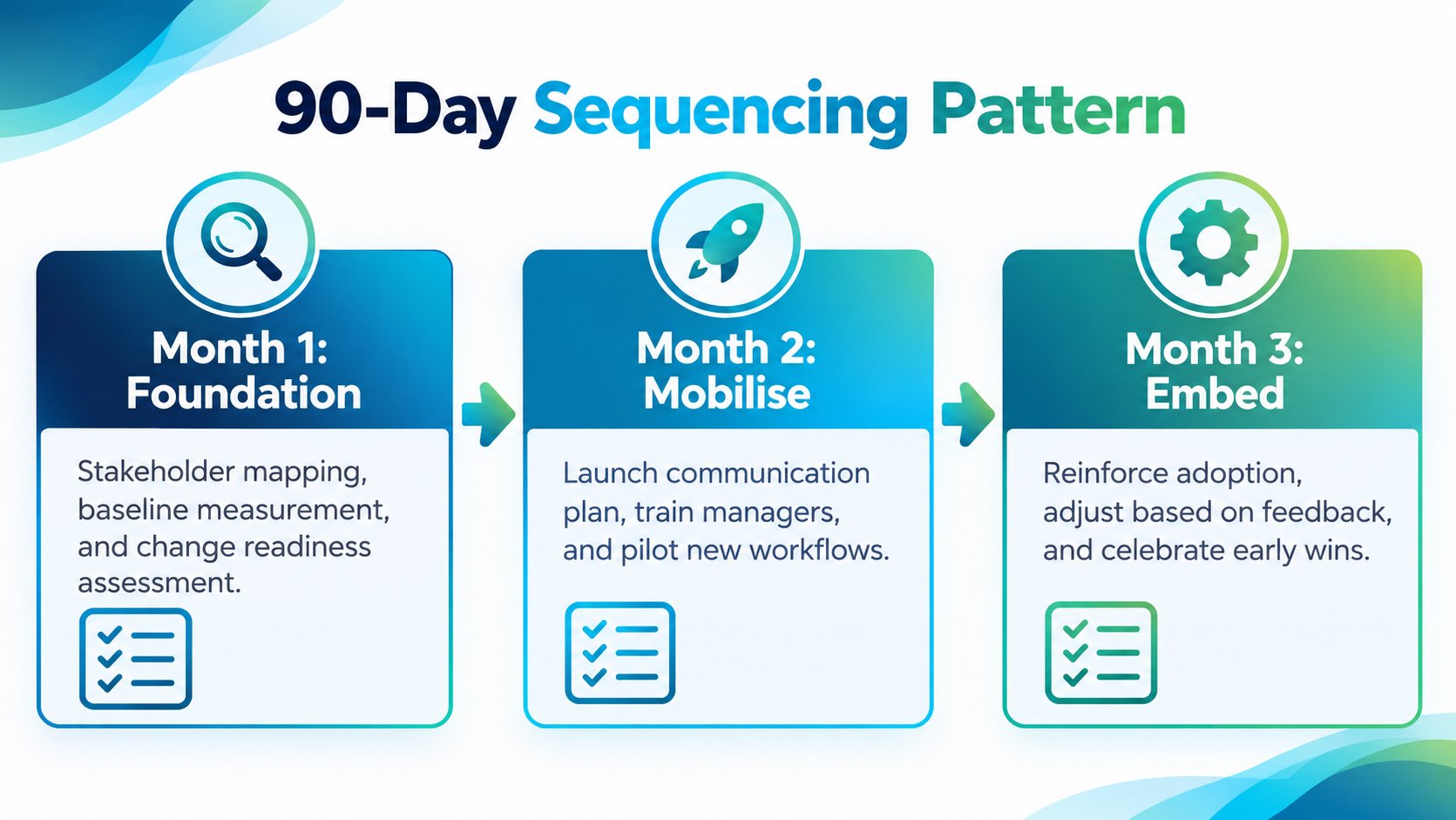
Sequence the work
Month 1, Foundation: Map stakeholders, document how work happens today, identify role and control impacts, and agree on the baseline measures. Confirm who owns decisions and how teams will surface issues.
Month 2, Mobilise: Brief managers, communicate role-specific changes, and practise the new workflows with the people who will use them. Use feedback to refine instructions and resolve avoidable friction before expanding the change.
Month 3, Embed: Review behavioural and operational indicators together, address gaps, and confirm who owns the new process once the programme team steps back. Recognise useful progress, but don’t treat a launch milestone as proof that the operating change has stuck.
Practitioner FAQs
How can we redesign roles without weakening accountability in a regulated organisation?
Keep named ownership clear while changing task allocation. Document decision rights, human review points, escalation paths, and evidence requirements before teams adopt the revised workflow.
When should a team escalate a scope change instead of absorbing it?
Escalate when the change affects agreed outcomes, controls, capacity, or accountability. A local adjustment may be manageable; a change that creates a new risk or displaces another priority needs a decision from the accountable sponsor.
How should we manage AI adoption where MAS-style controls apply?
Treat governance as part of the workflow. MAS’s AI risk-management guidance expects financial institutions to establish accountability, identify AI use, assess materiality, and apply proportionate controls across the AI lifecycle. Its guidelines for AI risk management also identify change management as a lifecycle control. Build permitted-use rules, human oversight, staff capability, and monitoring into the way work is designed.
What if adoption indicators look healthy but outcomes don’t move?
Check whether the indicator measures meaningful behaviour or only activity. Then examine the process for bottlenecks, duplicate work, or unresolved decision rights, and adjust the design before adding more training.
Ekipa helps enterprises turn transformation plans into day-to-day practice through change management training, coaching, and consultancy, alongside Agile, AI, and data capabilities. If your programme is live but the operating changes aren’t sticking, visit Ekipa to explore a practical next step for your teams.