

The Product Owner wants another item added. A developer mentions an unresolved security review. Someone’s on leave, production support is already busy, and the board still looks suspiciously full. Everyone agrees to the sprint anyway because challenging the plan feels harder than accepting it.
That’s where sprint planning stops being useful. You don’t need a more elaborate ceremony. You need a forecast conversation where people can name uncertainty, make trade-offs and leave with a plan they believe.
What a Good Sprint Planning Session Actually Produces
Consider a regulated enterprise team planning a change to customer onboarding. The Product Owner arrives with priorities, developers bring their known support commitments, and the Scrum Master keeps the discussion focused. Then someone asks whether the proposed data-handling change needs approval before release.
That question isn’t a distraction. It changes what the team can credibly deliver.
A weak planning session pushes ahead and records the approval as a footnote. A useful session distinguishes between work the team controls, decisions it depends on and evidence needed before the change can reach users.
The outputs that matter
A good session produces three things:
-
A credible forecast: Developers can explain why the selected work fits, which assumptions matter and what could change the forecast.
-
A meaningful Sprint Goal: Stakeholders understand the intended business movement, such as enabling operations staff to validate onboarding documents without a separate manual hand-off.
-
Shared understanding of done: Nobody leaves believing that coding complete, testing complete and approved for use mean the same thing.
Singapore’s GovTech Agile Development guidance assigns the Scrum Master responsibility for facilitating sprint planning, forecasting deliverables using evidence and reliable sources, and tracking or removing impediments. That’s a much stronger mandate than booking a meeting and moving tickets.
Practical rule: A full board isn’t evidence of a good plan. An explainable forecast is.
Treat planning as a bounded economic decision: which valuable work can this team finish with the capacity, information and authority available? Packing in more tasks doesn’t increase that capacity.
For a companion resource on the ceremony itself, Figr’s agile sprint planning guide is useful to keep alongside your team’s working agreement. Use a guide to support the conversation, not to turn planning into a script everyone performs.
In an auditable environment, record the reasoning behind selection as well as the selected work. A reviewer should be able to follow the connection between priority, delivery assumptions and the intended result.
The Three Inputs You Need Before Planning Starts
Planning fails early when the Product Owner brings competing objectives, the backlog contains unresolved questions, or availability exists only as a headcount. Fix those inputs before asking developers what they can deliver.
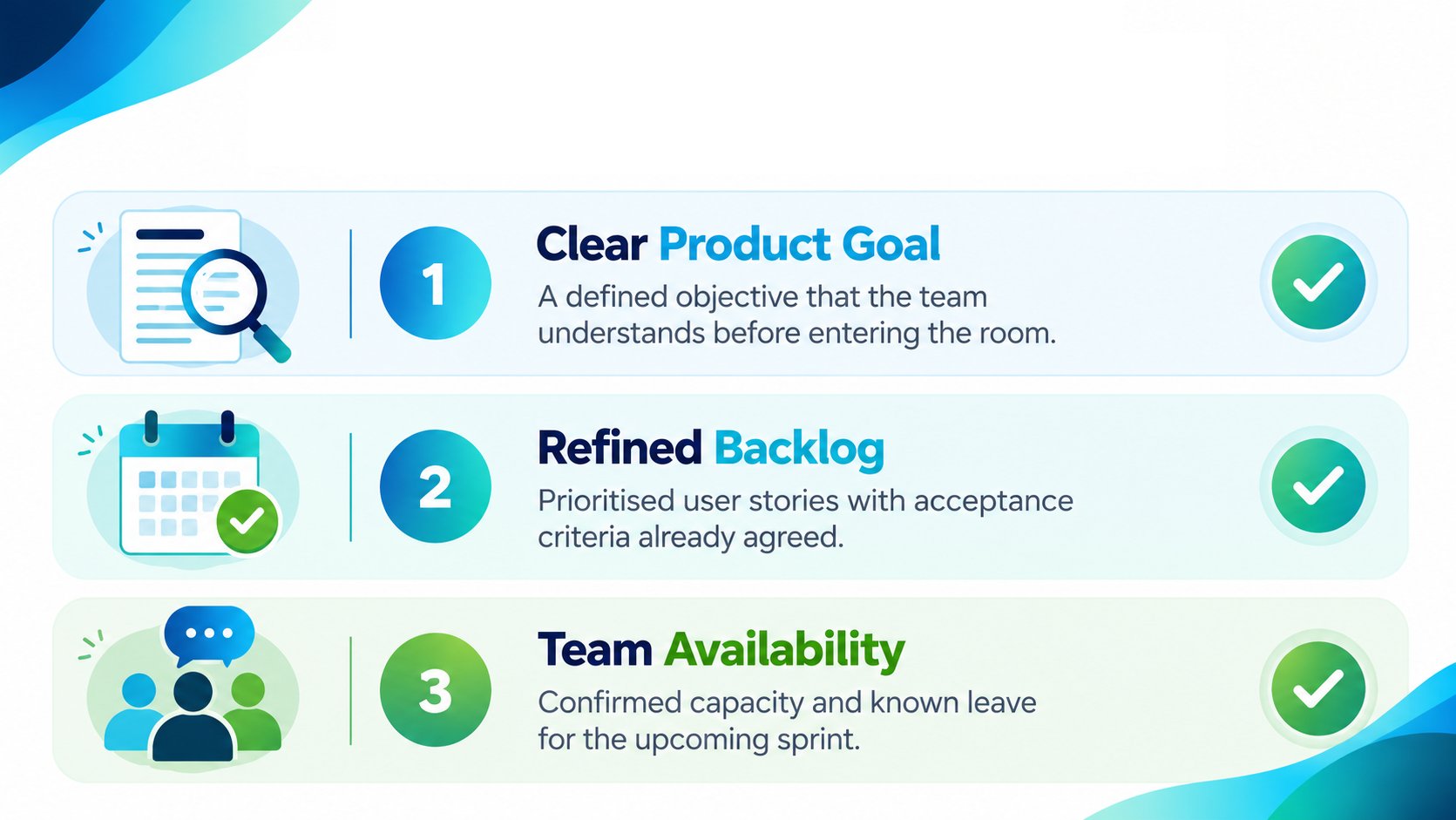
Start with a product objective
Ask the Product Owner to explain which problem deserves attention now and why. A request to improve onboarding is too broad; a proposal to remove a specific verification hand-off gives the team something concrete to discuss.
The objective should guide selection without prescribing every implementation decision. Developers need room to propose a smaller, safer route to the same result.
Make readiness operational
Use a 30-minute refinement session the day before planning as a practical starting point, not a guaranteed recipe. Review only the highest-priority candidate slice and resolve these questions:
-
Acceptance criteria: What observable behaviour will demonstrate that the item works?
-
Dependencies: Who must provide a decision, interface or approval?
-
Access and data: Can developers obtain the environments and information they need?
-
Constraints: Which security, regulatory or operational requirements affect delivery?
Singapore’s public-sector guidance on being Agile recommends decomposing top-ranked items into tasks typically completed by 1–2 developers within 3–4 days, and keeping highly interdependent Scrum teams smaller than 10 people. Use that as a prompt to inspect oversized work, not as a universal sizing law.
For teams organising this breakdown in their tracker, GoReplay’s Jira workflow tips provide a companion resource on tasks and subtasks. Keep the underlying distinction clear: a task describes work; acceptance criteria describe the result.
Bring an honest capacity view
Start with recent throughput or velocity, then adjust for changed availability. Subtract leave, support duties, expected incidents and ceremonies from nominal availability, without subtracting routine overhead twice if your historical delivery already reflects it.
When the Product Owner asks for more, show the assumption that would need to change. Don’t defend a mysterious capacity number; explain the delivery conditions behind it.
Running the Meeting in Two Parts Without Wasting Time
Open with a decision, not a status round. A useful facilitator’s opening is:
We’re deciding which outcome is worth pursuing, what work supports it and whether the delivery assumptions hold. Updates that don’t change those decisions belong elsewhere.
Borrow the discipline of a Power Start for purposeful and effective meetings: make the purpose, expected output and participation clear before discussing individual items.
Part one establishes what and why
The Product Owner proposes the highest-value ready work and explains the business reason. The team agrees the Sprint Goal before debating the full candidate list.
Don’t spend this part negotiating every estimate. Decide whether each item contributes to the outcome and whether it deserves consideration now. If stakeholders want unrelated work included, ask which priority they’re willing to displace.
For a prepared team, my default is a short, fixed working session with roughly equal space for selection and delivery design. Agree on its duration before starting, and don’t extend it automatically because the backlog is unclear.
Part two tests how the work will happen
Developers break down the selected items, compare the work with delivery evidence and identify bottlenecks. Look beyond total effort: access to a specialist, a shared environment or an external approver can constrain the whole plan.
Use this sequence when scope gets tight:
-
Protect the outcome: Remove a peripheral feature before weakening the reason for the sprint.
-
Reduce the slice: Keep an end-to-end result, but narrow its audience or operating conditions.
-
Expose uncertainty: If feasibility is unresolved, propose discovery work with an explicit decision output rather than pretending implementation is predictable.
-
Escalate beyond team authority: Record the blocker, decision owner, required response and route to escalation.
The MAS Technology Risk Management Guidelines require unresolved project risks and issues to be escalated to the project steering committee and senior management. Your sprint plan should make that route visible.
Close by asking each participant whether they see an unaddressed reason the forecast could fail. Silence isn’t the same as agreement, so invite concerns explicitly and record any remaining assumptions.
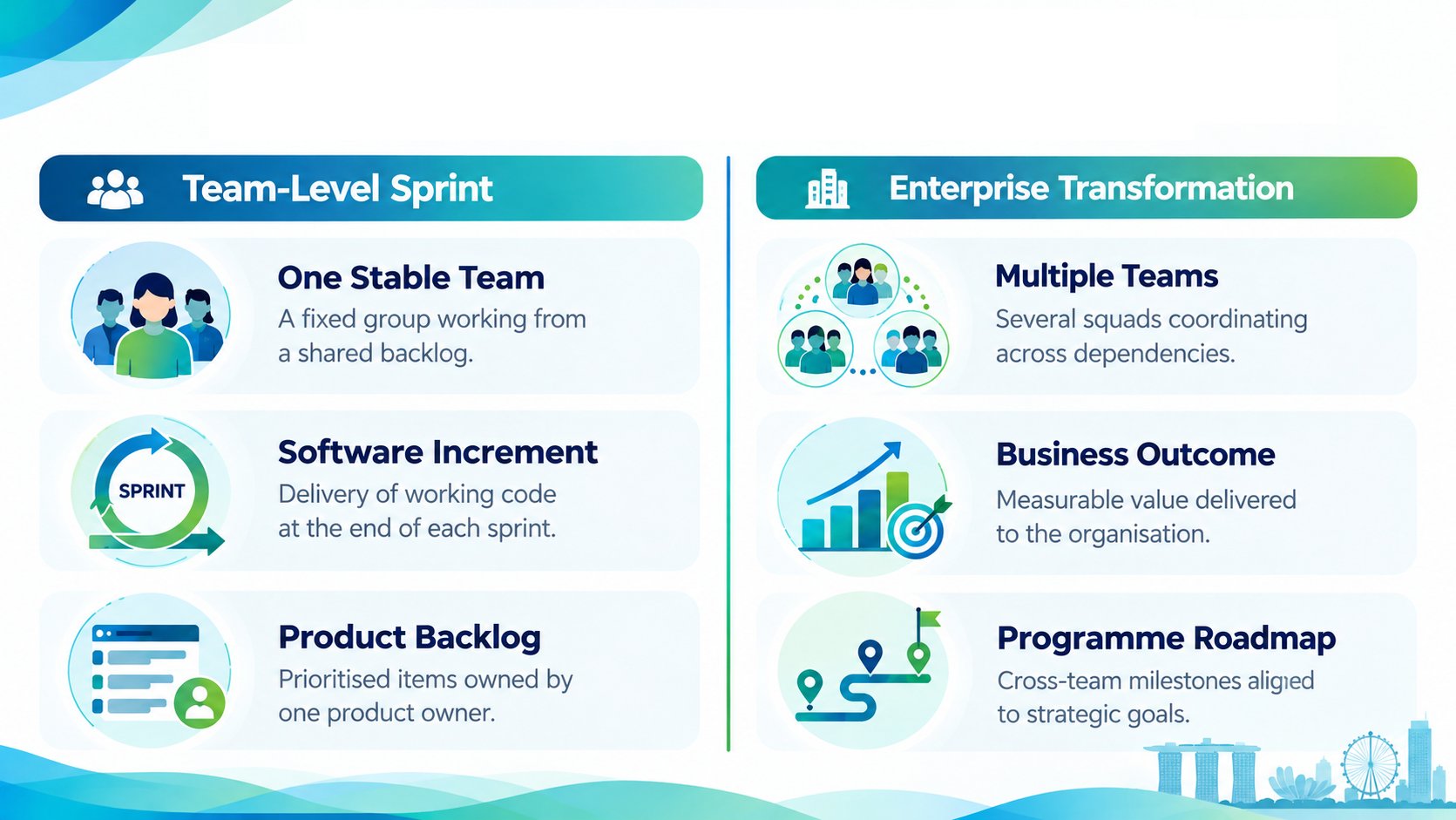
When the Goal Is a Business Outcome Not a Software Increment
A functioning AI model isn’t necessarily a functioning business process. Operations may still lack procedures, the data team may not have a reliable pipeline, and security may not have approved production access.
In that situation, better team-level estimation won’t solve the whole delivery problem. Leaders must coordinate decisions across teams.
Enterprise Singapore reported partnering with 2,300 companies on transformative projects, with participants expecting average cost savings of about S$230,000 per company once fully implemented. Those are expected benefits, not realised savings. The distinction matters: delivering project components and achieving business value aren’t interchangeable.
Choose the right planning level
| Planning model | Use it when | Keep the decision focused on |
|---|---|---|
| Team-level sprint | A stable team can deliver and inspect a coherent increment | Work the team can finish and validate |
| Coordinated 90-day outcome cycle | Several teams and business functions must contribute | Shared milestones, dependencies and benefit evidence |
Use the longer cycle as a coordination horizon, not as an oversized Scrum sprint. Teams can retain short delivery cycles while leaders resolve cross-functional trade-offs against a common outcome.
For example, an insurance team could plan a limited, human-reviewed AI-assisted document triage workflow. The useful slice includes approved data, frontline procedures, exception handling and operational ownership, not just model behaviour.
Plan governance as work
For Singapore AI initiatives, the Alan Turing Institute’s overview of AI governance in Singapore describes a framework- and guidance-led environment alongside statutory obligations such as the PDPA and sector-specific expectations. Don’t treat voluntary guidance and legal obligations as interchangeable.
Create distinct backlog items for discovery, data lineage, model-risk assessment, security testing, human oversight and production approval. Give each required decision an accountable owner, evidence requirement and release condition.
Reserve capacity for responses to external reviews. Track adoption, process cycle time and control completion where they suit the outcome, rather than aggregating story points across teams.
Use objectives and key results to connect work with company outcomes, but keep measures tied to observable business change.
Seven Planning Pitfalls Worth Naming Out Loud
A planning problem isn’t always an estimation problem. People can leave the same meeting with different interpretations of the requirements and still believe they’ve agreed.
An NTUC LearningHub survey of 300 senior and middle managers found 57% reported that not everyone understood Agile requirements, 55% said collaboration required substantial time and commitment, and 48% said work-from-home arrangements made communication harder. Treat shared understanding as something to check, not assume.

Name the behaviour and change it
-
Over-commitment under pressure: The Product Owner asks whether the team can squeeze something in, and nobody wants to disappoint. Answer with a trade-off: we can include that if we remove this; otherwise we’re accepting a forecast we don’t believe.
-
A goal that’s only a label: Calling the sprint “onboarding improvements” doesn’t help anyone choose between competing tasks. Ask what users or operations staff should be able to do differently at review.
-
Dependencies disclosed too late: Someone assumes another team will provide access when needed. Require confirmation or record the dependency as unresolved; do not treat it as available.
-
Support work treated as an interruption: Developers repeatedly handle incidents while the plan assumes uninterrupted feature work. Make operational duties visible and define how urgent requests affect scope.
-
No usable Definition of Done: Different people stop at different stages. Resolve the completion standard before accepting work, especially where testing, evidence or approval remains outstanding.
-
Retrospective findings left outside planning: The team discussed a testing bottleneck but changes nothing. Turn the agreed improvement into a delivery constraint or an explicit piece of work.
-
Capacity treated as permanent: Last sprint’s performance becomes this sprint’s entitlement. Check changed skills, availability and workload rather than copying the previous selection.
These behaviours deserve direct conversation, not a blame session. Ask which assumption the team keeps making and what evidence would justify changing it.
Don’t ask developers to sound more confident. Ask what would make the plan more credible.
If the same failure recurs, change the planning rule. Another reminder to be realistic won’t fix an incentive that rewards saying yes.
A Pre-Planning Checklist That Saves an Hour in the Room
Preparation should remove avoidable questions, not require developers to complete the entire planning discussion in advance. Run this checklist 24–48 hours before the meeting as a recommended working routine, and keep it in the team workspace.
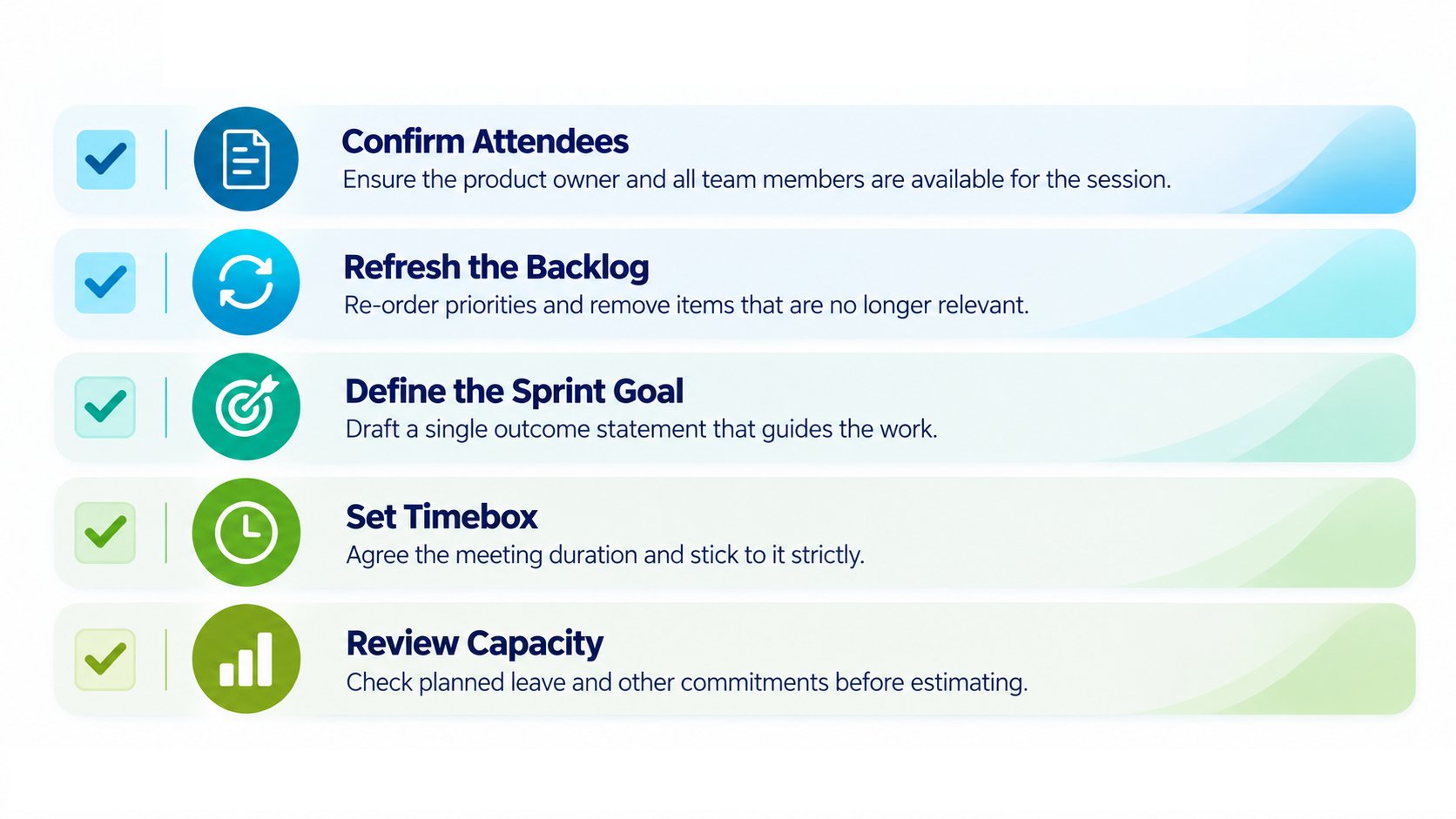
Before the session
-
Confirm participation: Check that the Product Owner, developers and facilitator can attend. Obtain specialist input beforehand when a live appearance isn’t necessary.
-
Refresh priorities: Remove obsolete candidates and publish the proposed product objective with the top backlog slice.
-
Check readiness: Have the Scrum Master facilitate a check against the team’s Definition of Ready, with developers validating feasibility and the Product Owner resolving requirement gaps.
-
Review availability: Developers disclose leave, support duties, incident follow-up and other commitments.
-
Raise dependencies: Contact external owners early and record outstanding decisions where everyone can see them.
-
Set the meeting boundary: Agree the timebox and identify discussions that belong in separate refinement or technical sessions.
For regulated projects, add the milestone reference beside the proposed work. The MAS consultation draft on Technology Risk Management Guidelines specifies a documented project plan with phase deliverables and clearly identified milestones. Connecting the sprint to that wider plan makes progress easier to inspect.
Before everyone leaves
| Check | Evidence to capture |
|---|---|
| Would we defend this forecast? | Assumptions, unresolved decisions and selected scope |
| Would an absent stakeholder understand the goal? | A plain-language outcome statement |
| What will we demonstrate at review? | Observable results and the evidence supporting them |
Keep the record short enough to use during delivery. A planning document that needs a presentation to explain it won’t help someone making a difficult trade-off mid-sprint.
The checklist won’t guarantee the time saving in the heading. Its purpose is to prevent the meeting from becoming an improvised search for information people could have supplied earlier.
Making Sprint Planning a Decision the Team Can Trust
The forecast will sometimes be wrong. That doesn’t make planning pointless; it makes the response to new evidence part of the job.
When delivery drifts, identify what changed before asking who missed an estimate. Was the work larger than understood, did an external decision arrive late, or did production support consume capacity the team hadn’t reserved?
Respond without rewriting history
Keep the original forecast visible and record the change. Developers and the Product Owner should discuss whether to adjust scope, sequence work differently or pursue an alternative route to the goal.
Don’t lower the completion standard to make the board look successful. If the goal is no longer achievable, say so and make the implications visible to the people who depend on it.
Useful recovery questions include:
-
What changed?
Separate new information from assumptions that were weak at planning.
-
What remains achievable?
Identify a usable result rather than a collection of nearly finished items.
-
Who needs to decide?
Bring in the accountable person when the team lacks authority.
-
What will change next time?
Update a readiness check, capacity assumption or escalation trigger.
A team doesn’t need unanimous enthusiasm for every reasonable plan. The distinction between consent and consensus for difficult decisions can help facilitators surface material objections without chasing agreement on every preference.
Judge the decision, not the ceremony
Look at forecast reliability, the value of the completed increment and whether people feel able to challenge assumptions. Don’t reward a team merely for selecting more work or finishing planning faster.
The useful test remains simple: did the team leave with a credible forecast, a clear Sprint Goal and shared understanding of done? Then ask whether they used those outputs when circumstances changed.
Planning is a habit, not an event. Leaders strengthen it by responding constructively to uncertainty, protecting meaningful trade-offs and helping teams learn from misses instead of pressuring them to promise more.
Ekipa offers Agile training, coaching and advisory support, alongside AI and data capabilities for enterprise delivery. If your team keeps carrying work forward or waiting on cross-team decisions, bring a recent sprint plan and missed forecast to a coaching conversation. Visit the website to explore support that helps your team improve its own planning, rather than depend on an external rescue.