

Your sponsor is asking for a date, your team is reporting percentage complete, and nobody can say what a user will actually get next month. That’s the moment most managers inherit a struggling project. Agile project management won’t rescue it with ceremonies alone. It works when short cycles, visible work and real decision rights replace one long plan, so problems surface while you’ve still got time and budget to act.
The Operating Rhythm of Agile Project Management
A plan that looked perfect in January can be wrong by March. The problem isn’t usually effort. It’s that nobody saw slippage until the release date made it undeniable.
A sprint changes that timing. On Monday, the team agrees on a goal and pulls work from the backlog. Each day, a short stand-up exposes blockers. At the end, stakeholders see working results and the team picks one improvement for the next cycle.
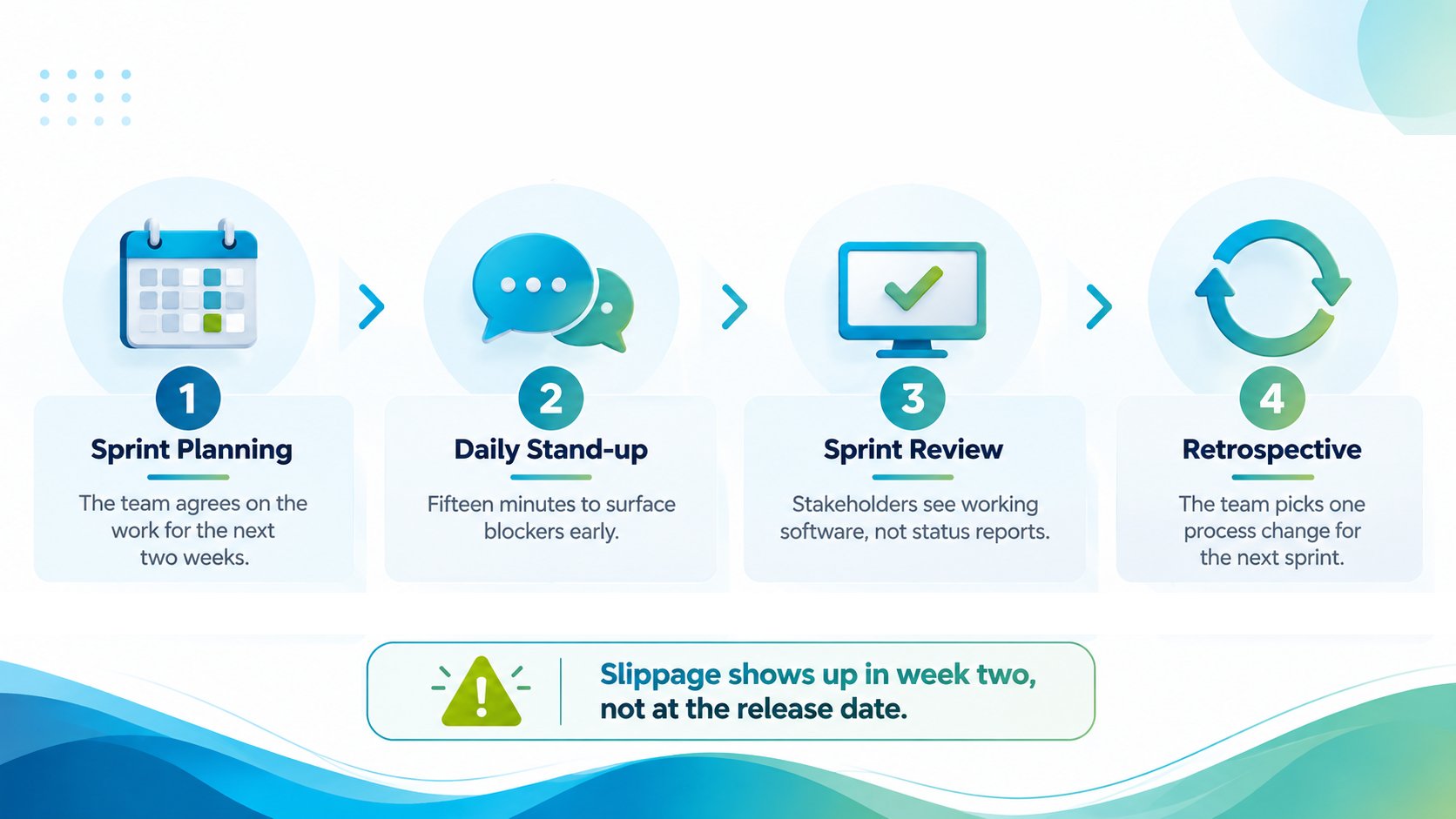
Core Agile Ceremonies and Artefacts at a Glance
| Element | What it does | Timebox | Owner |
|---|---|---|---|
| Sprint | Delivers a usable increment of work toward a sprint goal | 1 to 4 weeks, typically 1 to 2 weeks | Whole team |
| Sprint planning | Agrees the sprint goal and the work the team commits to | Up to 8 hours | Product Owner and development team |
| Daily stand-up | Shares progress, plans the day and surfaces blockers | 15 minutes | Development team |
| Sprint review | Demonstrates working results to stakeholders and gathers feedback | Up to 4 hours | Product Owner and team |
| Retrospective | Looks at how the team worked and picks one or two changes | Up to 3 hours | Scrum Master and team |
| Product backlog | Ordered list of everything the product may need | Ongoing | Product Owner |
| Sprint backlog | Items chosen for the current sprint, plus the plan to deliver them | Sprint length | Development team |
Timeboxes above are for a one-month sprint, so shorten them for shorter cycles. If you’re planning on phones or distributed tools, practical ways to improve mobile sprint planning can help keep commitments visible. I would keep the rhythm this small at first, and use a focused guide to agile retrospectives for continuous improvement rather than adding more meetings.
This isn’t a niche habit in Singapore. The National Library Board reference on agile workforce practice notes a 2016 CA Technologies Agile Application Lifecycle Management survey reported that 81% of Singapore businesses had implemented Agile methodologies at scale, placing Singapore third among Asia-Pacific and Japan markets. Treat that as a survey result, not a census.
Roles That Keep the Work Moving
Who decides the pricing rule while the sprint is already running? A product manager attends every stand-up for three weeks, and the rule stays undecided. The team builds around it, guesses, then reworks. Approval sits with a committee that never joins the sprint, so the ceremonies run on time while the decision stalls.
Singapore’s developer guidance on agile development defines the core Scrum team as a Product Owner, Scrum Master and development team. The Product Owner writes and prioritises Product Backlog items to maximise value, keeps the backlog visible and transparent, and clarifies actionable next steps. The Scrum Master facilitates the daily Scrum, sprint planning, sprint demonstrations and retrospectives, and forecasts deliverables using evidence.
Who Can Actually Decide
A title on an org chart says nothing about decision rights. A Product Owner who cannot reorder the backlog is a messenger. A Scrum Master who cannot escalate a blocked dependency is a meeting organiser.
Write down three answers before the next sprint starts:
-
Reprioritisation: Who can move items up or down, and how fast?
-
Release approval: Who says yes, based on what evidence?
-
Escalation: Who owns a blocker after one day, and what is the target decision time?
The development team decides how the work gets done and how much fits. That autonomy reaches down to the task level. One developer put it this way: agile “was more than just a standup meeting,” and managing your own tasks well affects how smoothly delivery runs and prevents the late-night sessions that bad timeline planning causes.
In a bank or insurer, someone still carries budget, schedule and steering committee reporting. That project lead role does not disappear. It shifts from policing a plan to making decisions visible, timely and auditable. In practice, governance rides inside the rhythm: the backlog shows what was prioritised, the sprint review demonstrates working results, and the release evidence pack answers the steering committee’s questions. A pricing question gets an answer in days, and the monthly committee paper draws on sprint artefacts instead of demanding a separate gate at the end.
How to Set Up Your First Agile Project in Six Steps
An insurer wants a new claims portal after a two-year waterfall programme ran over budget and never reached users. Leadership wants speed, compliance wants evidence, and claims handlers just want fewer manual workarounds. When you’re choosing between linear and iterative planning, an uncertain user problem like this is exactly the situation where iterative delivery earns its keep.

-
Agree on one outcome metric: Start with the user problem, for example, reducing first-time claim submission errors. Every scope question gets judged against it. The slip is starting from a feature list supplied by stakeholders, which freezes guesses into requirements before anyone has tested them.
-
Build a thin, testable backlog: Break the problem into small items a user can react to, then rank them. Don’t write detailed requirements before the first user test, because you’ll document guesses as if they’re facts. The ranked list also doubles as your first governance artefact: steering can see what’s coming, in what order, and why.
-
Form one cross-functional team: GovTech’s Agile Way of Working guidance recommends Scrum teams of fewer than 10 people. Include claims, engineering, design and risk input. People allocated at 20% across five projects will stall every handoff.
-
Limit the first release to a small slice: Pick one claim type for one user group, within a six- to twelve-month horizon that can scale later. Scoping the whole claims journey upfront recreates the waterfall problem in smaller meetings.
-
Run one to two-week iterations: Use planning, daily 15-minute coordination, a review with real users and a retrospective. The review is where governance lives: sponsors see working software and give direction, rather than reading a status slide about it. Don’t skip the review because work looks unfinished. Unfinished work shown early is the point.
-
Measure and expand on evidence: Track adoption, cycle time, quality and benefit realisation each sprint, and file the outputs into a release evidence pack that audit and compliance can inspect without scheduling a separate review. Expand only when those results support it, not because the original schedule says it’s time.
Funding in Tranches
For regulated enterprises, pair this with stage-gated funding that runs on the sprint rhythm rather than sitting as a separate gate at the end. Approve the strategic problem first. Then release money in sprint-sized tranches when the team shows the problem remains worth solving, success metrics are sound, and the cost estimate is credible.
Scope check: Excessive scope is the principal pitfall. If the first release needs every department’s approval, it’s too big.
Templates for Backlogs, Sprint Plans and Status Updates
You don’t need a dozen documents. You need a few templates that answer the questions leaders ask every week. What are we building, what’ll be done this sprint, what’s at risk, and what decision do you need from me?
A good backlog item also makes testing easier. If acceptance criteria are vague, review practical advice on connecting user stories to UX testing before you add more fields. For the planning conversation itself, this guide to sprint planning that teams can actually commit to is a useful companion.
Working Templates for Agile Project Management
| Template | Key fields | When to use it | Owner |
|---|---|---|---|
| Backlog item | User problem, acceptance criteria, estimate, priority, dependencies | When an item is added or reworked | Product Owner |
| Sprint goal sheet | Goal, selected items, capacity, known risks | Sprint planning and mid-sprint check | Product Owner with team |
| Definition of done | Testing, review, documentation, security and release checks | Set once, revisited at each retrospective | Development team |
| Sprint board | To do, in progress, in review, done, blocked | Daily stand-up | Development team |
| One-page status update | Goal, progress, top risks, decision needed | Weekly, for sponsors and stakeholders | Scrum Master or project lead |
| Dependency and risk log | Item, owner, impact, mitigation, due date | Reviewed at each sprint review | Scrum Master |
| Release evidence pack | Test results, approvals, open risks, sign-offs | Before each release in regulated teams | Product Owner with risk function |
The release evidence pack is where governance becomes part of delivery. Instead of assembling audit material at the end, the team attaches test results, approvals and open risks as work completes. The sprint review then doubles as the audit trail.
Keep every template brutally short. If nobody updates a field after week three, remove it. A template people maintain beats a thorough one they silently abandon.
Common Problems and How to Fix Them
The most familiar failure is a team running every ceremony while work waits weeks for approval. Stand-ups are punctual. Boards are tidy. Nothing moves because decision rights never changed. This pattern shows up constantly in banks, insurers and government-linked teams, where a steering committee still signs off every release long after the team adopts the rituals.
Singapore employers ran into the same gap during the pandemic. NTUC LearningHub’s 2021 Industry Insights Survey found most employers had accelerated Agile adoption, yet large shares reported that not everyone understood Agile requirements, that collaboration demanded substantial time and commitment, and that remote work made team communication harder. Adoption moved faster than understanding. The ceremonies arrived; the authority and shared language did not.
Agile Symptoms, Causes and Fixes
| Symptom | Likely cause | Fix |
|---|---|---|
| Ceremonies held, but work waits for approval | Decision rights never moved to the team | Give the Product Owner reprioritisation authority and a written escalation route |
| Only some people understand the method | One-off training and no shared language | Role-specific sessions and a short team glossary |
| Every sprint is overloaded | Backlog not ordered or sized | Commit to the recent average capacity, not the wish list |
| Remote team goes quiet or misses handoffs | No working agreements for distributed work | Fixed overlap hours and written norms for updates and response times |
| Status reports show percentage complete | Reporting habit from waterfall | Report what is demonstrably done, plus one clear risk metric |
Don’t try to fix all five at once. I would run one check in your next sprint: count how many items are blocked, who owns each blocker, and how long each decision has been waiting.
If most waiting time sits outside the team, your constraint is governance, not engineering effort. Another framework will not fix it. The durable fix is pulling that approval into the sprint rhythm itself, so the Product Owner reorders the backlog without asking permission and the sprint review carries the evidence a risk function would otherwise demand at the end.
Scaling and Governance for Regulated Teams
A bank’s first agile team delivers well, so leadership adds four more teams in one quarter. Within weeks, each team is waiting on another team’s API, test environment or risk review. Scaling failed because coordination load grew faster than delivery capacity.

Team Setups and the Governance Each One Needs
| Setup | Teams | Coordination | Governance attached |
|---|---|---|---|
| Single team | 1 team of up to 9 people | Daily stand-up and one shared backlog | Sprint review doubles as steering check |
| Several teams on one product | 2 to 5 teams | Joint planning, shared backlog, weekly cross-team sync | Programme-level backlog reviewed quarterly |
| Large programme | 6 or more teams | Portfolio planning and a dependency board | Steering committee of business owners and risk leads |
Regulated governance works best when it’s built into artefacts teams already use. The MAS supervisory expectations on responsible AI adoption expect financial institutions to maintain appropriate AI inventories and apply proportionate controls covering data governance, testing, human oversight, cybersecurity, monitoring, change management and third-party AI use.
Translate expectations like these into backlog acceptance criteria, sprint review evidence and release checks by risk tier. Map each control to a role, an artefact and a decision owner. Then product owners know what evidence to produce before a sprint closes, instead of facing a sequential gate at the end.
That discipline travels beyond banking. This account of agile working in a pharmaceutical programme shows how cross-functional coordination needs structure without becoming bureaucracy.
Pilot One Team for 90 Days Before You Scale
Don’t roll out a new operating model across the organisation because a workshop went well. Pick one team with a real outcome, real users and a sponsor who can actually decide. Then give it 90 days to produce evidence.
Days 1 to 30 are for setup. Agree the outcome metric, order the first backlog slice, confirm roles and decision rights, and adopt only the templates the team will maintain. Name the sponsor’s decision turnaround time in writing.
Days 31 to 60 are for delivery and repair. Run your sprints, review with users, and attack the top blockers you find, whether that’s overloaded commitments, slow approvals or unclear acceptance criteria. Resist adding new teams during this phase.
Days 61 to 90 are for judgment. Review cycle time, quality, adoption and decision latency. Decision latency matters most because it shows whether governance or engineering effort is your real constraint.
A pilot that shows its evidence wins support for the next team. A pilot that only shows enthusiasm doesn’t.
If the pilot exposes bottlenecks you can’t shift internally, outside help can be targeted rather than broad. We offer an Agile Roadmap Planning Session, a structured planning session with our transformation leads to review your operating model and identify delivery bottlenecks, and Agile Fundamentals training as a mindset-first starting point for new teams. For more practical reading, browse the Ekipa insights blog.
If your next sprint needs clearer decision rights, leaner governance and evidence your steering committee can trust, talk to us about agile training, coaching and consultancy that fit regulated delivery in Singapore and the region. Start with one pilot team, fix its biggest bottleneck, and visit Ekipa to explore the right next step for your organisation.