

Your teams hold daily stand-ups, sprint reviews fill the calendar, and the transformation dashboard looks reassuring. Yet customers still wait, managers still chase approvals, and every difficult decision lands on the same executive’s desk. You’re entitled to ask what has changed.
Agile consulting should address that gap between adopting a method and improving how work gets done. Its real test isn’t how many people complete training. It’s whether your organisation delivers better outcomes and keeps improving after the consultant leaves.
Three Types of Agile Consulting and When Each One Fits
Say a bank’s delivery teams run every expected ceremony, yet each release still waits six weeks for sign-off. The CEO asks why the agile rollout has changed nothing. Another workshop won’t resolve that problem if nobody has authority to change the approval process.
Agile consulting is outside help aimed at how people work, make decisions and deliver value. Training can support it, but an engagement should tackle a specific operating problem, not just teach teams the vocabulary.
Agile consulting engagement types at a glance
| Engagement type | Main focus | Who is involved | Good sign it fits |
|---|---|---|---|
| Agile coaching | Team habits, daily execution and removing friction | Teams, team leads and sponsors | Teams work but practice is inconsistent |
| Transformation consulting | Operating model, governance and rollout across units | Executive team, transformation office and business heads | Strategy is approved but delivery is fragmented |
| Delivery support | Backlogs, first increments and shipping a working outcome | Product owners, delivery teams and engineers | Results are needed now while capability is being built |
Choose the intervention, not the label
Coaching fits when people understand the direction but struggle to turn it into reliable daily practice. The coach works alongside them, helping them improve planning, conversations and problem-solving rather than taking permanent control.
Transformation consulting reaches beyond a team. It examines funding, reporting lines, governance and decision rights, including the uncomfortable question of which executive must give up approval authority.
Delivery support adds hands-on capacity. Consultants help shape work and ship something usable while internal people develop the capability to continue.
Buying rule: Match the engagement to the constraint you need to remove, not the framework you want to adopt.
Real projects often combine two approaches. Delivery support can create momentum, while coaching prevents the external team from becoming indispensable. The trade-off is that taking over too much work may produce an early result without teaching anyone internally how to repeat it.
Where testing capacity is part of the constraint, you can compare outsourced QA delivery models through 99tests before deciding how external delivery responsibility should be organised. Keep accountability for release quality explicit, regardless of who performs the testing.
At Ekipa, we believe agile people can embrace any technology. Technology is usually the easier part; getting an organisation to work differently is harder.
A useful starting test is simple: if teams can name their goal but not how to reach it, start with coaching. If the strategy is approved but nobody agrees who decides, start with transformation consulting.
How Agile Coaching Builds Habits That Stick
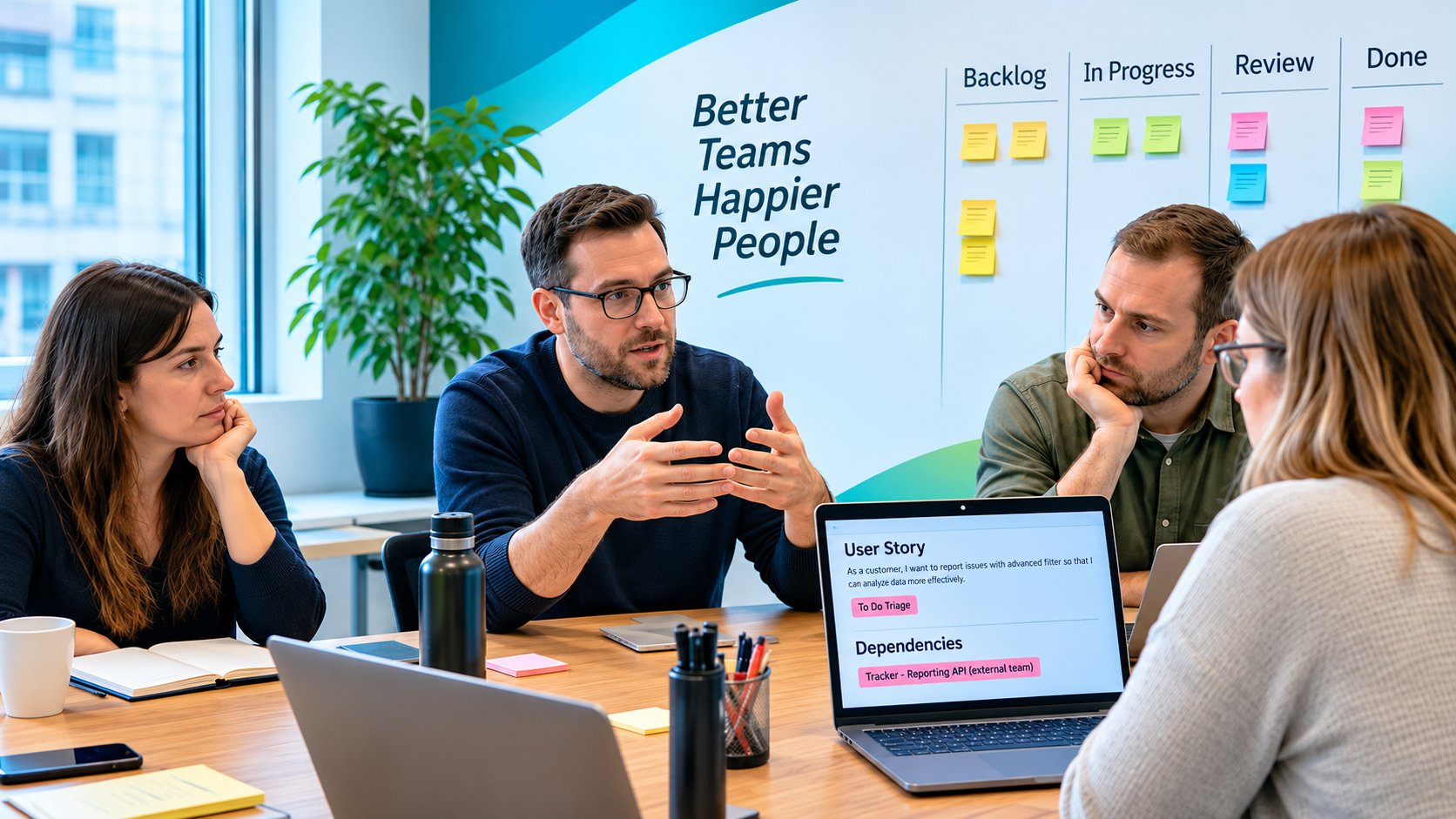
A coach earns their place by noticing what the team has stopped noticing. Perhaps refinement ends without a shared understanding of the work, or a retrospective produces actions that nobody owns.
Work at the level where friction starts
Team coaching happens inside real delivery conversations. The coach listens for oversized stories, unclear acceptance criteria and dependencies that everyone knows about but nobody escalates.
Leader coaching addresses different behaviour. A manager promoted for hands-on expertise may keep solving every problem personally, leaving the team waiting for instructions. The coach helps that manager set clearer boundaries, clarify priorities and let people make decisions within them.
At enterprise level, the work concerns relationships between departments. A team can’t become outcome-focused if finance rewards project completion, operations rejects small releases, and business sponsors change priorities without discussing capacity.
-
Team-level intervention: Make the next piece of work smaller and clarify what completion means.
-
Leadership intervention: Agree which decisions the team can make without permission.
-
Enterprise intervention: Resolve conflicting expectations between functions rather than asking the team to absorb them.
Practise on work that matters
Consider a team whose sprint goals keep slipping. During refinement, the coach discovers that each story includes several separate customer needs, while a dependency on another department remains invisible until testing.
The coach helps the team split stories into usable slices and establish a weekly dependency review with named owners. The team then tests whether those changes improve its ability to finish the agreed goal. If they don’t, the next retrospective examines the remaining constraint rather than blaming commitment.
A good gym coach doesn’t lift the weights for you. They demonstrate the form, watch you repeat it and step back when you no longer need them.
Role-specific learning matters too. For commercial teams, PreSales Unleashed GmbH’s guide to designing sales training for PreSales teams is a useful adjacent resource when planning development around the work people perform day to day.
Our coaches work embedded inside teams, supporting leaders and accelerating teams working at the forefront. Learning happens through live decisions, not just classroom exercises.
Look for two practical signs of progress: the team runs its retrospective without prompting, and fewer decisions wait for senior sign-off.
From Approved Strategy to Running Teams in 90 Days
An approved roadmap doesn’t create delivery capacity. Someone still has to translate intentions into work, protect people’s time and decide what happens when priorities conflict.
A 90-day execution cycle is a practical planning structure, not a promise that an entire transformation will finish within that period. Use it to produce a usable change and test whether the organisation can sustain the delivery routine.
Establish ownership before adding activity
-
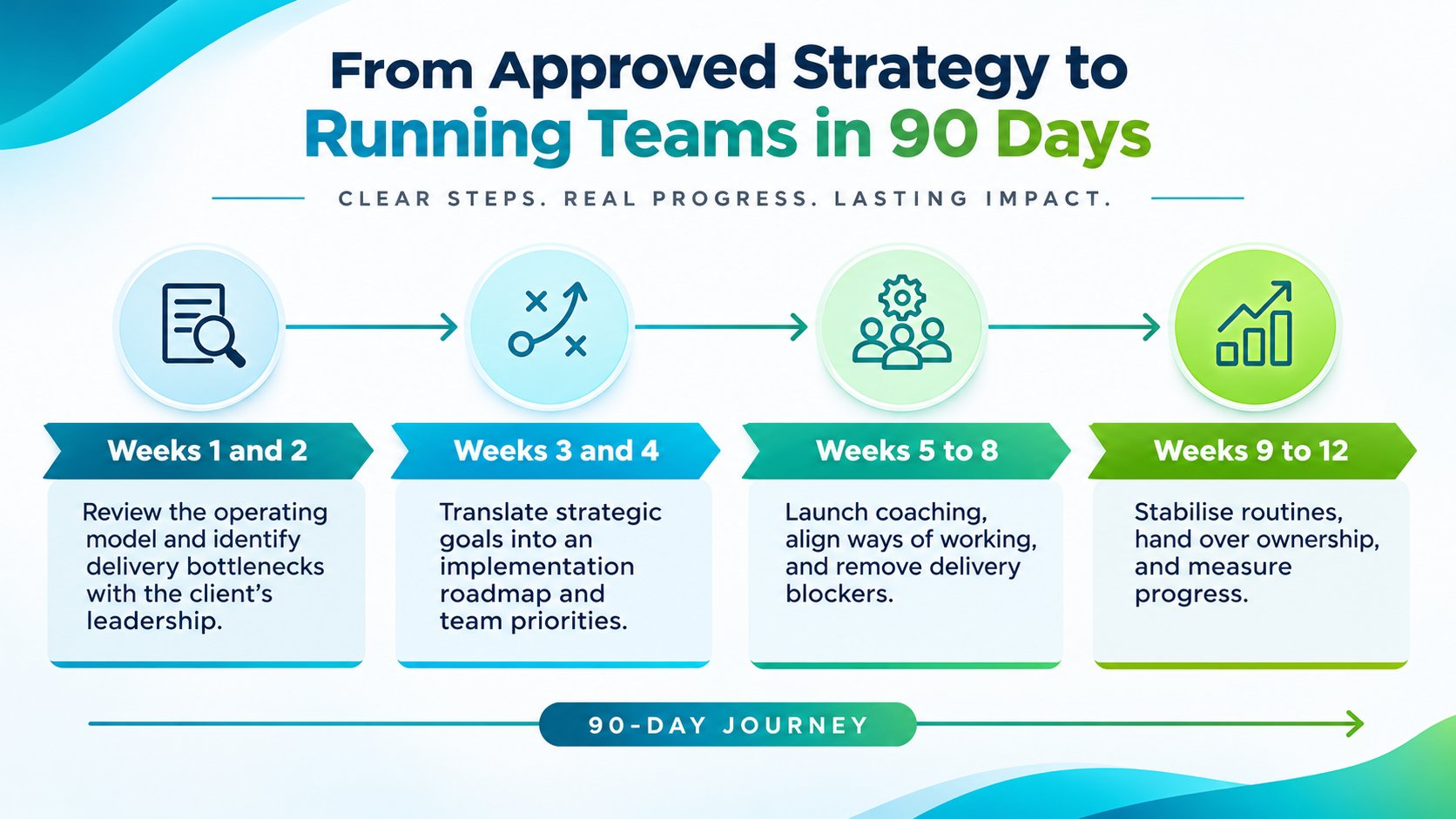
Weeks 1 and 2, diagnose the operating model: Review a recent piece of work with leadership, from request to release. Identify queues, repeated handoffs and decisions without an owner. In regulated settings, include compliance work in the backlog from week one.
-
Weeks 3 and 4, make the strategy executable: Translate the chosen objective into a prioritised backlog. Name the product owner, agree decision rights and confirm who can commit capacity. An implementation roadmap is useful only when someone can act on it.
-
Weeks 5 to 8, put teams into operation: Form a cross-functional group, run the first sprints and remove blockers as they emerge. Record the outcome baseline before changing the live workflow, so the team has a defensible comparison.
-
Weeks 9 to 12, release and stabilise: Deliver the first usable change, compare results with the baseline and decide what deserves further investment. Internal owners should increasingly lead the routines.
The sequence prevents a familiar failure: leadership approves the roadmap, but nobody owns the backlog, and everyone is already fully occupied. Scheduling more meetings won’t solve either problem.
Keep the first outcome narrow
Take a hypothetical insurer whose claims process takes nine days to settle. A small team with a clear owner changes how straightforward claims are triaged, bringing settlement time to six days in this example.
That result would need checking for claim complexity, rework and customer impact before anyone claimed success. Faster processing isn’t an improvement if staff move unresolved cases elsewhere.
Fund the next change because the first one produced useful evidence, not because the roadmap says the next phase must begin.
At Ekipa, we build the plan into how teams work, sprint by sprint, until the new way runs on its own. The important output is both a working improvement and people who can operate it.
Metrics That Show Agile Consulting Is Working
Velocity, training attendance and completed ceremonies can make a dashboard look busy while business performance stays unchanged. They describe activity, not necessarily value.
Use outcome measures alongside delivery and quality measures. Otherwise, a team might appear faster because it has deferred testing, moved approval work elsewhere or stopped recording difficult cases.
Measures that show agile consulting is working
| Measure | What it tells you | Warning sign |
|---|---|---|
| Control lead time | How long approval and compliance steps add to a release | Approvals take longer than the build work |
| Stories with acceptance criteria | Whether risk and quality are built in from the start | Many stories reach review without them |
| Adoption of the new workflow | Whether teams use the changed process daily | Ceremonies run but old handoffs remain |
| Outcome against baseline | Whether processing time, service quality or decision accuracy has moved | Velocity rises while the business measure stays flat |
| Defect escape rate | Problems reaching production after each release | Rising after each release wave |
Connect delivery to a business hypothesis
In the Singapore Business Federation’s 2025 Digitalisation Supplement, which surveyed 553 businesses, respondents reported operational-efficiency gains (45%), improved customer experience (44%) and stronger data-driven decision-making (40%) as tangible benefits. These are useful categories for setting objectives, not universal targets for your engagement.
Before the first sprint, define the operational measure and its boundaries. For processing time, specify when the clock starts, when it stops and how you’ll handle exceptions.
Then connect each increment to a testable hypothesis. For example, pre-validating application details should reduce the work returned to customers for correction. After release, check production records rather than relying only on a demonstration or team opinion.
Ekipa’s explanation of objectives and key results and their benefits can help connect that operational hypothesis to a broader business objective.
Measure behaviour without relying on sentiment alone
Workflow adoption needs observation as well as survey responses. Check whether staff use the new route, whether managers still request parallel spreadsheets and whether exceptions return to the old approval chain.
For the behavioural side, Corporate Challenge Events on measuring culture offers an adjacent perspective when deciding how to assess changes in workplace habits.
Segment results by workflow or customer journey. A healthy overall average can hide a claims category that’s deteriorating or a review queue that remains untouched.
Review the dashboard monthly with the sponsor. Drop measures nobody uses to make a decision, and investigate improvements that come with worsening quality or additional work elsewhere.
Success Factors That Decide Whether Change Sticks
Training alone doesn’t create agility. People can understand the method perfectly and still operate inside a system that punishes the behaviour they’ve just learnt.
The decisive conditions sit partly with leaders, not just delivery teams. A consulting engagement needs permission to address those conditions rather than treating every problem as a coaching issue.
Leadership must change the working conditions
Visible sponsorship means attending reviews, making trade-offs and removing obstacles that teams can’t remove themselves. A sponsor who approves the budget but never sees working results has delegated too much.
Product ownership needs equal clarity. Give a named person authority to order priorities and enough availability to answer questions. A committee can advise, but it shouldn’t leave the team guessing whose answer counts.
-
Protect realistic capacity: Remove or defer existing commitments when people take on transformation work. Don’t describe an overloaded team as resistant to change.
-
Support middle managers: They often have to lead changes they didn’t initiate while maintaining current performance. Coach them on delegation, escalation and conversations about competing demands.
-
Test data and tooling readiness: Confirm that teams can access accurate information, use suitable environments and obtain permissions before committing to a delivery date.
For AI-enabled workflows, data readiness deserves particular attention. A team can iterate quickly and still fail if nobody owns the source data, staff can’t access it safely, or the output can’t be checked.
Make governance part of completion
The Monetary Authority of Singapore’s Technology Risk Management Guidelines set expectations for approved project documentation covering feasibility and planning, risk management throughout the project life cycle, and security involvement where relevant in every software-development phase.
Translate those expectations into delivery practices. A backlog item may need architecture review, security acceptance criteria, test evidence and an updated risk record before the team treats it as complete.
Practical rule: Don’t call an increment ready if the people accountable for its controls can’t assess the evidence.
This doesn’t mean inviting every reviewer to every meeting. Agree which changes need specialist review, what evidence reviewers need and when they’ll be available. Proportionate involvement is more workable than either blanket approvals or unrestricted delegation.
When control lead time worsens, examine reviewer capacity and evidence quality. When defect escapes increase, investigate testing and completion standards rather than pushing the team to produce more.
Finish with a leadership self-check: who owns the top three priorities, how often does the sponsor see working results, and has a control reviewer seen the last release? Vague answers identify work to resolve before expanding the programme.
Handing Over to Teams That Run on Their Own
A handover is working when the team can keep adapting its practices after the consultant steps back. Set self-sufficiency as an acceptance condition early. A polished playbook has limited value if the team still depends on an external person to organise its work.
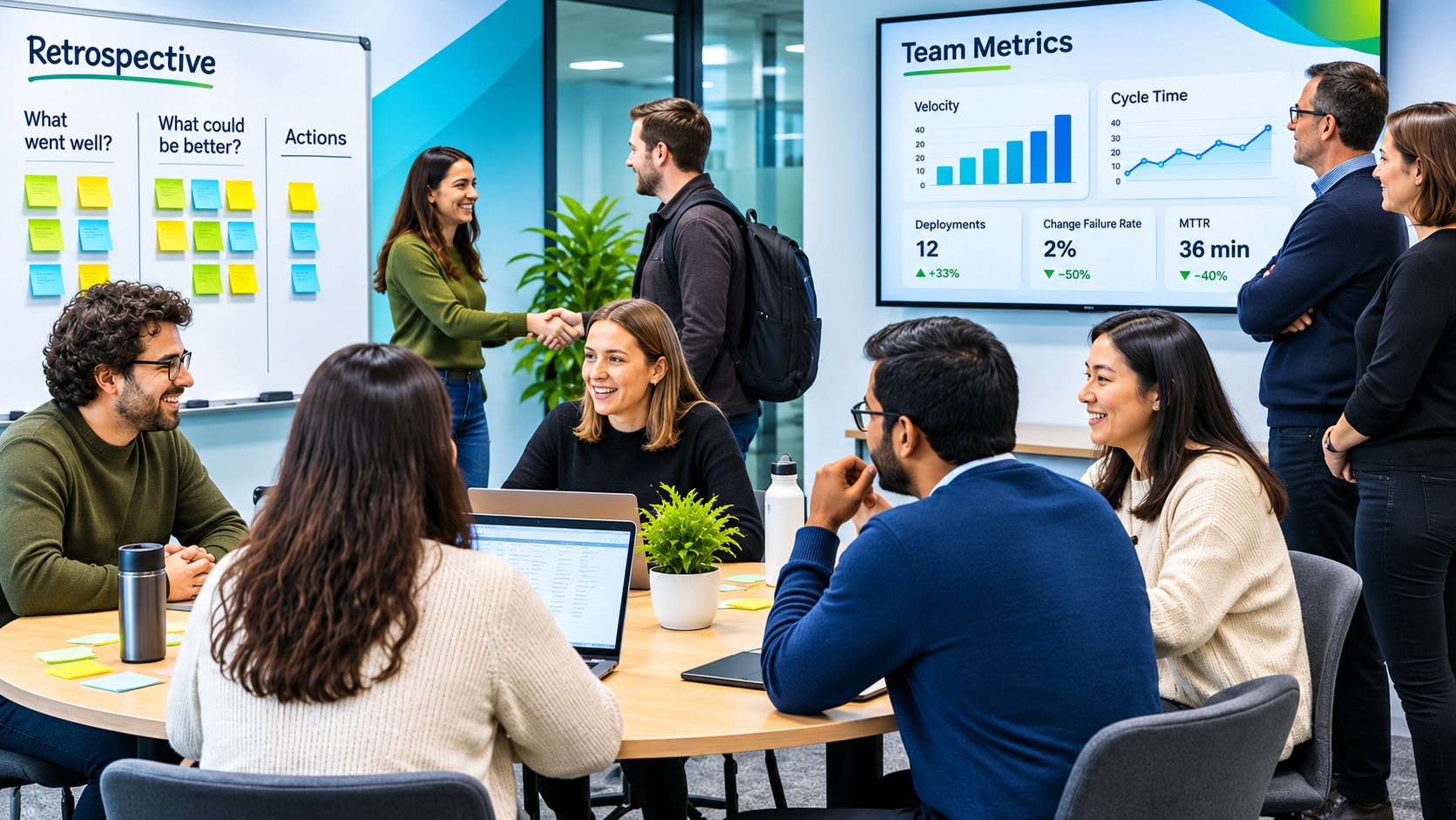
Look for observable signs: the team runs retrospectives, owns and reorders its backlog, and onboards new members using its own guidance. Leaders review performance and make decisions without relying on consultant prompts.
Transfer responsibility through practice
Name an internal coach or practice lead in the first week. They can shadow the consultant, co-facilitate sessions, then lead while the consultant observes. The transfer is complete when they can handle disagreement, explain prioritisation decisions and help colleagues adjust when a routine stops working.
Use a short readiness check before the consultant steps back:
-
Independent cycles: The team has completed at least three cycles without the consultant leading.
-
Accessible working guidance: The team owns the playbook, and it reflects current practice rather than serving as a presentation alone.
-
Explainable priorities: Someone on the team can explain why priorities changed last quarter and what evidence supported the decision.
Ekipa’s guidance on building accountability and self-organisation explores how teams can pair autonomy with clear responsibility.
Keep learning local
Learning needs an owner and a place in the team’s routine. If it becomes an unnamed extra task, urgent delivery work will crowd it out.
Keep the routine small: a monthly show-and-tell with neighbouring teams, a rotating retrospective facilitator or an internal community where team leads compare practical problems. Assign someone to convene it, without making that person responsible for solving every issue.
Ekipa embeds coaches and technical experts, then hands delivery over to client teams so they can sustain new ways of working on their own. Practitioner-led Agile Circles also connects team leads and executives driving change across Southeast Asia.
A strong handover leaves people able to adapt the practice, not just repeat it. That capacity matters when leadership changes, demand shifts or the team faces a problem its original playbook did not cover.
Choose Your First Agile Consulting Step
Before arranging a consultation, write down one stalled piece of work and the business result it was meant to produce. Identify the decision, approval or handoff that stopped progress, and who has the authority to change it. Specifics make the first conversation useful.
Then prepare a short brief: the work at stake, the constraint, the relevant approval route and the measure you want to improve. For regulated work, include who reviews a representative backlog item and what evidence they need. That gives an adviser something concrete to examine rather than a general request to “become more agile.”
Bring evidence to the first conversation
Ekipa offers an Agile Roadmap Planning Session, a structured session with transformation leads to review an organisation’s operating model and identify delivery bottlenecks. Come prepared to discuss the stalled work and the decisions around it.
A useful next step should leave you with a clearer view of what needs to change and how the team will carry that change into its daily work. A true measure of agile consulting is whether teams can run the change on their own, with progress judged by business outcomes rather than training completed.
Frequently Asked Questions About Agile Consulting
How much does agile consulting cost?
Scope it around the work and outputs: an initial assessment, coaching or advisory, and any hands-on delivery. Price depends on which phases are included, how many teams or leaders are involved, and how long support runs. Ask for each phase, its deliverables, and the decision point for continuing before agreeing to a longer engagement.
How long does an engagement last?
Team coaching may continue for several months; enterprise transformation usually takes longer. Set an early review against a business outcome, such as delivery speed, so the next phase reflects what has changed.
How is agile consulting different from agile training?
Training builds shared knowledge of methods and practices. Consulting applies them to live work and ties the changes to a business measure, such as delivery speed.
Is agile consulting only for software teams?
No. Finance, public-sector and operations teams can use Agile, with practices adapted to their workflows, governance and data requirements. In regulated work, include approvals and controls in the delivery plan.
Should you hire consultants or build internal coaches?
External consultants can provide advisory and hands-on support; internal coaches bring organisational context. Choose a model that gives internal coaches time to apply what they learn in day-to-day work.
Ekipa offers Agile training, coaching and consultancy to help organisations turn strategy into daily execution. Discuss a delivery bottleneck with Ekipa and define an initial engagement around a measurable outcome.