

You can feel it in the room before anyone says it out loud. The board has approved the AI direction, the budget is real, and now the pressure has shifted to delivery. The hard question is no longer whether to use AI; it’s whether your organisation can move from slideware to production without creating a mess in governance, security, or accountability.
That is why AI consulting Singapore buyers should stop shopping for impressive logos and start judging execution maturity. The strongest partners in Singapore are not the ones with the flashiest deck. They’re the ones who can help you redesign work, integrate into regulated environments, and leave your team able to run what got built.
| Buying lens | Tool-led consultancy | Operating-model-led partner |
|---|---|---|
| What they sell | Demos, workshops, and isolated use cases | Delivery that reaches production and stays governed |
| Where they struggle | Handover, adoption, and control ownership | Usually more demanding up front, because they challenge your process, not just your software wishlist |
| What you get | Faster start, weaker stay | Slower start, stronger finish |
| Best for | Exploratory interest and light experimentation | Regulated, multi-stakeholder, business-critical work |
What AI Consulting Singapore Buyers Should Actually Be Evaluating
The board has approved the direction, the CIO needs visible progress, and the business wants proof that the next quarter will not become another round of pilots. The pressure is straightforward. AI value matters, but delivery maturity matters more.
The buying decision hinges on whether the consulting partner can work inside your constraints, across your stakeholders, and through the messy middle of delivery, where governance, process change, and data quality collide. A polished demo means little if the solution cannot survive procurement, security review, audit, and the first month of live use.
Practical rule: if a firm talks first about models and only later about ownership, controls, and workflow redesign, you are probably dealing with a tool seller wearing a consulting label.
Useful partners make the hard calls with you. Which workflow should go first, which team owns it, what gets measured, what gets cut, and how the work is handed over when the consultants leave.
That is the filter for any AI consulting Singapore proposal. Read it for execution maturity and regulatory readiness, not for presentation polish. If you want a useful benchmark before the next vendor meeting, the MR2 Solutions AI transformation guide is worth reading first.
Why Singapore AI Adoption Looks Higher Than It Really Is
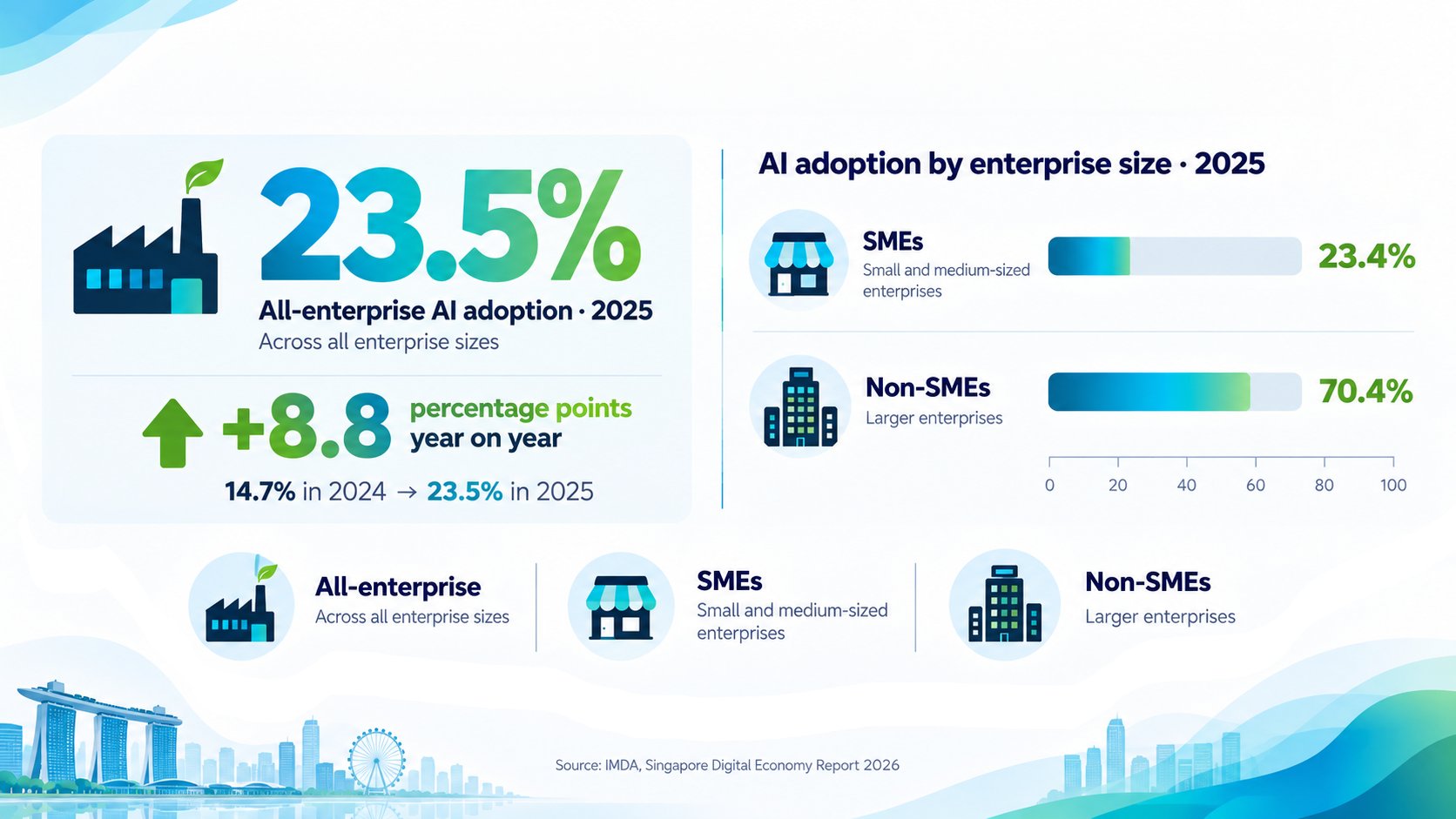
The headline number makes Singapore look further along than many leaders are. IMDA says AI adoption among all enterprises reached 23.5% in 2025, up 8.8 percentage points from 2024, and adoption among firms with at least 10 employees reached 34.6% after rising 13.2 percentage points year on year. The same dataset shows a sharp split by company size, with non-SME adoption at 70.4% and SME adoption at 23.4% in 2025.
But adoption is not the same as integration. Ministry of Manpower research shows that 71.5% of firms had not yet adopted AI. Among the 28.5% that had started, only 3.8% had integrated AI into core processes, while 7.4% were planning and 6.0% were piloting. That gap is the whole market.
What the numbers really mean for buyers
A lot of companies are using off-the-shelf generative tools, not building governed production systems. IMDA’s survey of around 500 AI-using firms found 84% used off-the-shelf generative-AI tools, and AI use was concentrated in operational functions such as IT and customer service. That tells you something important. Many organisations have started, but they haven’t yet built the muscle for workflow redesign, accountability, or repeatable delivery.
That is exactly where consulting value lives in Singapore. Not in helping people download another tool. In helping them move from informal usage to a properly governed use case, with the right data, the right controls, and a clean path into production.
The first AI win is rarely a model. It’s a working operating pattern.
For leaders, this means the shortlist should reward firms that understand integration, not just ideation. If a partner cannot explain how they cross the gap from pilot to production, they’re not solving the core problem.
Engagement Models and How to Compare Them
Singapore firms usually buy AI consulting in one of three shapes, and the right choice depends on how far you already are. Some organisations only need strategic clarity. Others need a pair of expert hands embedded with their own teams. A few need a partner to own a workflow end to end until it is stable enough to hand back.
| Comparing AI Consulting Engagement Models in Singapore | Typical Duration | Outcome Accountability | Best Fit For |
|---|---|---|---|
| Strategy advisory | Weeks | Advice and prioritisation, limited delivery ownership | Board-stage decisions, investment framing, governance setup |
| Embedded delivery team | Months | Shared delivery with your staff, outcomes depend on joint execution | Pilot-to-production work, cross-functional build, capability transfer |
| Managed pod | Quarters, then handover | Stronger ownership of delivery and operational outcomes during the engagement | Regulated workflows, production rollouts, teams that need a stable delivery engine |
Match the model to the real bottleneck
Strategy advisory is useful when the main issue is direction. If your executives need a clear use-case portfolio, governance principles, or a prioritised roadmap, this model is enough. It is not enough when the problem is execution discipline.
Embedded delivery is the middle ground. It suits companies that already know what they want, but need outside expertise to help ship it with internal teams. That’s often the best fit when the business wants to learn while it builds.
Managed pods are different. They suit organisations that need an accountable delivery unit, especially in regulated environments where governance and production controls matter as much as feature delivery. The trade-off is obvious. You get stronger execution ownership, but you also need to be ready for a more demanding operating rhythm.
Use this test: if the partner cannot tell you who owns the outcome six months after launch, the model is probably too thin for production work.
The wrong model is a main reason engagements stall. Many teams buy advisory when they need delivery, or buy delivery when they never defined internal ownership. The fit has to follow your maturity, not the other way round.
Operational Capabilities to Demand From Any Singapore AI Consulting Firm
Marketing decks all promise the same thing. The difference shows up in the operating details. A credible partner in Singapore should be able to diagnose data readiness, prioritise use cases against business value, deliver production controls, and help your people change how they work.
Ask for the mechanics, not the branding
Start with data readiness. If the firm doesn’t know how to assess source quality, access permissions, pipeline reliability, and process fit, they’re not ready to support production AI. Data problems are usually process problems dressed up as technology problems, so the partner needs to see both.
Then ask how they prioritise use cases. Good partners don’t chase novelty. They work from business KPIs, decision frequency, risk profile, and delivery feasibility. That keeps AI from becoming a scattergun exercise where every department wants its own experiment.
The third test is whether they can run the system after launch. MLOps, monitoring, retraining, exception handling, and escalation paths are not optional extras. If these aren’t designed in from the beginning, the pilot becomes a maintenance burden later.
A good consulting team should leave behind a working cadence, not just a slide deck.
What should still exist after handover?
The handover matters as much as the build. A proper engagement should leave your internal team with clear role ownership, documentation, and a measurable exit condition. That includes who owns the model, who handles the approvals, and who reviews exceptions when the system is live.
Role-based enablement matters too. Executives need decision visibility. Managers need workflow control. Front-line users need practical guidance on how to use the system without creating risk. If the partner only trains one group, they’re not doing their job.
For teams that want a structured route from strategy to working delivery, a responsible AI governance advisory service should be part of the conversation, not an afterthought. If governance is bolted on later, you’ll pay for it twice.
MAS Governance and the FEAT Principles in Practice
Financial institutions in Singapore need more than a generic AI policy. MAS frames its FEAT Principles around fairness, ethics, accountability, and transparency, and the point is practical, not theoretical. A consulting partner should already be designing for those controls, not waiting for a legal team to catch up later.
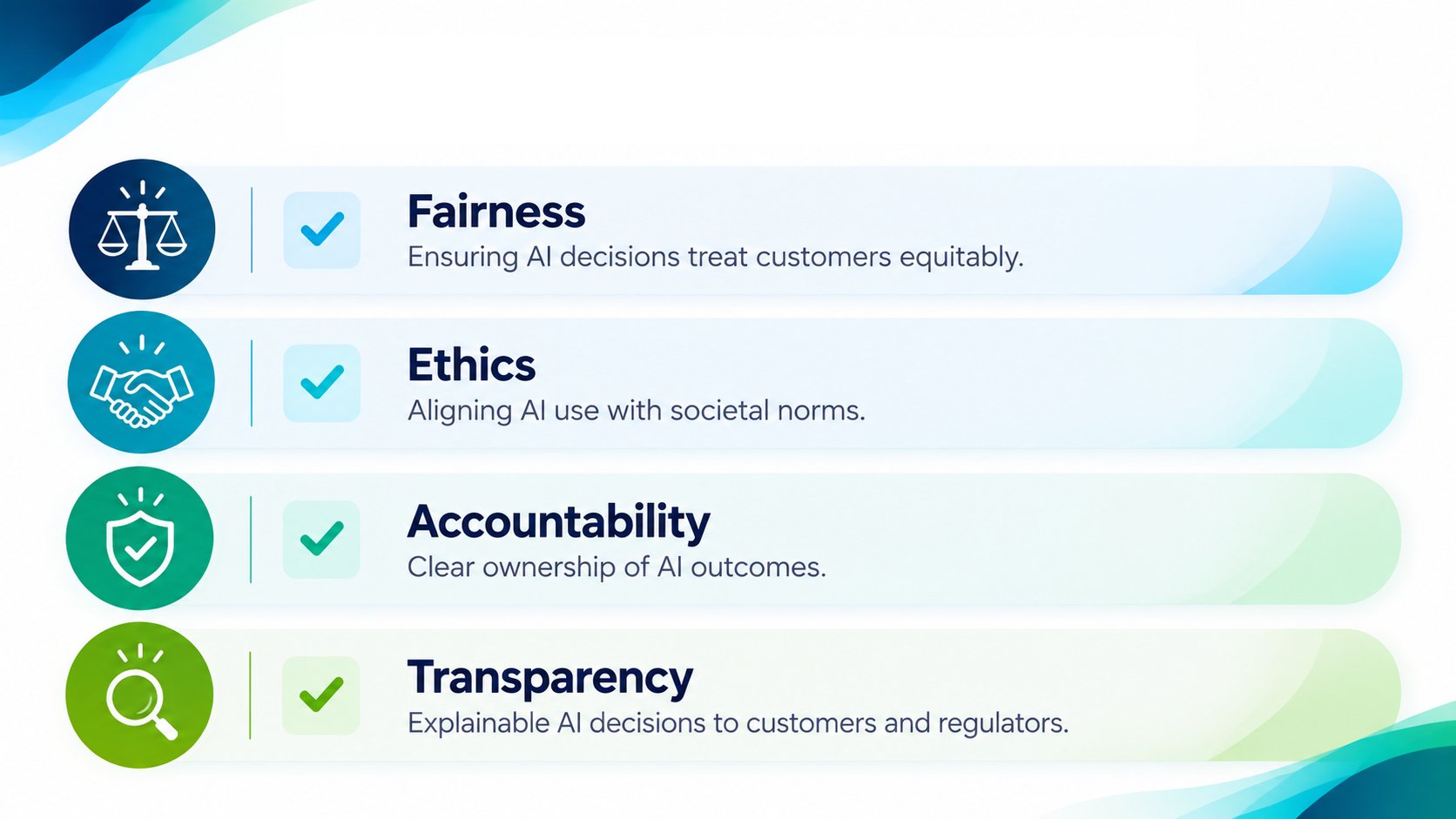
The cleanest way to think about it is simple. If AI is used in decisions that affect customers or operations, then the partner should help you document how the system behaves, who owns the outcome, and what happens when the system gets it wrong. That includes measurable controls like performance thresholds, drift indicators, bias checks, explainability requirements, human override rates, and evidence retention.
What a serious control set looks like
The financial sector AI oversight details are useful because they reinforce the same basic expectation. Monitoring must be continuous, not a one-time validation exercise. A proper delivery model should map each use case to a business owner, a technical owner, an approval authority, an escalation path, and a review cadence.
That’s also why outcome metrics and risk metrics should sit side by side. Business KPIs matter, but so do false positives, false negatives, unresolved exceptions, and time to remediate incidents. If a consulting firm can’t speak that language, they’re not ready for regulated delivery.
Questions to ask before you sign
-
Ownership design: Who owns each control after handover, and how is that ownership recorded?
-
Monitoring discipline: What gets checked weekly, monthly, and after any material model change?
-
Evidence trail: What records will you retain so audit and risk teams can test the system later?
-
Human oversight: When does a person intervene, and who can override the model?
-
Handover standard: What does “done” mean in operational terms, not just project terms?
From Pilots to Production Through 90-Day Sprint Cycles
Many AI programmes die because the pilot is treated like a finish line. It isn’t. The work starts when the organisation has to absorb the system into daily operations, revise the workflow, and decide who owns the thing after consultants leave.
Build the work in cycles, not big bangs
A 90-day cycle works because it creates a delivery rhythm. First comes use-case selection and scoping. Then data plumbing, model build, user enablement, and governance review happen in the same cycle rather than in separate silos. That stops the usual pattern where the technical team finishes first and everyone else is asked to catch up later.
For a bank, that might mean a GenAI assistant for customer operations. For an insurer, it could be claims triage. For a manufacturer, it might be forecasting support. The point isn’t the category; it’s the discipline. Each cycle should end with a visible operational outcome, not just a functioning prototype.
The team shape matters
Executives need to sponsor the direction and clear roadblocks. Managers need to translate the change into daily practice. Front-line teams need working guidance, not abstract AI principles. A competent consulting partner sequences these roles so the organisation can absorb the change instead of resisting it.
The cleanest programmes also create a backlog for the next cycle while the first one is still live. That keeps momentum moving and prevents the project from collapsing into a one-off experiment. If the partner can’t describe that sequence clearly, they probably don’t have a production mindset.
For teams wanting a structured delivery rhythm, the FDE sprint approach is the kind of engagement pattern that turns strategy into executable work rather than another presentation deck.
Matching the Partner to Your Use Case and Maturity
A bank piloting a GenAI assistant in wealth advisory needs something very different from an SME choosing its first AI workflow. So does a regional group trying to harmonise delivery across business units. The partner fit should change with the maturity of the buyer.
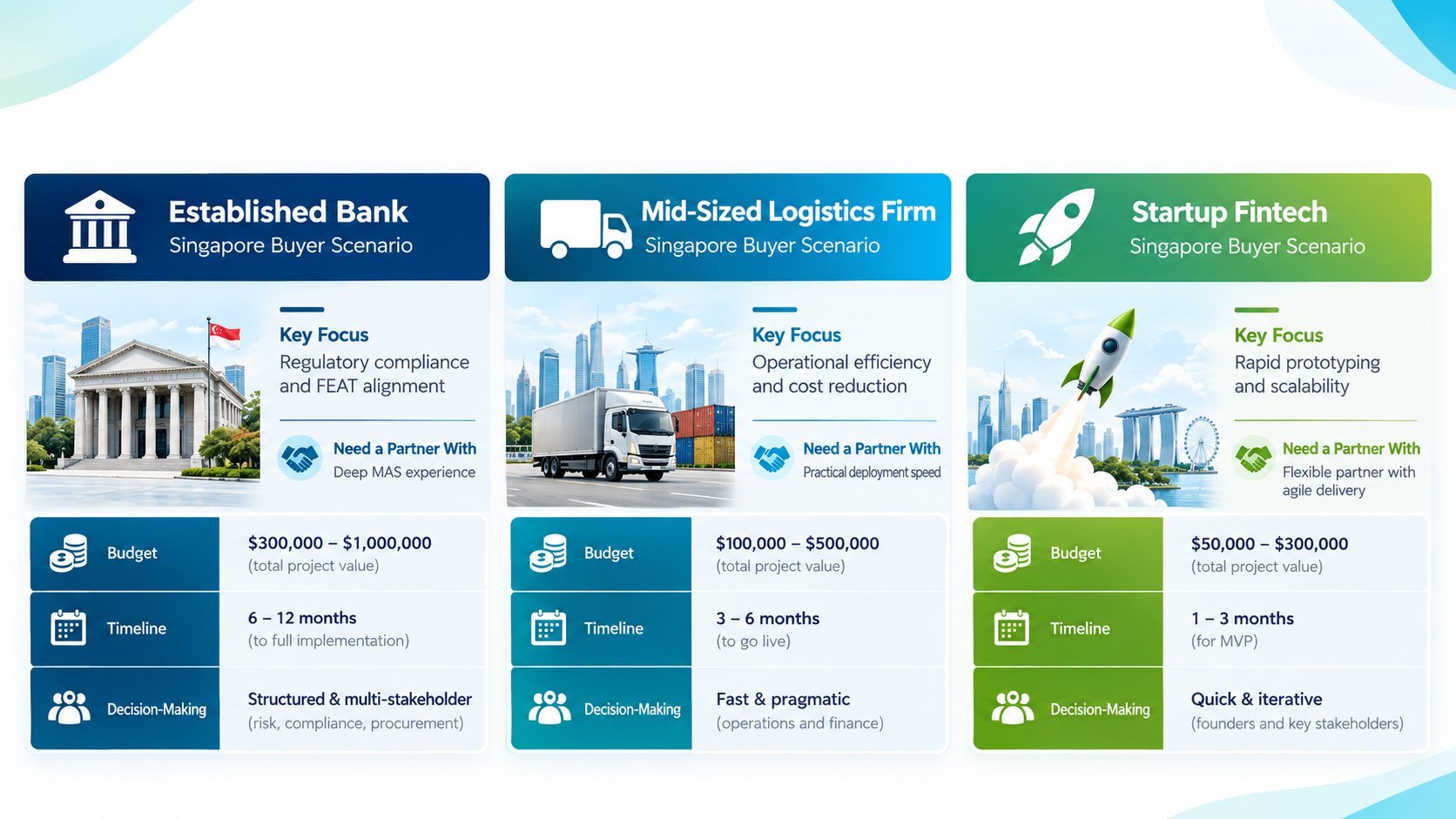
| Buyer situation | What good looks like | Signals the partner is right |
|---|---|---|
| Established bank piloting GenAI | Strong governance, architecture that survives audit, and a delivery team that understands model risk | They ask about controls before features, and they can explain how handover works in a regulated setting |
| SME selecting its first workflow | Lean scope, fast feedback, and internal capability transfer without unnecessary complexity | They resist over-engineering and talk plainly about the business metric that justifies the work |
| Regional group across business units | Multi-entity delivery, data residency awareness, and consistent governance across markets | They can handle multiple stakeholders without turning the project into a coordination circus |
One question reveals a lot
The fastest way to separate serious firms from glossy ones is to ask how they would approach your exact maturity level. A strong partner will adjust the delivery shape, the governance depth, and the handover plan. A weak one will give you the same pitch they give everybody else.
For teams who need help defining the right use case before buying delivery, a use case discovery workshop is a sensible first step. It helps you separate realistic workflow opportunities from the usual list of vague AI ideas.
A Short Checklist Before You Sign
Before you sign, ask for evidence of governance design, handover discipline, and internal capability transfer. If the partner can’t show where those live in the delivery model, walk away. A credible firm should also be able to explain cost transparency, production support, and what happens when the first version needs change.
Red flags are easy to spot. Vague answers about ownership, no clear post-launch support, and too much talk about tools with too little talk about operating change. The best first question is blunt: who owns the system six months after launch, and how will you prove it still works?
Pick the partner who treats AI as an operating-model change, not a software purchase.
Ekipa helps organisations turn AI and data strategy into day-to-day execution through advisory, training, coaching, and delivery. If you need a partner who can work on governance, workflow redesign, and structured 90-day delivery cycles, visit Ekipa and see how we support teams that need results, not theatre.