

Your Kanban board is full. The backlog keeps growing, urgent requests interrupt planned work, and tasks marked “in progress” stay there longer than anyone expected. People can see the work, but they still don’t know what to finish first or how to get blocked items moving.
That’s where Kanban training can help. It gives teams a shared way to make work visible, manage capacity and improve how tasks move from request to completion. In Singapore, that matters because many organisations have adopted Agile practices, while teams still need practical support to use them well.
Why Kanban Training Is Showing Up on Leadership Agendas
A delivery review ends with the same question: why are customer requests still waiting when teams look busy? The answer may lie in how work is prioritised and coordinated, not in how hard people are working.

For a CEO, the result may be missed commitments. Operations leaders may see requests sitting in queues while urgent work disrupts planned tasks. L&D managers may find that staff have attended Agile sessions but still lack a shared understanding of how work should move.
Singapore’s Agile employment data helps explain the gap. In a survey of 300 senior and middle managers, 78% of employers said they were already using Agile methods, and 83% said the pandemic had accelerated adoption. The same survey also found that 57% said not everyone on their teams understood Agile requirements, while 55% said effective collaboration took substantial time and commitment.
Adopting a method and building the habits to use it are different tasks. Kanban training gives teams a shared way to discuss priorities, capacity, blockers and coordination. That shared language can also help leaders decide how AI-enabled work fits into existing processes: which tasks need human review, where responsibility sits, and how teams can see when work is waiting for a decision.
Singapore’s national workforce-development agency reported that 660,000 people participated in funded upskilling and reskilling activities in 2021, a workforce training participation rate of 50%. This figure is not specific to Kanban training, but it reflects a broader focus on building workforce capability.
The workshop itself is only a starting point. Teams need to apply what they learn to real work, agree on who will review progress, and make time to adjust their working agreements. Ekipa’s guide to introducing Agile practices across a company explores how organisations can support that shift from training to everyday practice.
What Kanban Training Actually Covers
Kanban training teaches people to manage work as a flow, not just to move cards across a screen. A supermarket queue offers a simple picture: customers are visible, the checkout has limited capacity, and the queue shows when demand is greater than the service available.
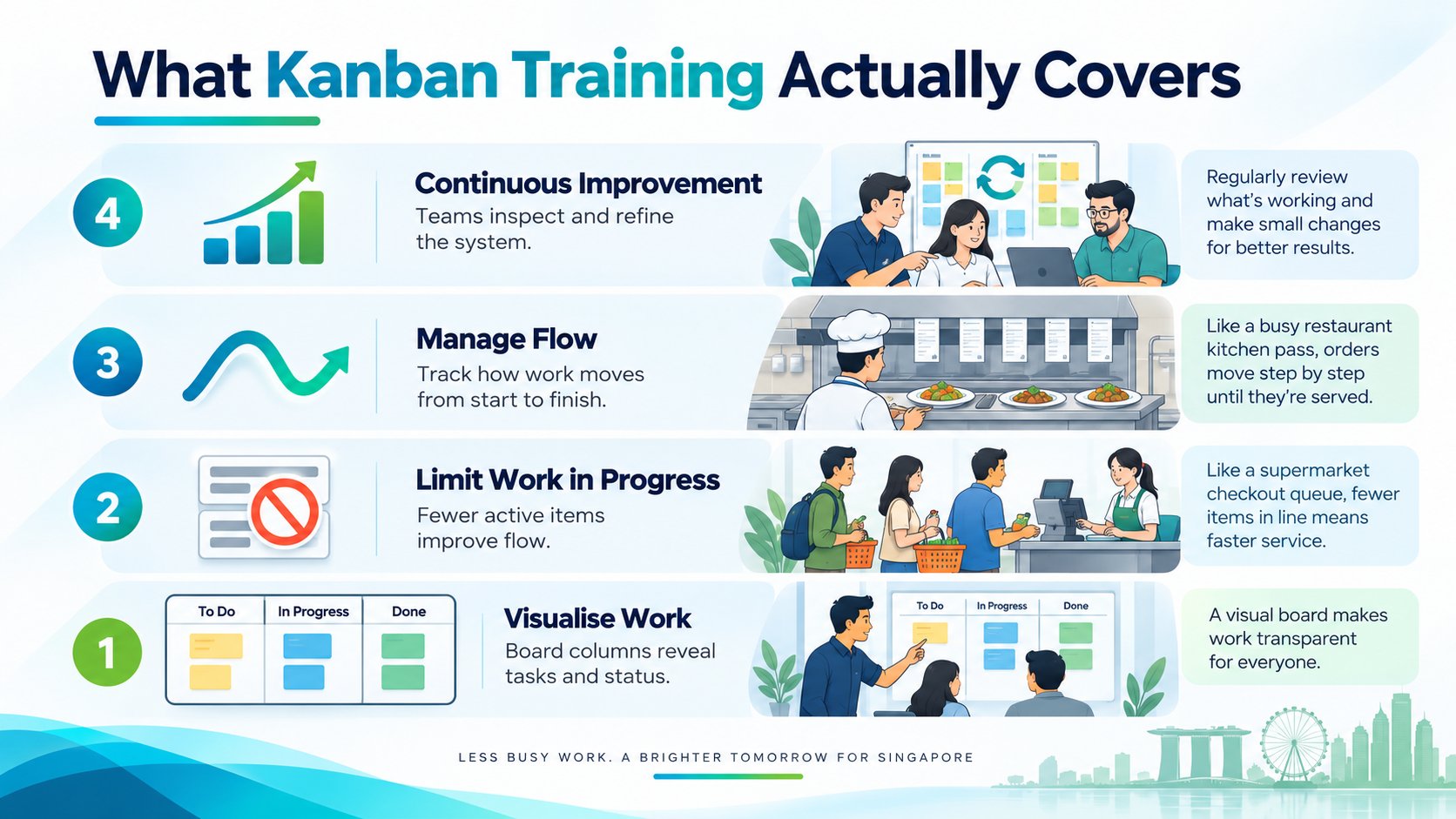
A sound programme usually develops four connected practices:
-
Visualise the work: A board shows what’s waiting, what’s being handled and what’s finished. A busy restaurant kitchen pass works in much the same way: the team can see which orders are ready, which are being prepared and where the queue is building. The columns should reflect the actual stages of work, not an idealised process.
-
Limit work in progress: If a checkout has more customers than it can serve, adding more people to the queue doesn’t make service faster. Likewise, opening more tasks doesn’t guarantee that a team will complete more. A WIP limit gives the team a reason to finish or unblock active work before starting additional items.
-
Pull work when capacity is available: New work should enter a team’s active workload when there’s room to take it on, not because someone has added another task to the board. This is the difference between pushing requests into a crowded system and agreeing to start work when capacity frees up.
-
Manage and improve flow: Teams look at how long work takes from start to finish, where items wait and how long open items have been sitting. Cycle time helps describe completed work; the age of an unfinished item helps flag a task that may need attention now.
The board is the visible surface. Underneath it sit the team’s agreements: what qualifies work to enter a stage, what “done” means, who can change priorities and what people do when an item is blocked.
Practical rule: If a board can’t prompt a useful conversation about what to finish, what’s stuck and what to start next, the team needs clearer working policies, not more columns.
The simplest explanation to give a colleague is this: Kanban makes work visible, limits how much is active, starts new work when capacity opens and uses what the team observes to improve the system.
Who Kanban Training Is Built For
A support lead starts the morning with a queue of requests. Some are routine, some are urgent, and a few need help from another department. The team’s board shows the work, but nobody has agreed how to handle interruptions or what to do when an item waits on another group. A Kanban workshop can help the team make those decisions together.
This kind of continuous incoming work is common in support, operations and maintenance. Those teams may not be able to group their requests neatly into fixed delivery periods. A flow-based approach gives them a way to respond to new work while still making current commitments and bottlenecks visible.
A product manager faces a different version of the same problem. Several stakeholders want their requests handled first, while designers, engineers and reviewers are already occupied. If each person works from a different priority list, the team may stay busy without moving the most valuable work forward. Kanban training gives the group a shared view of demand and a place to discuss trade-offs.
The people attending together matter. A workshop made up only of practitioners can produce a board that reflects daily work, but leave questions about priorities and escalation unanswered. A workshop made up only of leaders can set policies that don’t match what people do.
| Participant | What they bring to the training |
|---|---|
| Practitioners and team members | The detail of how tasks really move, including hand-offs and recurring delays. |
| Team leaders and product managers | Responsibility for priorities, capacity and resolving blockers. |
| Operations and L&D leaders | A view of how the workflow connects to service needs and capability development. |
| Senior sponsors | The authority to clarify decision rights and help remove organisational barriers. |
Ekipa’s dairy-company case offers one model for combining learning with planning: 20 selected team members, including future Agile Coaches, underwent intensive training, followed by Agile squad kick-offs for project planning.
Training tends to be most useful when the people who handle the work attend with the people who set priorities or can remove blockers. If that mix isn’t possible, make sure the missing decision-makers are involved in agreeing the team’s policies and follow-up.
Typical Modules and the Outcomes They Should Deliver
A team can learn to draw a Kanban board in an hour. The harder work is agreeing what moves through it, how decisions get made, and what to change when flow stalls. Training modules should build those skills in sequence.
| Module | What participants practise | Useful outcome |
|---|---|---|
| Foundations and mindset | Examine how work arrives, what value it delivers, and where current agreements fall short. | A shared reason for using Kanban, grounded in the team’s actual workflow. |
| Workflow and board design | Map stages, hand-offs, and queues, then represent them clearly. | The team can see where work waits and agree what each stage means. |
| WIP limits and pull policies | Set initial limits and practise deciding when to start new work. | The team manages active demand instead of continually adding tasks. |
| Flow measures and cumulative-flow diagrams | Review throughput, cycle time, ageing work, and items accumulating across stages. | Teams can discuss delivery using observed patterns rather than impressions alone. |
| Replenishment and improvement rhythms | Agree how to review incoming work, raise blockers, and refine policies. | The practices have a place in the team’s working routine. |
A simulation can make the effect of excess work visible. Participants overload a sample workflow and see how queues grow when active tasks increase faster than completed work. They then test limits against the capacity of their own team. The point is to learn from the pattern, not copy a universal number.
For regulated organisations, Kanban can fit alongside existing governance. In governed delivery curricula, Kanban is taught alongside cumulative-flow diagrams, so teams can keep existing controls while changing how work flows. University-level programmes in Singapore increasingly pair Kanban with Scrum, backlog prioritisation, planning, and stakeholder management.
The modules should also address how work changes when AI is involved. If AI helps generate, summarise, or route work items, teams still need clear policies for checking quality, assigning ownership, and deciding what enters the workflow. Kanban makes these decisions visible; governance defines who can make them.
A class introduces the practices, while team routines make them last. Regular reflection helps turn observations into changes; Ekipa’s guide to Agile retrospectives for continuous improvement explains how teams can structure those conversations.
Ekipa provided a 2-day Agile fundamentals training course and kicked off cross-functional collaboration with a 3-day big room planning for a pharmaceutical vaccine launch programme. Connecting learning to live delivery gives participants a chance to practise collaboration and planning in the work they will carry forward.
How to Run an Effective Kanban Workshop
Start with a workflow problem, not a board template. If the team can’t say what it wants to improve, the workshop may produce tidy columns without changing how requests move.
Prepare with the people doing the work
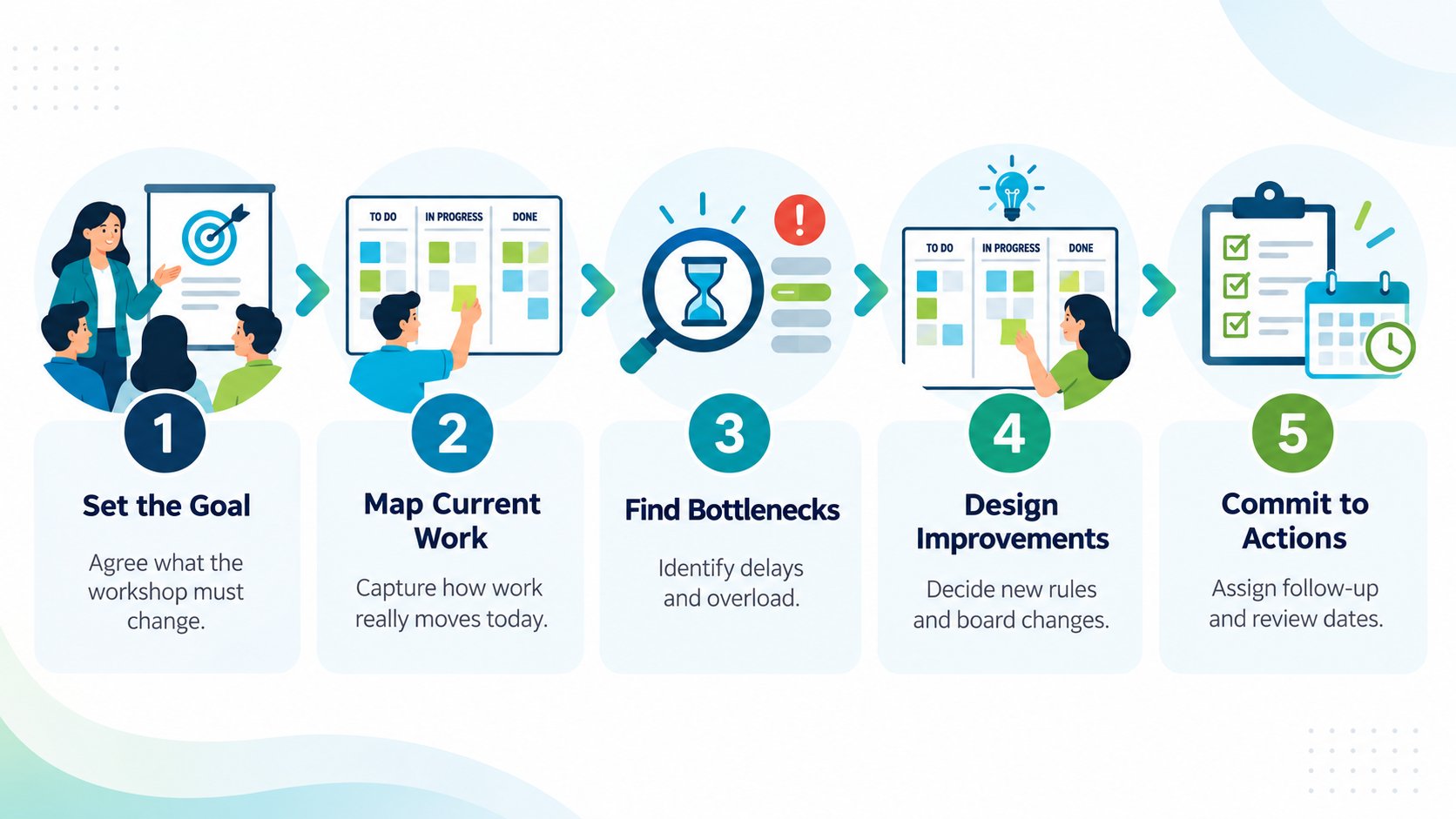
Agree the purpose first. It might be to make blocked work easier to spot, reduce confusion about priority, or understand why requests wait between teams. Invite people who do the work, people who set priorities and anyone who can make decisions about hand-offs or escalation.
Map the current workflow before proposing changes. Ask participants what happens from the moment work is requested to the point it’s complete. Capture exceptions too, especially urgent requests and items that depend on another team.
Where the data is available, record a baseline for blocked-item age, throughput and work-item size. This gives the group something concrete to compare later. Don’t delay the workshop because the measures aren’t perfect; note the gaps and decide how the team will collect better information.
Use the workshop to agree how work moves
Build the board around real stages, then ask the group what each stage means. Set initial WIP limits based on the team’s current capacity, and run a short simulation that shows what happens when new work keeps entering an already crowded system.
Next, make the policies explicit. Decide what lets an item enter a stage, what must be true before it leaves, how the team marks blocked work and how it handles dependencies. A policy that people can’t apply on a busy day isn’t a useful policy.
Facilitators often lose momentum when participants debate the perfect board design or try to solve every organisational problem in the room. Keep the discussion anchored to the chosen workflow. Record bigger issues with a named owner rather than letting them take over the session.
A board becomes useful when the team knows what to do differently because of what it can see.
For a larger group, split participants into working groups to map their part of the flow, then bring them together to resolve hand-offs and dependencies. Ekipa has facilitated multiple-day big room planning sessions with more than 30 people from all layers of the organisation, covering planning, brainstorming, team agreements, vision and purpose, and inter-team dependencies.
Close with owners and review points
Before people leave, confirm who owns the board, when the team will review it and how it will check whether the new policies help. Assign follow-up actions to named people. A short written record of decisions makes it easier for people who weren’t in the room to understand the changes.
If the workshop produces guidance that needs to be shared with colleagues, a training video generator can help turn process material into a learning resource. The tool doesn’t replace agreeing on the workflow; it can support communication after the team has made those decisions.
Choosing a Kanban Training Path That Sticks
A team can finish a Kanban workshop with a clear board and still face the same delays on Monday. The training path needs to match the decisions people make at work, from who can reprioritise requests to when an AI experiment is ready to move into production.
A short introduction can give colleagues shared language. An accredited course provides a structured learning path for individuals, while coaching lets a team work through its own workflow and working agreements. A blended path combines learning with practice, so people can test ideas against real decisions rather than treating the board as a classroom exercise.
Singapore’s AI capability plans make these choices relevant to enterprise leaders. The government announced approximately 800 new AI training opportunities and up to 500 AI projects intended to benefit 1,000 enterprises over three years. A Kanban board can show, for example, that a data-readiness blocker has waited nine days. The team can then decide whether to resolve the issue, pause the experiment or stop it before production, with the decision and its owner visible.
That kind of visibility also helps teams apply governance without turning every decision into an approval queue. For AI-enabled work, training should address how requests enter the system, who assesses risk and what evidence is needed before work proceeds. If those rules are unclear, a board may show stalled work without helping the team resolve why it is stuck.
Ekipa’s Malaysian banking case offers a practical example of training paired with leadership support: over 45 team members underwent detailed training on Agile practices focused on Scrum and Kanban. Ekipa also coached Product Owners to shift from command-and-control leadership towards enabling team members. Teams need methods they can use; leaders need to make room for those methods in everyday decisions.
Choose a path by matching the learning to the workflow, the decisions it must support and the people who will reinforce the practice. A course can establish shared understanding. Coaching can help teams and leaders apply it to their own work.

Turning Your Training Into Everyday Practice
Training only matters if people use what they learn when priorities change, and the board gets busy. Put the follow-through in the calendar before the workshop begins, then make sure someone inside the organisation can keep the practice going.
Use this checklist to get started:
-
Name the workflow problem: Agree what the team wants to make easier to see or manage.
-
Bring the right people together: Include practitioners, priority-setters and leaders who can remove blockers.
-
Capture a baseline: Record available flow measures before changing the system.
-
Set the review rhythm: Schedule leadership check-ins and team reviews across the next 60–90 days.
-
Build internal ownership: Identify facilitators and team champions who can reinforce the practices after external support ends.
Ekipa’s Agile & Kanban Applied course is designed to help teams visualise and improve workflow using Kanban’s core principles. Embedded Agile Coaching provides team, executive and enterprise coaching to build daily execution habits, resolve organisational friction and improve delivery speed.
Tomorrow morning, choose one workflow that feels harder than it should, invite the people who touch it and map what happens today. That’s a practical starting point for a board your team can use rather than merely maintain.
If your team is ready to improve how work flows, Ekipa offers Agile and Kanban training alongside embedded coaching for teams and leaders. Visit Ekipa to explore a practical next step for your organisation.