

A familiar pattern plays out in many organisations: an HR director books six managers onto a three-day leadership course. They return with fresh language and a stack of notes, but a quarter later the same decisions still get escalated, and the same team problems persist. The issue often isn’t the quality of the teaching. It’s whether the program gives managers a reason and a chance to use what they’ve learned at work.
That’s why choosing leadership training programs is less about comparing brochures and more about identifying the behaviour or business decision that needs to change. The right format should make that change easier to practise, observe and reinforce.
The Main Leadership Training Program Types Compared
| Program type | Typical length | Main outcome |
|---|---|---|
| Short workshop or classroom course | 1-3 days | Shared concepts and vocabulary |
| Self-paced online modules | Short, modular units | Knowledge checks, little practice |
| Cohort-based leadership programme | Sessions across a programme cycle | Peer learning with projects between sessions |
| Action learning on a live business problem | The length of the business challenge | A decision or result the business can see |
| One-to-one executive coaching | Recurring sessions over several months | Changed habits in the leader’s own role |
| Bespoke in-house programme | 3-12 months | Competencies tied to company priorities |
Each option solves a different problem. A workshop can give a group a common language for feedback, delegation or decision-making, but it can’t build fluency through explanation alone. Self-paced modules work well for sharing baseline knowledge and checking comprehension. They’re convenient to schedule, but they offer little practice unless learners apply the material in a real conversation or decision.
A cohort-based programme gives managers time to compare approaches and learn from peers. Between sessions, they can test a technique or work on a project, then bring back questions and results. That combination makes peer learning more useful than putting managers in the same room. For ideas on the group format, Ekipa’s article on the benefits of group coaching explores how shared learning can support practical development.
Action learning starts with a live business problem and makes the work itself part of the learning. The group must investigate the issue, agree a course of action and make a decision that others can assess. One-to-one coaching is more personal: the leader works through situations from their own role and practises different responses with a coach. Senior professionals weighing up that kind of support may also find this guide to career development coaching for senior professionals useful when considering what individual coaching can provide.
Choose the gap before the format
A bespoke in-house programme links development to the organisation’s priorities, so the scenarios, assignments and measures reflect managers’ work. It takes more coordination than a standard course, but the content can be designed around specific decisions, constraints and team practices.
Most effective programmes combine two or three formats rather than relying on one. A workshop might establish shared concepts, a cohort could practise them on live assignments, and coaching could help a manager change a difficult habit in their own role.
Start by naming the single gap you want to close. Is it a knowledge gap, a habit that needs practice, or a recurring decision that leaders aren’t making well? The right row usually follows from that answer, not from how many days the course runs.
Why Courses Alone Rarely Change How Leaders Act
A good course can help a manager understand a new approach. It can’t, by itself, change what that manager does when a deadline is at risk, a team member needs difficult feedback, or a senior colleague challenges a decision. Training without a live assignment and follow-up often stops at awareness.
A 2007 study by Singapore’s Civil Service College and Public Service Division, conducted with the Center for Creative Leadership, interviewed 36 senior public-sector leaders across ministries and statutory boards. In the Singapore public-sector leadership-development study, 92% identified challenging work assignments as significant or memorable leadership-learning experiences, while 11% cited coursework or training as a major source of leadership learning. 53% said bosses or superiors had a lasting influence on their development.
The practical implication is straightforward. A regional operations manager might learn coaching techniques in a classroom, then return to a team where urgent work leaves no time to listen. Without a real opportunity to practise, feedback on how the conversation went and a manager who reinforces the behaviour, the new technique can fade into the day-to-day pressure.
Practical rule: Attach every leadership concept to a real decision, conversation or piece of work.
That doesn’t mean courses are useless. It means their value depends on what surrounds them. In one pilot, a cross-functional team member and programme expert said Ekipa’s coaching helped the team become more effective, minimise setbacks and clarify roles while moving towards common goals. Coaching and feedback gave the team a way to address its work as it happened, rather than leaving the learning in the classroom.
If managers are reacting to every new issue as though it’s an emergency, the distinction between leadership reactiveness and responsiveness can help frame what behaviour to practise instead.
Before you buy a programme, check three things: Is there a real piece of work attached? Who will reinforce the behaviour afterwards? How will learners be coached while they do it? If those answers aren’t clear, you’re buying attendance, not applied development.
A Sample Six-Month Curriculum You Can Adapt
A six-month curriculum should test whether leaders change a real decision within 90 days, not just whether they complete the sessions. Use each month’s assignment to connect the learning to work the manager already owns.
| Month | Focus | Workplace assignment |
|---|---|---|
| 1 | Team diagnosis and self-awareness | Map the team’s decisions and note where they stall |
| 2 | Strategic thinking | Link the team’s priorities to one company objective and present it to a sponsor |
| 3 | Change leadership | Lead a small change, such as a new meeting rhythm, and log how people respond |
| 4 | Communication and trust | Hold three one-to-one feedback conversations and run a team retrospective |
| 5 | Talent development | Coach one team member through a stretch task |
| 6 | Review and sustain | Present results to the sponsor and agree three habits to keep for 90 days |
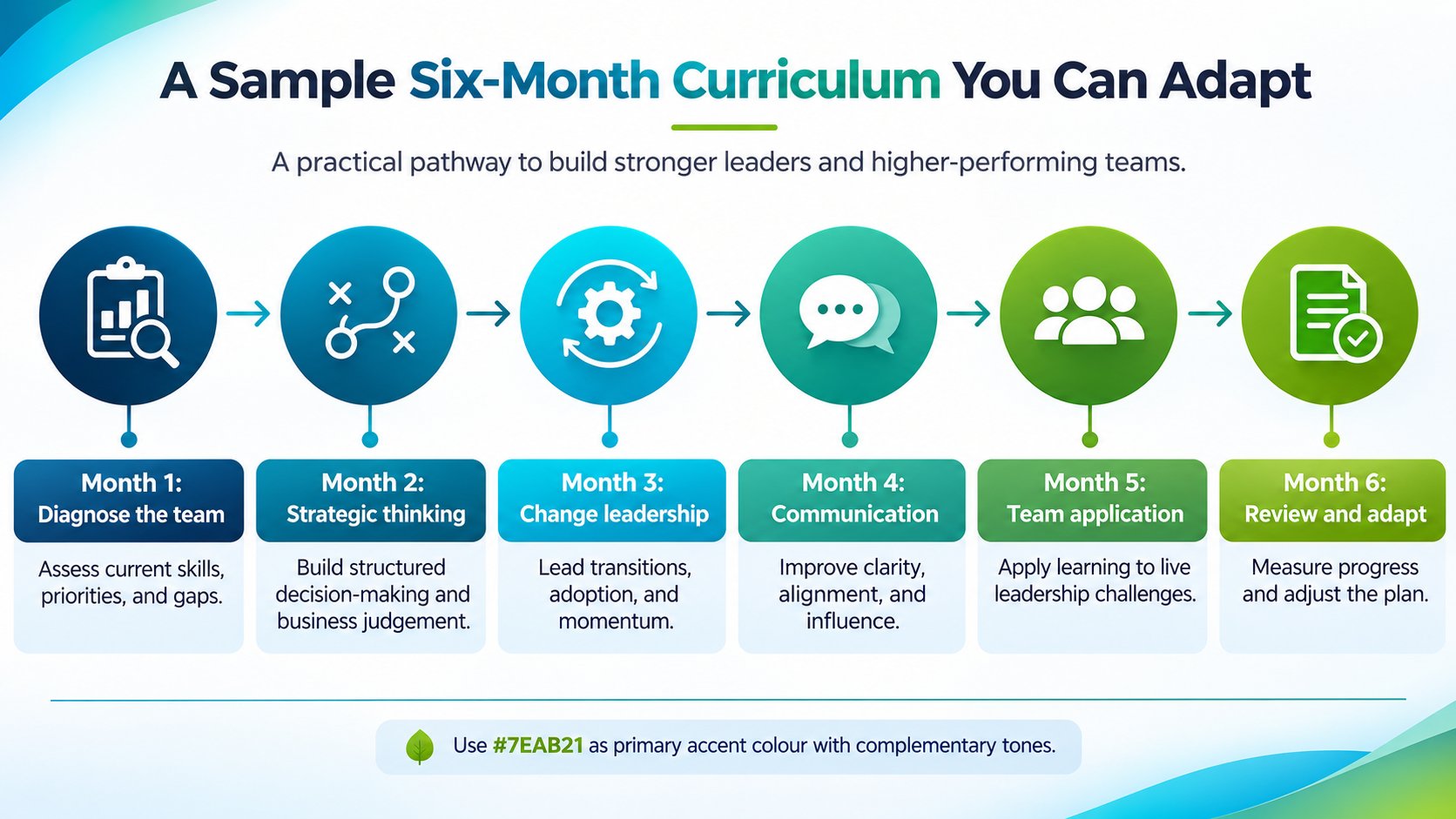
Begin with a map of where work stalls, decisions are delayed, or responsibilities are unclear. That gives leaders a practical baseline. At the end of the programme, they can compare it with what changed in their team’s work.
A Singapore Management Agenda survey discussion reports that 70% of managers viewed leadership in their organisation positively, while 30% held a less positive view. It also identifies gaps in strategic thinking, managing change and developing talent. Those findings give the curriculum useful areas to address, but the assignments should reflect the organisation’s own priorities.
In month two, ask leaders to connect a team priority to one company objective and explain the link to a sponsor. In month three, they lead a small change and record how people respond. The sponsor can then assess whether the manager translated organisational intent into a decision the team could act on.
Month four turns communication into observable practice. A product owner who tends to issue orders can hold one-to-one feedback conversations, then run a retrospective that gives the team room to make decisions. At the next session, they report what changed, what resistance arose and what they will try next.
Make each assignment part of the manager’s actual job, with consequences for the team’s work.
In month five, the manager coaches a team member through a stretch task and reflects on where they delegated well and where they took control back. In a Malaysian banking case study, Ekipa coached Product Owners to shift from command-and-control leadership towards enabling team members. The assignment tests that shift in practice: does the manager change how decisions are made, or complete another exercise?
This sequence can suit a cohort of six to twelve leaders and be compressed into three months for a fast-moving team. Keep the assignment between sessions, with learners reporting back at the next one. If the organisation’s immediate gap is talent development or change leadership, bring that work forward. The test remains the same: can each manager point to a real decision that changed within 90 days?
AI Leadership Training Needs More Than AI Literacy
A CEO has five AI pilots to consider and no agreed basis for choosing between them. Training in AI terminology or prompt writing can build familiarity, but leaders also need to decide what to fund, who owns the results and which risks warrant a pause.
Singapore’s latest digital-economy evidence points to a gap between adoption and preparation. Enterprise AI adoption rose to 23.5% in 2025, while 36.7% of surveyed workers had attended AI-related training in the preceding 12 months. More than two-thirds believed they needed AI training, according to IMDA’s digital-economy evidence.
Train leaders to make operating decisions
Awareness sessions and tool demonstrations can introduce AI, but leadership development should also address the choices that shape its use: which cases merit investment, who is accountable, how data and model risks are managed, and when deployment should stop, particularly in regulated settings.
Singapore’s public sector is planning an Institute of Digital Government to build public officers’ digital, data and AI skills, including through leadership components and modules on data governance and AI applications. The direction is clear: AI leadership is an organisational capability, visible in how decisions are made, responsibilities assigned and risks governed.
A useful programme should leave leaders with practical outputs they can apply to a live initiative:
-
A named owner for each use case, accountable for delivery and business outcomes.
-
A risk tier and stop conditions that tell teams when to pause or reject a proposal.
-
A shared scorecard linking the work to business outcomes rather than tool usage alone.
The test is whether these outputs change a real decision within 90 days. A scorecard that tracks activity without informing a funding, deployment or stop decision adds paperwork, not leadership capability.
For a practical approach to measuring ROI from AI adoption, connect investment measures to business outcomes. Ekipa’s AI training for managers can support managers who need to connect AI adoption with the decisions and workflows they oversee.
Ask providers to show how participants will apply the learning to an actual AI initiative, and what decision they should be better equipped to make within 90 days.
Choosing the Right Programme for Your Audience and Gap
A newly promoted team lead may be strong technically yet avoid difficult performance conversations. Their record earned the promotion, but it does not prepare them to coach, motivate or hold a team accountable. Choose development around the decisions and conversations the role now demands.
Start with the audience. Executives need practice sponsoring change, making trade-offs across business units and pacing decisions. A short course or one-to-one coaching may suit a leader working through decisions tied to their own role. Mid-level managers need development built around recurring operational decisions. Frontline leads need structured practice in feedback, active listening, removing blockers, motivating people and holding colleagues accountable for goals.
In Singapore, Gallup’s Singapore Workplace Report says organisations often invest in senior executives and individual contributors while giving people managers less support. Gallup also reports that 82% of companies fail to select manager candidates with the right talent. Build development into the transition to management rather than assuming technical performance predicts people-management ability.
Score options against the same five checks
-
Describe the gap as behaviour: Replace “we need better leaders” with an observable pattern, such as routine decisions being escalated or teams repeatedly missing commitments. This makes the intended change clear.
-
Match the audience to the role: A newly promoted lead needs practice with conversations, delegation and accountability. A senior executive may need to sponsor change across units. Avoid putting both into a generic programme just because they share a job grade.
-
Choose a format that fits the gap: A knowledge gap may call for a workshop or online module. A habit gap may need a cohort or coaching. A decision gap is better suited to action learning on a live business problem.
-
Connect learning to real work: Name the assignment, the manager who will reinforce the practice and the opportunity for feedback. Without these, even relevant course content can remain separate from the job.
-
Plan the handover: Ask how the provider will equip your internal team to continue after delivery ends. Ekipa structures consultancy engagements from leadership alignment to handoff, so internal teams can maintain momentum after its work ends.
Three buying mistakes are common: choosing a programme for its brand rather than its fit with the gap, judging quality by hours of content, and starting without a sponsor. For more perspectives on programme selection, explore leadership programme insights from Acheloa Wellness. For smaller employers, modular and subsidised options can make cohort learning easier to organise. SMEs accounted for 97% of participating enterprises in SkillsFuture-supported training in 2023, according to the Singapore Workforce Development Agency update.
Score two or three options against the same five checks. For the newly promoted lead, define a behaviour to practise, a live situation in which to practise it and a manager who will follow up. A programme with less content but stronger application and reinforcement may be the better investment. Judge each option by whether it helps a manager change a real decision within 90 days, not by its brand or how confident participants feel after class.
Set a 90-Day Test Before You Commit to a Programme
A leadership programme earns its place when a manager changes a real decision within 90 days. Before signing, select one leader group, one decision or behaviour to change, and a way to check whether the change reaches day-to-day work.
Randstad’s 2025 Singapore Workmonitor found that 82% of respondents considered training and development important in their current role or when seeking a new job. That signals employee interest in learning; the programme still needs a workplace test.
| Checkpoint | What to check | Who verifies |
|---|---|---|
| Day 30 | Managers have tried one new practice in live work | Line manager and direct reports |
| Day 60 | Decision lead time on the chosen priority has started to fall | Senior sponsor |
| Day 90 | Delivery predictability, retention signals and active strategic priorities have moved | L&D lead and finance partner |
Set the baseline before training starts, and assign someone to verify each measure. For slow decisions, track how long the selected decision takes. For weak strategy execution, check whether priorities become active work and whether delivery becomes more predictable. For a new tool or workflow, assess whether people use it in their work.
A shorter programme tied to a live business task may be easier to apply, but only if managers provide coaching, feedback and follow-up. A classroom course may suit leaders who need shared concepts; live-work assignments make it easier to test whether those concepts affect decisions. Choose based on the behaviour you need to change, not the format’s prestige.
If the challenge spans several teams, Ekipa’s Leadership Development & Culture Shaping advisory builds leadership capabilities that support decentralised decision-making and resilient teams. Its consultancy engagements run from initial leadership alignment through handover, helping internal teams maintain momentum after Ekipa exits.
At the review, ask each participant to bring one example of a decision handled differently, feedback from someone affected by the change, and an adjustment to try next. For more ideas on leadership and organisational change, browse the Ekipa insights blog.
If you cannot name the decision or behaviour you expect to change by Day 90, define that before buying the programme.
Ekipa connects leadership training, coaching and advisory with day-to-day execution. To explore options for a programme or a 90-day workplace test, visit Ekipa.