 Indonesia | English
 .png) Worldwide
Worldwide Malaysia
 Singapore
Many people aspire to become entrepreneurs and start a company. Today more than ever, startups are attractive alternatives to working in an established company. Inspired by the startup success stories, people want to jump and start something new. But even though we have the aspiration, our brain gives us plenty of reasons NOT to do it. We’re experts at finding excuses, blockers and risks that hold us back from making that jump.
Since a young age, I decided to be an entrepreneur. When I was 10 years old, I walked around in the warehouse of my uncle. He had started a jewelry import business and grew it into a profitable company. Walking around there I thought ‘wow, this is so cool. He started with 0 and built this giant warehouse all by himself’. And I also liked the big house and the Porsche he was driving. That’s what I wanted (I gave up on the Porsche idea quite some time ago)!
Last week I did a presentation for 300 aspiring entrepreneurs at Sagoo festival, hosted by BeKraf and Telkom, in Makasar. Here’s the top 5 mental blockers I shared with them:
1) I need….an idea

We believe that to start a company, we need a great idea. Next, we realise that our brains don’t crank out ideas. And so we conclude that we can’t start. Now that line of thinking seems very logical. But I’d say it’s the wrong starting point. First of all, most ideas that entrepreneurs start with is not the idea they end up with. Which means that whatever you come up with will likely be wrong anyway.
Second, ideas are easy to find. Just ask a seasoned entrepreneur and he’ll give you a list of 5 great ideas within 5 minutes. Or search the internet, you’ll find plenty websites sharing great ideas from across the globe (no I’m not going to put links for u here, that’s too easy :)). Hence, if you find yourself in the above situation, my advice is: start moving. Make a decision to start with someone else or alone. And then start talking to people, start searching, until you find an idea to work on. The decision to start, followed by action, is all that counts. The idea will come.
2) I need….money
Second excuse we find is: we need money. I’d say; YES you need money, because you need to eat and live somewhere; and NO you also don’t need money because there are plenty of ideas to work on that don’t require a million dollars to start. Today, with modern technology, cheap servers and saas software, it’s cheap to start any digital product. Using frameworks like lean startup give u plenty of ways to start with something simple, so you can first explore whether the world is waiting for your new product. You don’t need (much) money to do that.
And if you find yourself in a position thinking that yes you still need money. Well, nobody told you that the only way to start is quit your job and work on this full time. You’ve got 24 hours in a day. If you are truly an entrepreneur and you’re dedicated to starting, then squeezing out another 2-4 hours a day after your 8 hours at work shouldn’t be a problem. Which means you’ve got your income, you can eat and sleep and you may even have enough money to pay for $10 a month in hosting and another $50 to get some designs from fiver.com?
3) I need….co-founders
Research shows that highly successful companies like Microsoft and Facebook are started by 2-3 people. Usually they have a CTO, a CEO and a CMO. If you go it alone, the odds of creating a super successful startup which grows like a rocket, are slim. But then again, there’s plenty of startups that stay under the radar but are still highly profitable and successful in their smaller scale. And there are plenty of startups with 2-3 co-founders on the startup graveyard.
So you don’t necessarily need co-founders.
You might be telling yourself ‘I need someone else, I can’t do this alone’. The question is: why do you tell this to yourself? Have you tried? And even if in your case it’s better to have a co-founder, it still takes your decision to get started. You are the sole owner of ‘the start’. So you might make your first goal ‘search a co-founder’, but at the same time you could start searching for your great idea, you can start building your first MVP. There’s a lot you can do just to get started while you search. And then…maybe you’ll find a soulmate. And maybe you don’t. The important thing is to just get started and build stuff or start your service.
Read More : What Corporates can Learn from Startups
4) I need….knowledge and experience
When I started my second company (the first one failed), Bridge Global, I called my uncle (the one that inspired me to become an entrepreneur). I had decided to start an IT outsourcing company. I had just visited India and thought that outsourcing to India would be the next big thing in Europe (the US were already doing it on a massive scale).
He asked me ‘Hugo, do you have any experience in this line of business?’. Uhhh…nope. I had done an MBA and learned some stuff about IT, but had no experience running an IT business, let alone one involving teams in a far away country. ‘And Hugo, are there any other companies doing what you plan to do?’. Yes plenty, I have a whole list of them and did quite a bit of research and had even spoken to some of them to learn a bit. ‘So why don’t you join one of them, work there for 2 years, learn the tricks of the trade and then start?’. Yeah that’s quite a good idea; that would enable me to learn faster while having someone else finance my curriculum. And no, that’s not what I did.
Although the above advice is good and many people follow that route (start a business which you’ve been doing for a boss for years and just compete with your boss), I’m way too impatient. And maybe also ignorant. I always believe I can figure things out by myself. Learn the hard way. It might be a longer, riskier way, but it’s also fun. You get into something without any knowledge and learn step by step until it works. I probably could have prevented a lot of sleepless nights though.
So yes you need knowledge and experience. And no, you don’t need to wait until you’ve figured it all out, before you get started. You can start, learn and grow your startup step by step. I don’t think Mark Zuckerberg had any idea of what bus he was driving, how to drive it and where to drive it, when he started Facebook. Look at where that brought him.
5) Fear of Failure
I put it at number 5, but deep down, you might think this is number 1. And for many people it’s fear that keeps them where they are. They are so scared about failing, they prefer to just not start. I never understood this. We’ve got 1 life, if you really want something, why sit around till you’re 80 and then regret you never did it?
Look at below list, taken from ‘the 5 regrets of the dying’:
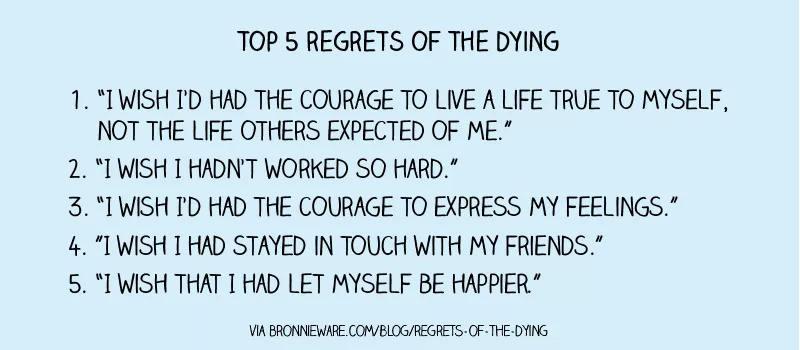
The author spoke to dozens of people who were about to die. She asked them what they regretted looking back at their lives.
Most fear is related to the first regret. People around us have all kinds of expectations of us. Our parents want us to succeed and have their own ideas of what that means. Friends and family have all kinds of demands. Especially in cultures like Indonesia, where people have very strong social ties and it’s important to behave according to the ‘rules’ and ‘expectations’ of the groups we are in.
Looking at life, I’ve always thought that I have only 1 chance. My feeling deep down has always been that I was meant to start my own companies and decide every minute of my life what I’ll do with that minute. I never really cared what others expected of my or what ideas they have about how I should behave or what I should do. That includes the opinion of my parents. If I’ve got some idea in my brain, I’ll just go out and do it.
I think that’s what an entrepreneur needs. The worst that can happen is that your first venture doesn’t succeed. You might run out of money Your company might go bankrupt. And there might be people telling you ‘I told you so’. So what? Just get up and do it again. If you’re afraid of this scenario (and it’s unlikely that it would play out this way!), just make up your mind, get started and do everything you can to avoid failure.
The fear might also come from losing money and a lot of time. My line of thinking on that is: would you rather go bankrupt one time, have the time of your life and just do what you had in mind; OR regret stuff on your deathbed? As long as you’re alive, money will keep coming back, even if you’ve lost it all.
Conclusion:
The most important thing is to realise that you need none of the above things. And you also need all of them. But you don’t need them at the start. The only thing you need to start is your decision to start. And then take the first step. Just start moving, try to gain momentum and keep moving! I’ll share some more insights into tools and systems that have helped me in my next article.
Read More : What Corporates can Learn from Startups – Part 2