

It’s Monday’s management meeting. Last year’s dashboards are still available, but the operations director brings a spreadsheet, finance brings a different number, and nobody can say which chart changed a decision. The next proposal is for an AI pilot, even though the team hasn’t resolved why people stopped using the reporting they already have.
Data analytics consulting should fix that disconnect. The useful outcome isn’t another place to view information. It’s a decision the business can make reliably, with trusted inputs, clear accountability and evidence that the new way works.
What Data Analytics Consulting Includes
Data analytics consulting connects a business decision to trusted data, a repeatable analytical method and a named owner. That includes technical delivery, but also the less glamorous work of agreeing definitions, resolving access questions and changing what people do with the result.
Singapore’s adoption figures put the challenge in perspective. In 2024, 96.9% of non-SMEs used data analytics, compared with 35.9% of SMEs, according to IMDA’s enterprise digitalisation statistics. For a large enterprise, the starting question is therefore often about depth, not access: can people trust, operate and act on the analytics they already own?
An engagement might begin with a forecasting problem, a service backlog or inconsistent risk reporting. The consultant’s job is to establish what decision needs to improve before proposing an architecture or analytical technique.
Commission decisions rather than deliverables
Say a regional operations leader wants better demand forecasting. A dashboard showing historical orders may be useful, but it doesn’t establish who changes purchasing quantities, how exceptions are handled or whether the forecast arrives before orders must be placed.
A workable scope names those details. It also separates what the business hopes to achieve from what the available data can support.
What each phase of data analytics consulting delivers
The lengths below are indicative planning windows for a bounded first engagement, not guaranteed delivery commitments. Access approvals, source remediation and validation requirements should determine the actual schedule.
| Phase | What the team does | What the business receives | Typical first length |
|---|---|---|---|
| Discovery | Map the decision, sources, owners and constraints | A shortlist of use cases with a baseline metric | 2 to 4 weeks |
| Platform and pipelines | Check architecture, quality, lineage and access | A governed path or semantic layer for one domain | 4 to 8 weeks |
| Analytics models | Build a descriptive, predictive or rules-based method | A validated model with documented limits | 3 to 6 weeks |
| Operationalisation | Place the output in a workflow with controls | A production routine, monitoring and a handover | 4 to 8 weeks |
| Measurable outcomes | Compare results with baseline, cost and risk | A value read and a go or stop decision | First read at about 90 days |
These phases follow a dependency rule, not a rigid waterfall. Teams can investigate later work early, but they shouldn’t commit to production modelling while the underlying definitions remain disputed.
Think of a renovation. You can discuss fittings while checking the building, but you don’t remove a wall before finding out whether it’s load-bearing. In analytics, source quality, decision rights and privacy constraints are the structural checks.
Make the acceptance criteria visible
A good statement of work describes what the client must be able to do at the end. That might mean explaining a metric’s origin, approving an exception, recovering a failed feed or withdrawing an unreliable recommendation.
The business sponsor should also recognise their own responsibilities. Consultants can expose conflicting definitions, but finance and operations must agree which definition governs the decision.
Practical rule: Accept a deliverable when the intended business role can use it, explain its limits and act on its output.
This changes procurement conversations. Instead of comparing dashboard counts or presentation packs, leaders can compare the decision being supported, the evidence needed for release and the capability their team will retain.
Tick the table rows for which you already have usable evidence, rather than documents alone. If all you can tick is a dashboard, the decision-centred engagement hasn’t really started.
Discovery as an Operating Model
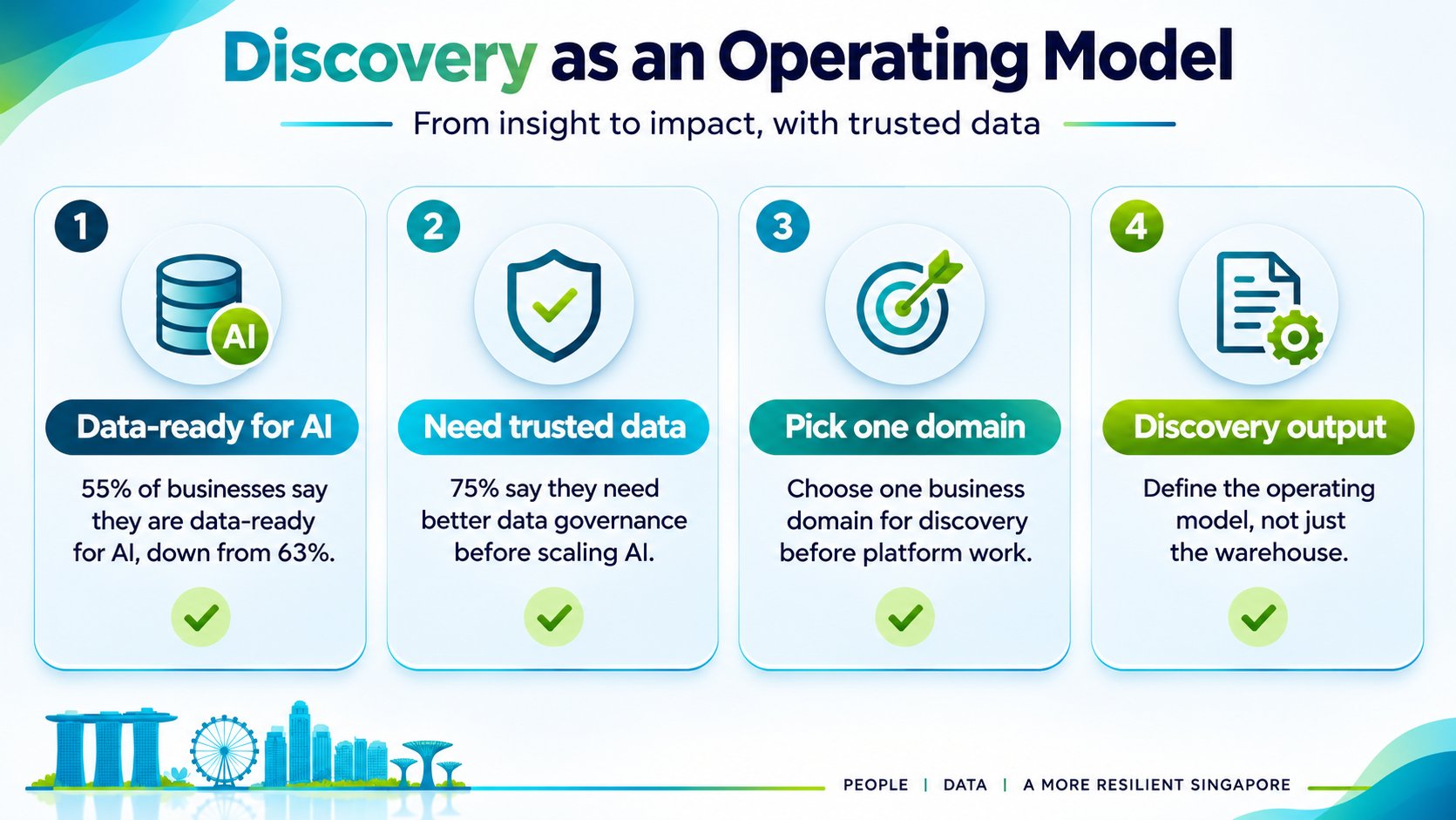
A cloud warehouse stores and processes information, but it doesn’t settle what that information means. Readiness lives in the routines around it: who owns each data product, how quality gets checked and what happens when a feed fails.
In Singapore, 55% of businesses said they were data-ready for AI, down from 63% previously, while 75% rated data availability and quality as very important or critical to AI decisions, according to SAP’s Value of AI Singapore report. That gap sits in daily work. Infrastructure is the easy purchase; the harder job is agreeing definitions, assigning owners and building the quality routines that make outputs safe to act on.
Put ownership into the discovery conversation
Start with a decision a non-specialist can describe. Ask who makes it, what they use today and who will own its performance after the consultants leave.
Then work through the vocabulary. Say sales reports revenue when a contract is signed, while finance recognises it as the service is delivered. Both figures can serve legitimate purposes, but a model trained on either will conflict with the board pack unless the team specifies which meaning applies.
A data-readiness assessment should make those disagreements visible before anyone automates them. Record the source systems, permitted uses of sensitive fields and acceptable freshness and completeness for the chosen decision.
For banks and insurers, make the record detailed enough to explain sourcing, processing, fitness for purpose, representativeness, lineage, approvals and remedial action. Treat those as working records that people maintain, with a named owner for each, and they stay useful long after the review that first demanded them.
Check whether the controls work
The MAS thematic review of fairness in AI and machine learning examined institutional frameworks alongside their application to actual use cases. That sets the bar for any analytics engagement: a written framework counts for little unless teams can demonstrate the controls operating in live work.
Run this checklist during discovery:
-
Data-product owner: Name the person who accepts changes and resolves business-definition disputes.
-
Quality service level: Specify when the information must arrive and which missing fields make it unusable.
-
Lineage evidence: Record how source records become the figures people act on.
-
Issue path: Identify who investigates a failure and who decides whether to pause use.
-
Handover measure: Ask the client team to demonstrate the operating routine without prompting.
Related perspectives on data, AI adoption and ways of working are available in the Ekipa insights library. The immediate test sits inside the organisation: ownership at go-live is what separates a finished project from a working capability.
Platforms, Pipelines, and Models in Sequence
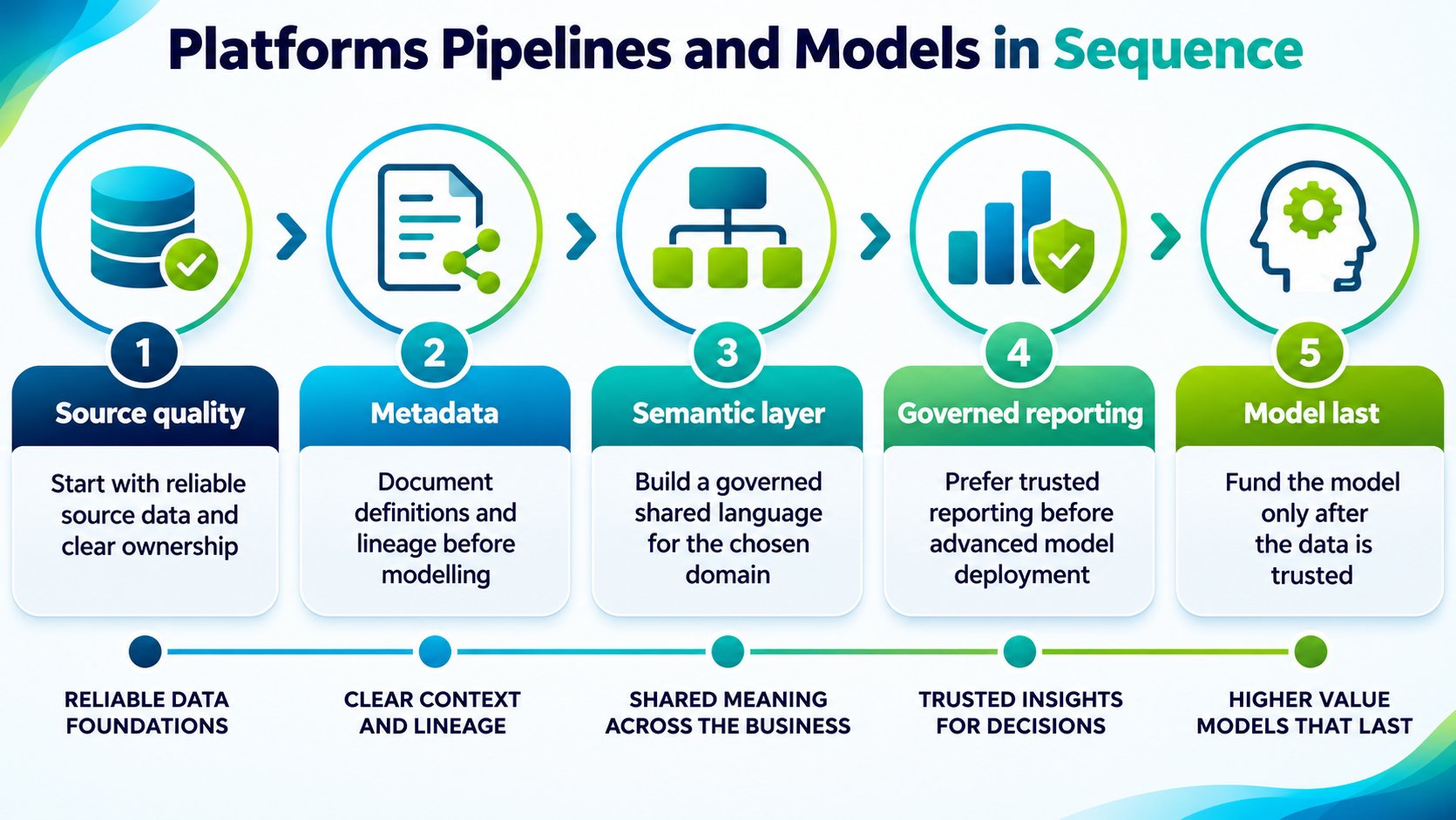
A model shouldn’t be the first expensive commitment. Begin with the source records for the chosen domain, document their meaning and build a shared business layer that people can inspect.
That semantic layer translates technical fields into agreed concepts such as active customer, overdue balance or completed order. When the foundations are weak, governed reporting and automated quality checks are more useful than a prediction built on disputed inputs.
Choose infrastructure around the decision
A pipeline moves information from its source through the checks and transformations needed for use. Batch processing suits work such as finance close or daily operational planning, where scheduled updates are sufficient.
Streaming makes sense when waiting hours would miss the decision. It also introduces more demanding recovery and monitoring work, so don’t pay for immediacy that nobody needs.
Good data architecture design makes these trade-offs explicit. The team should be able to see when a feed last completed, what it omitted and whether the output remains safe to use.
For projects that require external training material, WebscrapingHQ’s training data collection guide offers a starting point for collection planning. Separately establish permission, permitted use, provenance and whether those records represent the population relevant to your decision.
Share definitions without centralising every decision
Among Singapore firms using AI, non-SMEs applied it across an average of five business functions, compared with three among SMEs, according to IMDA’s 2024 enterprise pulse survey. That breadth makes a shared analytical pattern important.
Consider a contact-centre score and a finance forecast that both claim to measure customer value. One estimates service priority; the other estimates future margin. Adding them together is meaningless unless their purpose, units and limitations are clear.
Use a shared pattern with local ownership:
-
Common metric language: Publish definitions that business teams can challenge and approve.
-
Domain-owned data products: Document schemas, permitted uses and quality thresholds.
-
Observable pipelines: Expose freshness, completeness and failures to the people responsible.
-
Controlled releases: Retain versions, approvals, rollback instructions and post-release monitoring.
Prioritise proposed use cases by value, feasibility, available data, regulatory exposure and change effort. A modest method that fits the operating context can be preferable to a more accurate model that nobody can maintain.
Write down the model’s intended use and limits before release. Don’t start production model work until the pipeline for that use case meets its agreed quality service level.
Operationalisation and Outcomes You Can Audit
A model can pass every technical check and still change nothing on the floor. Operationalisation means making the analytical output part of normal work, with a safe way to challenge it. The recommendation should appear inside the system where the decision happens, at the moment the decision gets made.
Give an authorised person the ability to override it, restrict access to the people who need it and assign someone to monitor whether the method still behaves as approved. Those arrangements matter as much as deployment success.
Turn principles into operating duties
The MAS FEAT principles set out Fairness, Ethics, Accountability and Transparency for AI and data analytics in financial services. They call for checks against systematic disadvantage, justification for personal attributes, regular review of data and models, appropriate internal approval and accountability for internally developed and externally sourced models.
Translate that into a case an operator can demonstrate. Ask them to show the inputs, the applicable model version, the validation record, the decision and what happened when someone challenged the result. Each of those artefacts needs a named owner, since an unowned control is a control that expires unnoticed.
Document-heavy workflows make this concrete. Study a working example such as Matil’s deed processing for legal teams to see how extraction, review and sign-off are sequenced, then write your own acceptance criteria from that shape. Your acceptance test should examine source-document traceability, extraction errors, reviewer approval and exception handling. A successful extraction is an input to the business outcome, and the reviewer still has to act on it.
Deployment can also leave the original manual work untouched. Use a business process optimisation review to identify duplicate checks, unclear approvals and steps that staff continue performing out of habit.
Review value alongside reliability
Refuse a pilot that can’t name its baseline. Without an agreed starting position, a faster-looking demonstration offers little evidence about the operating result.
Use the following scorecard for a proposed first 90-day review. Each use case also needs a visible implementation and running cost, a risk owner and a production-readiness gate.
Outcome measures for a live analytics use case
| Measure | What it tells you | A useful first reading |
|---|---|---|
| Data freshness | Whether the decision uses current inputs | Within the service level agreed at discovery |
| Pipeline failure rate | Whether the feed is reliable enough to trust | Failures visible and cleared inside the agreed window |
| User adoption | Whether the intended people actually use the output | Regular use by the named decision role, with overrides and challenges logged |
| Cycle time | Whether the old process got shorter | A recorded drop against the baseline |
| Business result | Whether value showed up in money or service | Movement versus the target set before build |
| Model behaviour | Whether the method still acts as approved | Drift, fairness or accuracy reviewed on a set cadence |
Attribute results accurately. Record other changes, such as staffing, demand or policy, that could explain the improvement, and say so in the review rather than letting the model absorb credit it didn’t earn.
A green model with no users is a failed outcome, not a successful technical delivery.
The review ends with a decision: continue, adjust, restrict or stop. Retire a use case whose build is complete but whose results don’t hold, and put the released capacity into the next candidate on the prioritised list.
When Pilots Never Change the Work
The demonstration goes well. Managers approve another experiment. On Tuesday, the claims team still copies information between systems and sends exceptions through the same email chain. The model worked; the workflow it was meant to replace never moved.
A 2026 Singapore maturity study, reported by Singapore Business Review, found that 51% of enterprises used agentic AI, up from 22% a year earlier, while only 10% had redesigned processes for multi-step work end to end; 68% named inadequate data accuracy or access as a leading challenge, 58% cited privacy and security, and just 28% ran formal AI testing, auditing and risk processes.

Redesign a bounded claims queue
Suppose an insurer wants analytics to triage incoming claims. Keep the scope to routing cases for review, rather than allowing the system to approve or reject claims.
Ownership comes before accuracy. The claims manager defines the routing categories and stays accountable for the queue. Reviewers receive the supporting evidence, not just a score, and disputed or incomplete cases go to a documented exception path instead of an inbox.
-
Remove a specific task: Replace manual sorting only after reviewers confirm the new routing works.
-
Keep a human checkpoint: Require review where the evidence is incomplete or the consequence is material.
-
Retain audit evidence: Log the inputs, recommendation, reviewer action and reason for an override.
-
Practise failure: Show how staff return to the approved fallback when the service is unavailable.
Make managers part of the design
For a financial institution, maintain an inventory of AI uses, assess each case’s materiality and apply proportionate controls across data, testing, oversight, cybersecurity, monitoring and change. A low-consequence routing aid shouldn’t be assessed as though it were identical to an automated credit decision. Each entry in that inventory needs a named owner who answers for the output.
Managers also need time to redesign responsibilities and coach staff through exceptions. Buying another model won’t resolve uncertainty about who can challenge its output.
Which step of the current process will stop, and who remains accountable when the output is wrong?
Scale the claims workflow only when the service result improves, and the control evidence holds. Until both are visible in review, a pilot is a rehearsal for a change that hasn’t happened.
Questions Leaders Ask Before They Commission Analytics Consulting
How is analytics consulting different from BI or dashboard work?
Business intelligence often centres on reporting what happened. Data analytics consulting has a broader remit: deciding what action the information should support, selecting a suitable method and assessing whether people made a better decision.
The boundaries overlap. A well-designed dashboard can be the right solution, especially when the core problem is inconsistent reporting rather than a need for prediction.
Do we need a new data platform before starting?
Usually, no. Test a governed domain using your existing environment, and separate genuine constraints from preferences for newer technology.
An upgrade becomes justified when the test exposes a material gap, such as inadequate access controls, untraceable transformations or an inability to deliver information when needed. Ask for evidence of that gap before approving a migration.
Is data analytics consulting only for large enterprises?
No, but smaller organisations should resist copying enterprise complexity. A dependable feed from operating systems, reconciled reporting and staff who can interpret the results may be the most valuable starting point.
Choose a scope the internal team can maintain. Advanced methods aren’t a bargain if the business must retain external specialists indefinitely to keep them running.
What should a consulting proposal include?
Look beyond the list of technical outputs. The proposal should make commercial and operational accountability clear:
-
Baseline and stop rule: Define success and the conditions under which further spending stops.
-
Client responsibilities: Name the owner after go-live and the people needed during delivery.
-
Access and approval rules: Specify who grants access and who authorises production use.
-
Handover evidence: Require operating documentation, practical training and a demonstrated recovery routine.
Be wary of value promises without a named metric. Also clarify ownership of code, documentation and configuration, so the client team can continue operating the capability after the engagement ends.
Choose the First 90-Day Cycle
Choose a use case with an existing baseline, a willing owner and data you can defend. Don’t begin with a programme that attempts to modernise every domain at once.
A first cycle should be small enough to stop without leaving the business dependent on unfinished infrastructure. It should also be meaningful enough that an operational leader cares whether it works.
Set a bounded delivery shape
As a proposed working schedule, use weeks one to four for discovery, source checks and agreement on the baseline. The remaining work should follow the evidence, not a promise that every use case will reach production on the same date.
Build a thin governed pipeline for the selected decision. Introduce a simple analytical method only when quality holds, then run a production check against the outcome scorecard.
Keep unresolved questions visible:
-
Continue: The team can demonstrate useful results and operate the controls.
-
Adjust: The decision is worthwhile, but a specific source or workflow defect needs attention.
-
Stop: The benefit doesn’t justify the cost, risk or ongoing operating burden.
Stopping is a valid investment decision. It’s better than expanding the scope to conceal an inconclusive first result.
Make independence the definition of done
Ekipa’s Data Modernisation includes readiness assessments, platform architecture and data engineering to prepare systems for scalable AI. Its AI Strategy & Advisory connects leadership alignment, governance and ground-level execution planning to 90-day cycles, while coaches change how teams work and embedded experts build alongside them before handing over.
For the client, the acceptance test is practical. Your own team runs the quality check, manages the release and leads the Monday review without consultants in the room.
Give the operational owner authority to reject a release that isn’t ready. Give the sponsor a clear view of unresolved risks and ongoing costs, rather than presenting completion as a reason to continue.
Fund the smallest governed decision you can measure, then keep it only if the owner can run it.
If you want help choosing that first case, Ekipa offers readiness assessment, execution planning and hands-on data delivery alongside team coaching. Bring a candidate workflow, its current performance measure and the person who owns it, so the conversation starts with a decision your team needs to improve.