

Your team has a growing queue of scans, unfinished clinical notes and another proposal for an AI pilot. The demonstration looks promising. But someone still needs to decide who checks the output, what happens when it’s wrong and whether the time saved outweighs the extra review work.
That’s the practical challenge of AI in healthcare. Choosing a model is only part of the job. Leaders need an operating model that connects patient safety, data protection, staff capability and running costs, with named people accountable when performance changes.
Where AI Already Works in Healthcare
A radiology team facing a queue of chest X-rays doesn’t need another dashboard unless it helps someone act sooner. A GP reviewing chronic-disease risk needs a clear next step, not a risk score. Useful healthcare AI starts with that connection between an output and a human action.
Investment appetite is strong. In the 2024 Philips Future Health Index survey, 89% of Singapore healthcare leaders were investing or planning to invest in generative AI within the following twelve months, compared with 62% globally. That measures intentions, not proven clinical benefit.
Clinical support and operational work
Clinical support tools help professionals interpret images, identify risks or consider interventions. Operational tools help prepare documentation, organise work or support coding. Don’t confuse the categories: an administrative output can still affect care if an incorrect detail enters the patient record.
Live and planned healthcare AI uses in Singapore
| Use case | Setting | What it does | Who acts on the output |
|---|---|---|---|
| Diabetic eye disease screening | Retinal screening | SELENA+ detects diabetic eye disease from retinal images | Clinicians and referral teams |
| Retinal imaging across 20 polyclinics | Polyclinics | A separate retinal-imaging system supports screening across 20 polyclinics | Clinicians |
| Severe pneumonia estimate | Hospital chest X-ray | A Changi General Hospital and IHiS system estimates severe pneumonia likelihood to support earlier intervention | Clinicians |
| Intracranial haemorrhage review | Neuroimaging at Singapore General Hospital | Supports brain-scan review, built on expert-labelled training data | Neuroradiologists |
| Chronic disease risk using ACE-AI | GP clinics and polyclinics | Flags high risk of diabetes or hyperlipidaemia within three years | Primary-care teams, with rollout planned from early 2027 |
| Clinical-note automation and coding | Hospital documentation | Drafts clinical notes and supports coding | Clinicians, coders and records teams |
The planned preventive-care pathway matters. MOH describes ACE-AI as a standardised aid for identifying people at high risk of diabetes or hyperlipidaemia within three years, with rollout projected from early 2027. Identifying risk is only useful if the clinic can explain it and offer an appropriate intervention.
Practical rule: Before evaluating a tool, finish this sentence: “When it produces this output, this person will take this action.”
Use that test against your own workflows. A clearly assigned response is a stronger starting point than an impressive demonstration with no place in the working day.
Why Healthcare AI Needs a Different Standard
A new specialist who passes a written examination still needs supervised practice. A model that performs well on a test dataset has passed something closer to the examination. The ward tests whether it can support decisions under real conditions.
Three things determine that fit: the data it learned from, the workflow it enters and the trust of its users. A model trained on a different patient population may not behave as expected locally. A useful prediction can also arrive too late, or appear somewhere clinicians rarely look.

Local data changes the question
According to Singapore’s Ministry of Health, the National Electronic Health Record was introduced in 2011, genomic information is being generated from 100,000 consenting individuals, and a retinal-imaging AI system has been deployed across 20 polyclinics. MOH also describes SELENA+, the pneumonia-support system and anonymised lifestyle information from programmes including the National Steps Challenge and LumiHealth.
The point isn’t to collect more records. Connected clinical histories and locally representative information can help teams develop predictions suited to Singapore’s patients and disease patterns. Leaders should ask where those records came from, which patients are missing and whether the model’s intended use matches their setting.
Trust needs usable explanations
Clinicians need to understand what a result means, what information informed it and when not to rely on it. That doesn’t require every user to understand model mathematics. It requires clear limitations, visible uncertainty and a reliable way to challenge the output.
A diagnostic or treatment tool may need a medical-device pathway; an operational tool still needs boundaries and accountability. Passing the examination isn’t permission to work unsupervised.
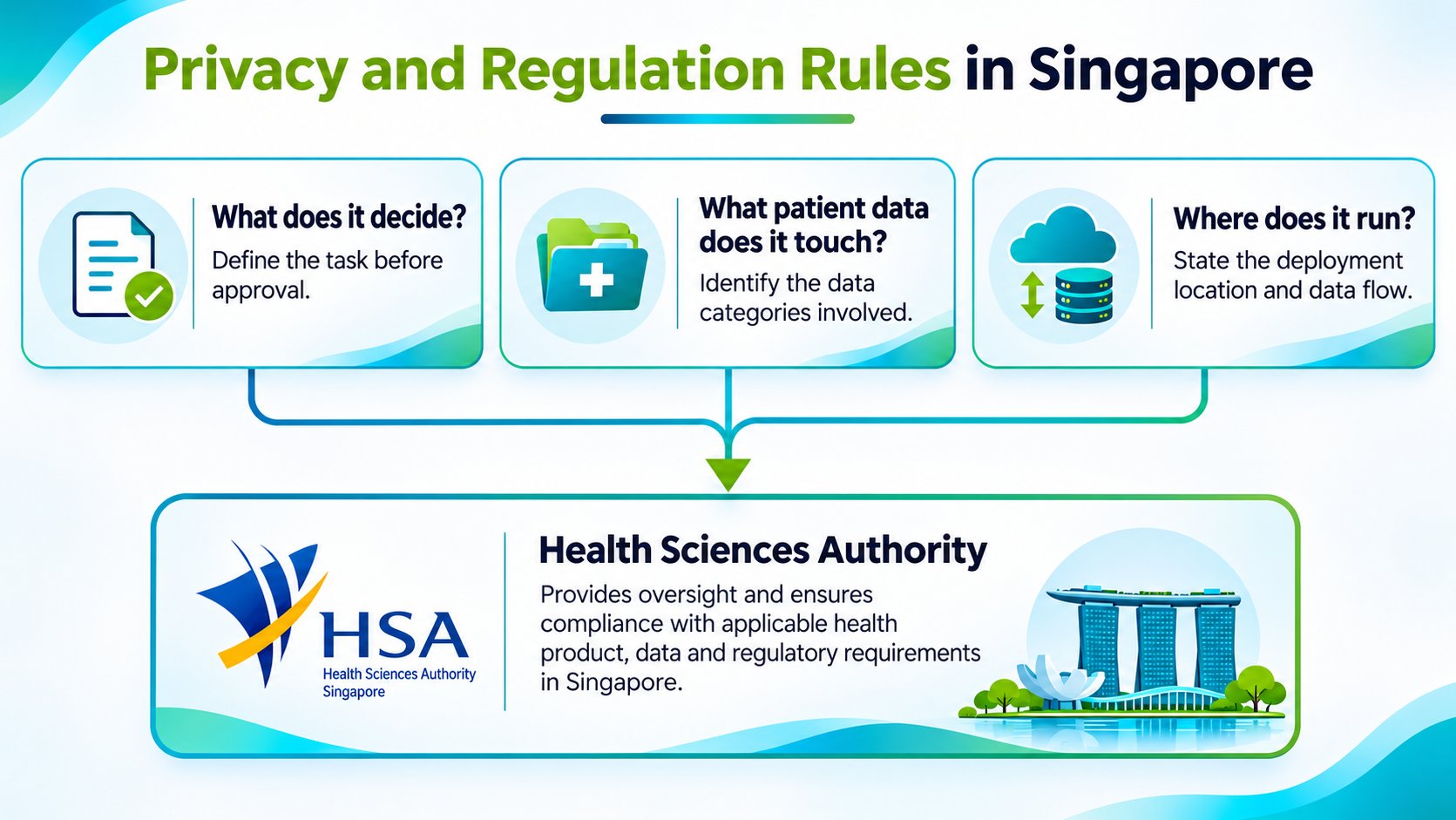
Privacy and Regulation Rules in Singapore
Before a tool goes further, ask: What does it decide? What patient data does it touch? Where does it run? Record the answers alongside its intended users and the consequences of an incorrect output.
The Ministry of Health’s healthcare technology guidance explains that AI used to diagnose, manage or treat medical conditions may fall under Health Sciences Authority medical-device regulation. MOH expects healthcare AI to be safe, clinically effective and cost-effective.
Match the controls to the use
The table below is a practical approval map, not a statement that every tool follows an identical legal pathway. In particular, secure-environment and no-retention requirements should be confirmed for the institution and contract concerned.
Which rules apply to each type of healthcare AI
| AI tool type | Main touchpoint | What you must show or put in place | Who should approve |
|---|---|---|---|
| Diagnoses, manages or treats a condition | HSA medical-device rules | Safety and clinical-effect evidence, documented risk controls | Regulatory lead and deploying clinical leadership |
| Patient-data tool hosted on-premise | Healthcare Services Act and PDPA | Data protection controls, role-based access and an audit trail | Data protection officer and IT security |
| Patient-data tool on third-party cloud | Healthcare Services Act and PDPA | Confirm applicable contractual restrictions on retaining inputs and outputs, and secure-environment access requirements | Legal, procurement and IT security |
| Research on de-identified data | HEALIX and TRUST platform governance | Approved access; TRUST supports analysis without downloading data and deletion after analysis | Data governance committee |
| Administrative tool with no patient decisions | PDPA where personal data is involved, plus institutional policy | Data minimisation, access controls and usage monitoring | Operations and informatics leads |
Build a controlled data lifecycle
HEALIX brings together anonymised clinical, socioeconomic, lifestyle and genomic information for model development and deployment. TRUST supports analysis of de-identified datasets without researchers downloading them, with data deleted after analysis. They serve related purposes, but shouldn’t be treated as interchangeable platforms.
For your organisation, translate that approach into data lineage, reproducible training, controlled releases and documented access permissions. The AI in Healthcare Guidelines provide implementation guidance for developers and healthcare organisations, as MOH’s explanation of AI-based diagnostic solutions makes clear.
Freeform Company’s guidance on how to build a practical AI governance strategy can help organise the internal decision-making around those controls. This is an orientation rather than legal advice; regulatory counsel should confirm the pathway for any patient-facing tool.
How to Choose Your First Healthcare AI Use Case
Start with a workflow problem you can describe without mentioning AI. Unfinished discharge notes, repeated coding corrections or missed appointments are workable starting points because the team can identify the current task and its consequences.
Then score each candidate from one to three, using this as a proposed internal decision method: one means unresolved or difficult, two means manageable with preparation, and three means ready. Score readiness positively so a higher total consistently means a more suitable starting point.
Use a readiness checklist
-
Clinical or operational risk: What happens if the output is wrong, and how quickly would someone notice?
-
Data readiness: Is the information complete, consistently defined and accessible through an approved route?
-
Workflow fit: Where will the result appear, and who can act on it during the same shift?
-
Measurable baseline: Can you measure current documentation time, coding corrections or repeat work?
-
Staff appetite: Do intended users see practical help, or another checking task?
-
Regulatory route: Have you established whether the tool touches diagnosis, treatment or identifiable patient information?
Don’t let the total conceal a serious weakness. An unresolved privacy issue or unacceptable safety risk should block progression even when everything else scores well.
Compare the work, not the demonstrations
Say a clinical-note drafting tool has approved source information, a clear documentation-time baseline and mandatory clinician sign-off. It may offer a manageable starting point, provided the team tests omissions, invented details and medication errors. Calling it administrative doesn’t make it harmless.
A diagnostic imaging tool presents a different proposition. It may offer substantial clinical value, but the team needs representative cases, specialist review and stronger evidence about missed findings before patient-facing use.
A structured AI use-case discovery workshop can give clinical, operations, technology and risk colleagues a shared way to assess those differences.
Choose one workflow with accessible evidence and committed users, rather than several pilots competing for the same clinical time.
How to Validate AI Before Patients Use It
A model can score well in a test and still fail in a clinic. Validation needs to show that it supports a specific task for the patients and staff who will use it, under the conditions they face.
MOH’s account of Singapore General Hospital’s intracranial-haemorrhage programme describes expert neuroradiologists creating slice-level subtype annotations, followed by model training, validation and simulated clinical-environment testing. The sequence matters: define credible reference answers, test performance, then examine how the tool behaves in the intended workflow.
Build a case for the intended use
Start with the evidence, not the headline score. Keep evaluation cases separate from development data, document how experts resolve disagreements, and test cases representative of local patients, including relevant differences in age, ethnicity, disease patterns and clinical sites. Where a subgroup has too few cases, report the uncertainty rather than treating its score as conclusive.
Then test the tool in context. Check screen placement, alert wording, response time and task sequence, including interruptions and incomplete records. For each error type, specify what happens next. A missed haemorrhage and an unnecessary referral carry different consequences and need different responses.
| Measure | What it shows | What it can miss |
|---|---|---|
| AUROC | How well the model ranks cases from lower to higher risk overall | Performance at the threshold used in clinics |
| Sensitivity | The share of true cases the tool catches | False alarms and the staff time they require |
| Specificity and false-positive rate | How often unaffected patients are correctly cleared, and how often they receive false alerts | Misses within a particular subgroup |
| Subgroup performance | How results vary by age, sex, ethnicity and site | Uncertainty when a subgroup has few cases |
| Simulated workflow test | How outputs fit screens and task sequences | Behaviour under real peak-hour pressure |
| Time saved per case | Potential time benefit in the workflow | Time spent checking and correcting outputs |
Distinguish working as specified from fit for care
DevArmor explains verification and validation: verification checks whether software behaves as specified; validation asks whether it is suitable for its intended use. In healthcare, both matter, but passing the first does not establish clinical suitability.
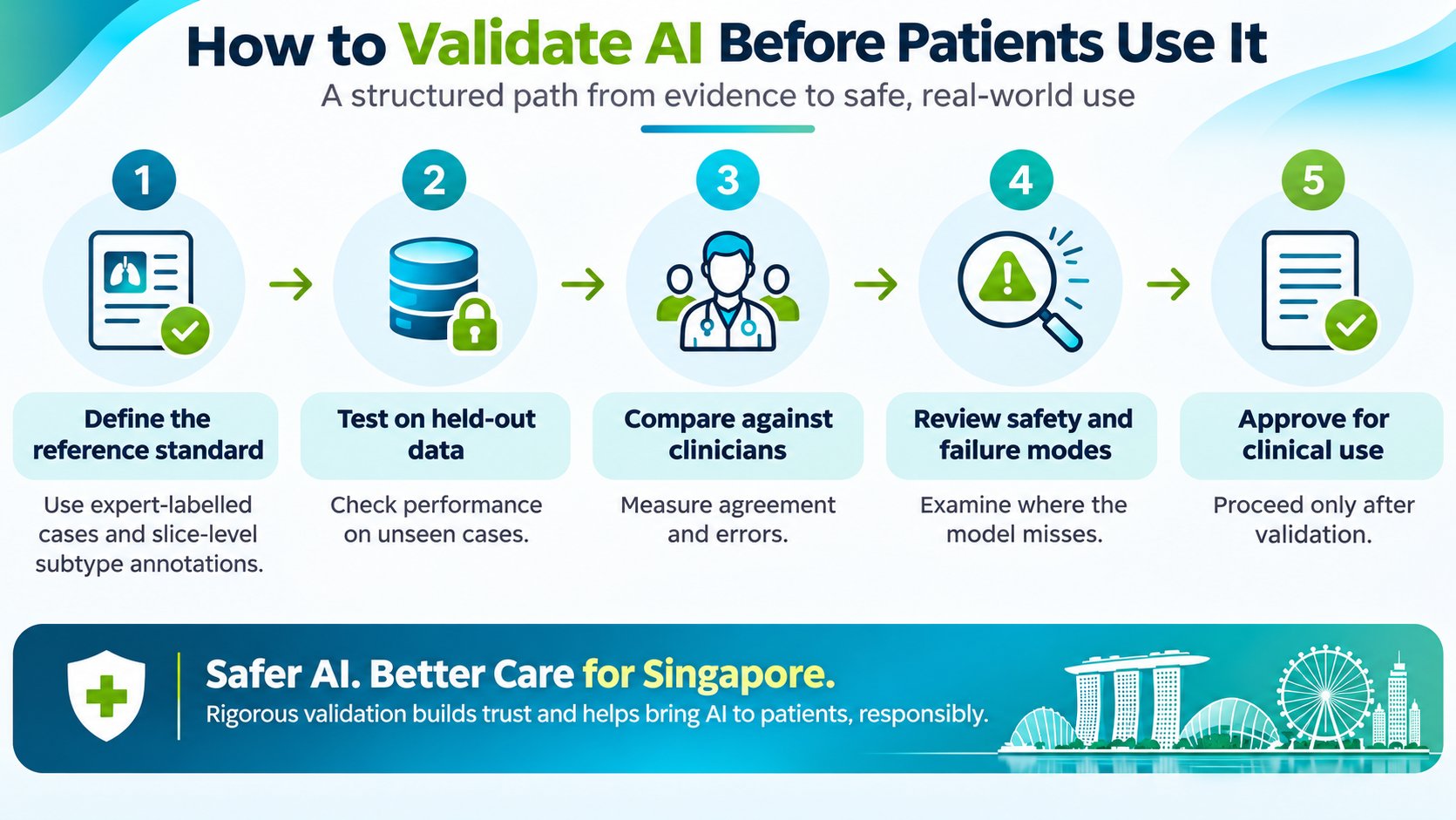
Keep an approval pack with the test evidence, known limitations and unresolved issues. It should make clear what was evaluated, for whom, under which workflow conditions, and what would require reassessment before the tool is used in care.
Who Owns AI Once It Goes Live
The vendor doesn’t become the sole owner of clinical risk because it supplies the software. Healthcare organisations control deployment conditions, and professionals decide how outputs influence care.
MOH’s updated healthcare AI direction places responsibilities across developers, institutions and professionals, including evaluation, multidisciplinary governance, monitoring, incident reporting and preserving professional judgement.
Give people authority, not just responsibilities
Appoint a clinical owner who can pause use, a technical owner who investigates performance and data changes, and a governance group that reviews incidents and release decisions. Give each a deputy and a documented escalation route.
Agree withdrawal triggers before launch. Examples include sensitivity falling below the accepted validation threshold, an unexplained increase in overrides or a cluster of clinically significant near misses. Investigate the pattern rather than assuming every override signals a defective model.
Say a documentation tool starts substituting the wrong name for a commonly prescribed medicine. The clinician rejects the suggestion and reports it; the clinical owner pauses the affected function, while the technical owner preserves the model version and audit evidence. The vendor must investigate the cause, and the organisation assesses whether earlier records need review.
Copy this ownership sheet
| Field | Record before launch |
|---|---|
| Intended use | Permitted task, users and prohibited uses |
| Clinical owner | Named person, deputy and authority to suspend |
| Technical owner | Monitoring duties, support route and rollback responsibility |
| Governance group | Membership, review cadence and release authority |
| Incident route | Reporting channel, urgency categories and investigator |
| Withdrawal triggers | Agreed safety, performance and workflow thresholds |
| Restart conditions | Required evidence, revalidation and sign-off |
Clinicians should be able to override outputs and record a meaningful reason without navigating a cumbersome process. Make reporting easy enough to use during a busy shift.
A useful responsible AI operating approach connects these duties to everyday decisions. Accountability isn’t a committee name on a presentation; it’s knowing who can stop the system and who must make it safe to restart.
Running Costs for Healthcare AI
A coding assistant can shorten the time needed to draft code, while adding review and correction work for senior coders. Budget for the whole workflow: the time saved on drafting and searching may shift into checking, correcting and investigating, with costs falling on clinical, coding, informatics or supervisory teams.
Singapore’s wider AI activity gives context for the demand for workforce capability. The Economic Development Board’s roundup of AI initiatives describes roughly 800 training opportunities over three years, an AI workforce exceeding 6,000 professionals, and plans for up to 500 generative-AI projects benefiting 1,000 enterprises over twelve months. These figures measure economy-wide activity, so they say little about clinical productivity.
Budget for the full workflow
The licence is only one cost. Include:
-
Workflow redesign: Map handovers, exceptions and fallback procedures.
-
Assurance and validation: Fund expert review, test datasets and approval work.
-
Secure infrastructure: Account for integration, access management, logging and recovery.
-
Human review: Set aside staff time for checking and correction.
-
User training: Cover system limitations, escalation and safe handling of patient information.
-
Ongoing operations: Budget for monitoring, incident investigation and revalidation after changes.
For a hypothetical coding deployment, a senior coder reviews every suggestion during the first six months. The tool may prepare codes faster, yet the organisation releases little staff capacity if review and correction absorb most of the time saved.
Budget test: Count the work people stop doing, then subtract the work they must start doing.
Calculate net capacity
Net capacity released = avoided task time − review time − correction time − additional operating time. Track financial costs separately, so leaders can assess staff capacity and cash expenditure without conflating them.
Before launch, record rework, checking time, staff hours and completed-work volume. At a six-month review, compare equivalent tasks and similar case complexity. A quiet baseline period can distort the result if deployment coincides with a busier workload.
Then identify where the benefit lands. Reducing clinician workload while adding a larger burden to coders may be a deliberate operational choice. Report the shift clearly, rather than presenting it as an organisation-wide productivity gain.
Start With One Governed Use Case This Quarter
Choose a workflow with a clear baseline and a named owner. For example, a team considering AI-assisted documentation should specify who owns the workflow, which measures will show whether it helps, and who can pause its use if errors or operating conditions change. Record those decisions before selecting or buying software.
A 90-day rhythm can create focus while leaving room for evidence. The quarter is a planning window, not a promise to launch: higher-risk applications may need a longer evaluation.
Weeks 1–4: Select the use case, confirm the data route, assign owners, and define approval and withdrawal criteria.
Weeks 5–8: Test the workflow in simulation. Review failures with intended users and update the process where needed.
Weeks 9–12: Move to limited use only if the agreed criteria are met. Otherwise, extend evaluation or stop.
At day 90, the accountable owner should decide whether to continue, change the workflow, or withdraw it, based on safety, adoption, workload, and costs.
Agile thinking can accelerate AI adoption by breaking delivery into smaller decisions, with evidence and approval criteria guiding each step.
Ekipa’s AI Strategy & Advisory helps leadership teams turn priorities into governance, execution plans, and 90-day cycles. Bring a specific workflow, its current measures, and the people responsible for it to an initial discussion. The practical transformation blog library offers further reading.
This week, name the workflow owner and agree on the conditions that would pause or end the use case.
Frequently Asked Questions About AI in Healthcare
Does AI replace clinicians?
Not in the applications discussed here. They support screening, interpretation, risk identification or documentation, with professionals reviewing outputs and retaining responsibility for clinical decisions. Design the workflow so human oversight is meaningful, not a hurried approval click.
How long should validation take?
Set the duration based on the evidence required, not a launch deadline. An operational drafting tool may suit a shorter simulated evaluation, while diagnostic applications need enough representative cases to assess important failure modes and patient groups.
What if our clinic has no data team?
Start with a narrowly scoped administrative task and assess whether a vendor-hosted solution can meet your security requirements. Put retention, access, audit logging and incident obligations into the contract, and appoint an internal owner. Outsourcing hosting doesn’t outsource accountability.
Is every patient-facing tool a medical device?
Not automatically. Intended purpose matters, particularly whether the tool diagnoses, manages or treats a condition. Ask regulatory counsel to confirm the classification and approval pathway before deployment, rather than relying on the supplier’s marketing description.
Ekipa helps leadership teams turn AI priorities into governance, practical delivery plans and working use cases, while preparing staff to use them responsibly. Visit Ekipa to discuss one healthcare workflow, its baseline and the ownership needed to move it safely towards production.