

Your operations team has started using an off-the-shelf AI assistant. HR is testing a workflow that recommends how employee requests should be handled, while a product team wants to automate customer eligibility checks. Each initiative sounds reasonable, but nobody can give you a consistent answer about who approves the risks or what happens when the system gets something wrong.
That’s where responsible AI governance becomes practical. Leaders need more than an ethics statement. They need a way to connect AI adoption with everyday decisions, clear responsibilities and evidence that safeguards work.
Why Responsible AI Demands More Than Principles
Consider a typical leadership meeting. A business unit wants permission to expand its AI pilot because employees find it useful. Risk asks what data it accesses, technology asks who supports it, and HR asks whether staff understand its limitations.
These aren’t separate administrative questions. They’re different views of the same operating problem: the organisation hasn’t agreed how AI moves from an interesting experiment into an authorised business capability.
Adoption makes that problem harder to postpone. Singapore business AI adoption rose from 14.5% in 2023 to 19.3% in 2024, while SME adoption increased from 4.2% to 14.5%, according to IMDA’s reporting on enterprise AI adoption. Readily available tools make experimentation accessible, but access doesn’t establish acceptable use.
The real issue is decision quality
A poorly governed system might treat similar customers differently, expose sensitive information or recommend an action that nobody can explain. Even when an output looks sensible, the organisation may lack evidence that anyone checked it appropriately.
Responsible AI means shaping, using and overseeing AI so that its effects are fair, transparent and accountable. Those qualities should influence what teams build, what they permit and when they intervene.
For a busy leader, the useful questions are concrete:
-
Authority: Who can approve this use, and who can stop it?
-
Evidence: What would demonstrate that the system is suitable for its intended purpose?
-
Remedy: How can an affected person challenge an outcome and obtain a meaningful response?
A policy expresses intent. An operating capability shows who acts, what they check and what happens when a check fails.
For CEOs, product managers, operations leaders and learning teams, the task is shared. Governance needs to protect people while giving delivery teams a clear route to useful, authorised adoption.
Understanding Responsible AI Across the Lifecycle
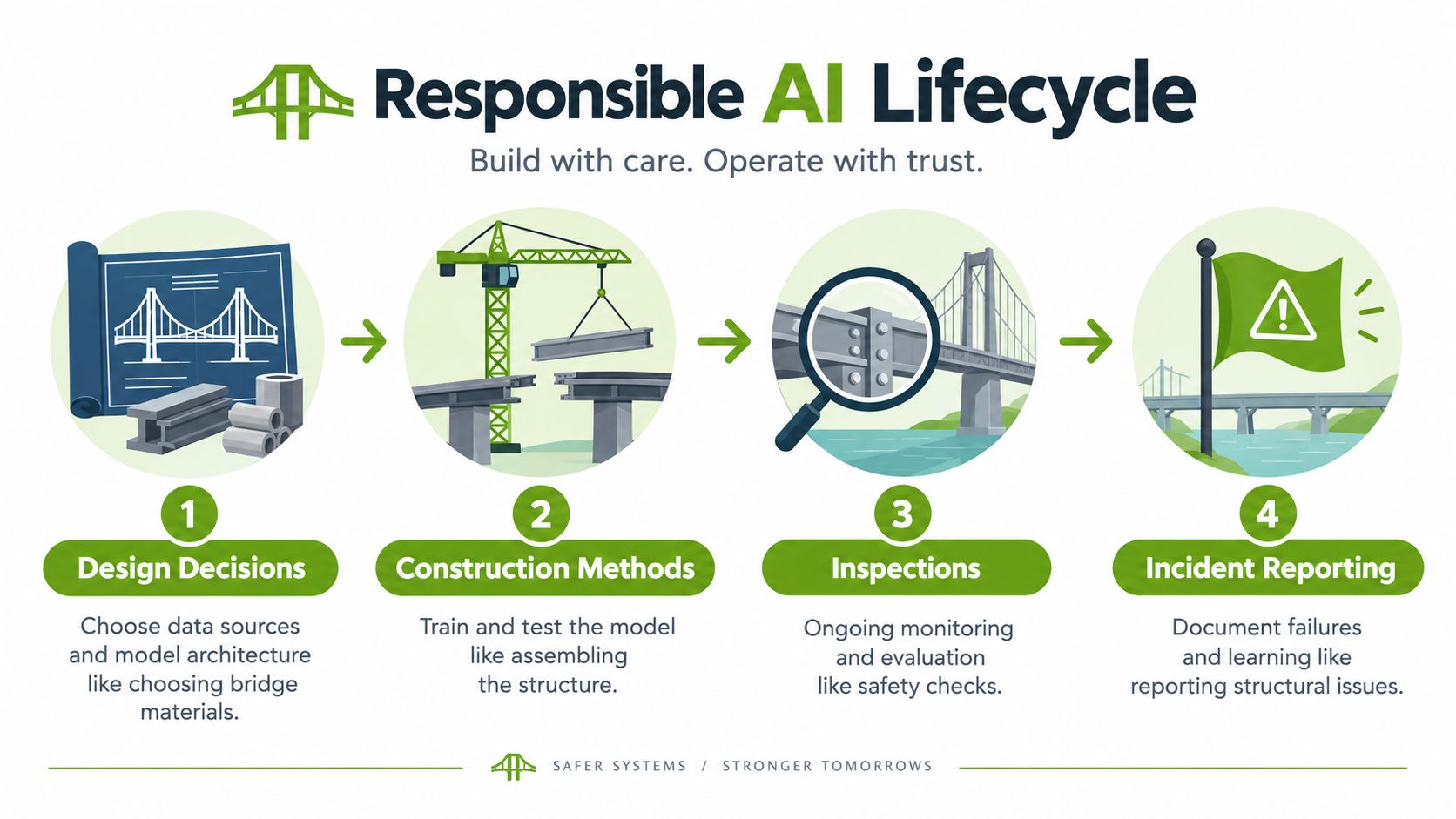
Building an AI system is a little like building and operating a bridge. Good intentions don’t establish whether the structure is safe. Designers choose materials, builders follow specifications, inspectors examine performance, and operators respond when conditions change.
The same distinction applies to AI. An ethics statement describes the standards you want to uphold; a lifecycle approach establishes how people will uphold them during design, testing, operation and eventual withdrawal.
Begin before model development
Start with the purpose, not the technology. A team should explain the problem, who will be affected and why AI is an appropriate option rather than a simpler workflow change.
Data preparation follows. Practitioners need to examine whether records and labels are accurate, complete, relevant and understandable, while distinguishing training, testing and validation activities. These practices are reflected in Singapore’s Model AI Governance Framework.
A data readiness assessment can help teams identify what must change before they commit to development. The useful outcome is a documented view of suitability and limitations, not mere confirmation that data exists.
Keep responsibility intact through change
Development and validation should test whether the proposed system fulfils its purpose within agreed boundaries. Deployment introduces operational questions, including support, permissions and intervention.
The lifecycle continues after release:
-
Monitor actual use: Look for behaviour that differs from the assumptions made during development.
-
Review changes: Reassess material updates to data, models, prompts, integrations or permitted actions.
-
Plan retirement: Decide how to withdraw the system, handle records and move users to an alternative process.
Business owners remain responsible for outcomes. Product and data teams contribute design and evaluation evidence, technology teams operate the service, risk specialists challenge assumptions, and affected stakeholders help identify overlooked consequences.
A useful control passes a simple test: someone applies it, evidence shows whether it worked, and someone escalates when it fails.
Turn Fairness, Transparency, and Accountability into Decisions
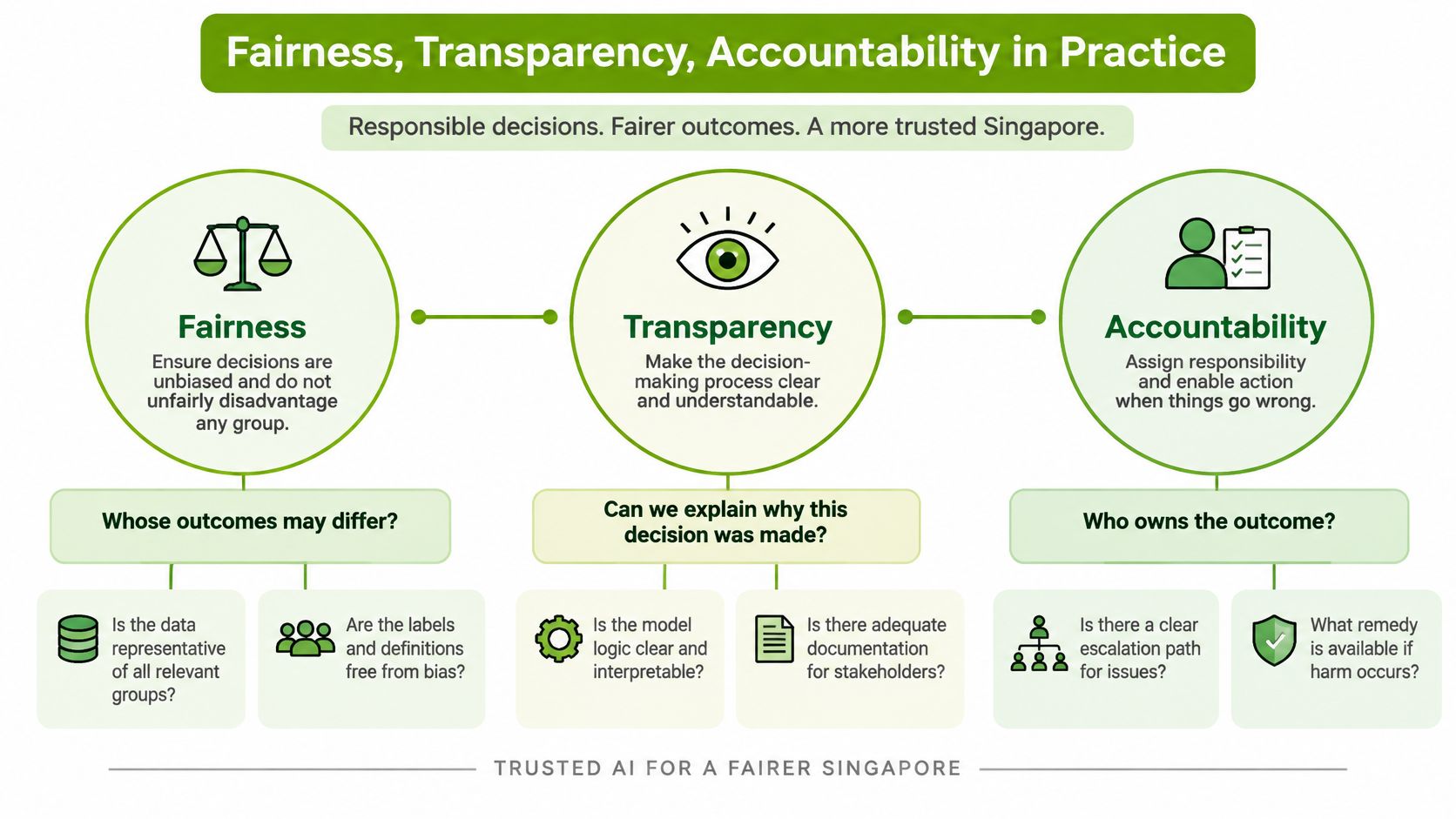
Fairness, transparency and accountability become easier to understand when you attach them to a decision. Consider an AI-assisted employee development process that recommends who should receive additional training. The question isn’t whether the organisation supports fairness in principle, but whether its recommendation process gives people a defensible opportunity.
Fairness starts with whose experience you examine
Ask whose outcomes might differ and whether those differences are justified by the intended purpose. A system trained on previous nominations might reproduce managers’ historical preferences rather than identify employees’ current learning needs.
Teams should examine the meaning of the labels they use. A label such as “high potential” may reflect subjective judgement, so treating it as unquestionable truth would weaken the evaluation.
Practical design questions include:
-
Representation: Whose circumstances are missing or poorly described in the data?
-
Impact: Could an incorrect recommendation disadvantage someone, and how seriously?
-
Challenge: Can an employee supply missing information or request reconsideration?
Transparency should help someone act
Publishing a technical description isn’t enough. Employees need to understand how recommendations influence access to training, what information is considered and where the system may be unreliable.
Managers need a different explanation. They should know which outputs require verification, what evidence to consult and when the system shouldn’t be used.
This is procedural transparency: making the decision process understandable enough for someone to participate in it or question it. It doesn’t require every user to understand model architecture.
Accountability must include the power to intervene
Name the business owner who accepts responsibility for the process. Define who authorises deployment, who investigates disputed outcomes and who can suspend use.
Human oversight must also be meaningful. A manager who has neither time nor information to review a recommendation is likely to become a rubber stamp, regardless of what the policy says.
Practical rule: A reviewer needs sufficient information, time and authority to disagree with the system.
Retain the evaluation results, approval rationale and records of consequential interventions. Together, these make it possible to explain not just what the system produced, but why the organisation considered its use acceptable.
Compare Policy Principles and Operating Controls
A useful way to assess your programme is to ask for evidence from a recent AI release. Don’t start by requesting the governance presentation. Ask the team to show how it handled a difficult decision.
A policy-only programme will usually produce statements of commitment. An operational programme should also produce test results, decision records and examples of people acting within defined responsibilities.
From Responsible AI Principle to Evidence
| Principle | Policy statement | Operating evidence |
|---|---|---|
| Fairness | We avoid discriminatory outcomes. | Relevant subgroup evaluation, documented data limitations and a route for reviewing disputed decisions. |
| Transparency | We explain our use of AI. | Role-specific disclosures, understandable limitations and records showing how consequential decisions were reached. |
| Accountability | We have an AI policy owner. | Named business, technical and risk responsibilities, approval records and a tested escalation route. |
The distinction isn’t between paperwork and no paperwork. Useful documentation supports action: a reviewer can find the applicable test result, understand an exception and decide what to do next.
A polished policy with no operational records offers little help when a customer disputes an outcome. Equally, a folder of test results is incomplete if nobody has authority to respond.
Match control depth to consequences
An internal writing assistant and a system influencing insurance eligibility shouldn’t face identical approval requirements. Their possible consequences, technical uncertainty and degree of organisational reliance differ.
Use proportionate controls:
-
Lower-impact use: Establish a clear purpose, approved information boundary and responsible owner.
-
Consequential use: Require deeper validation, explicit approval conditions and a defensible review process.
-
Uncertain use: Restrict the scope until the team can produce enough evidence to support a decision.
The most revealing question is often what happens when a check fails. If the team continues unchanged because a deadline is approaching, the check isn’t functioning as a release gate.
Responsible AI governance doesn’t mean treating every experiment as a major regulatory programme. It means making the level of assurance deliberate and recording why that level is appropriate.
Build Governance That Works Across the Enterprise
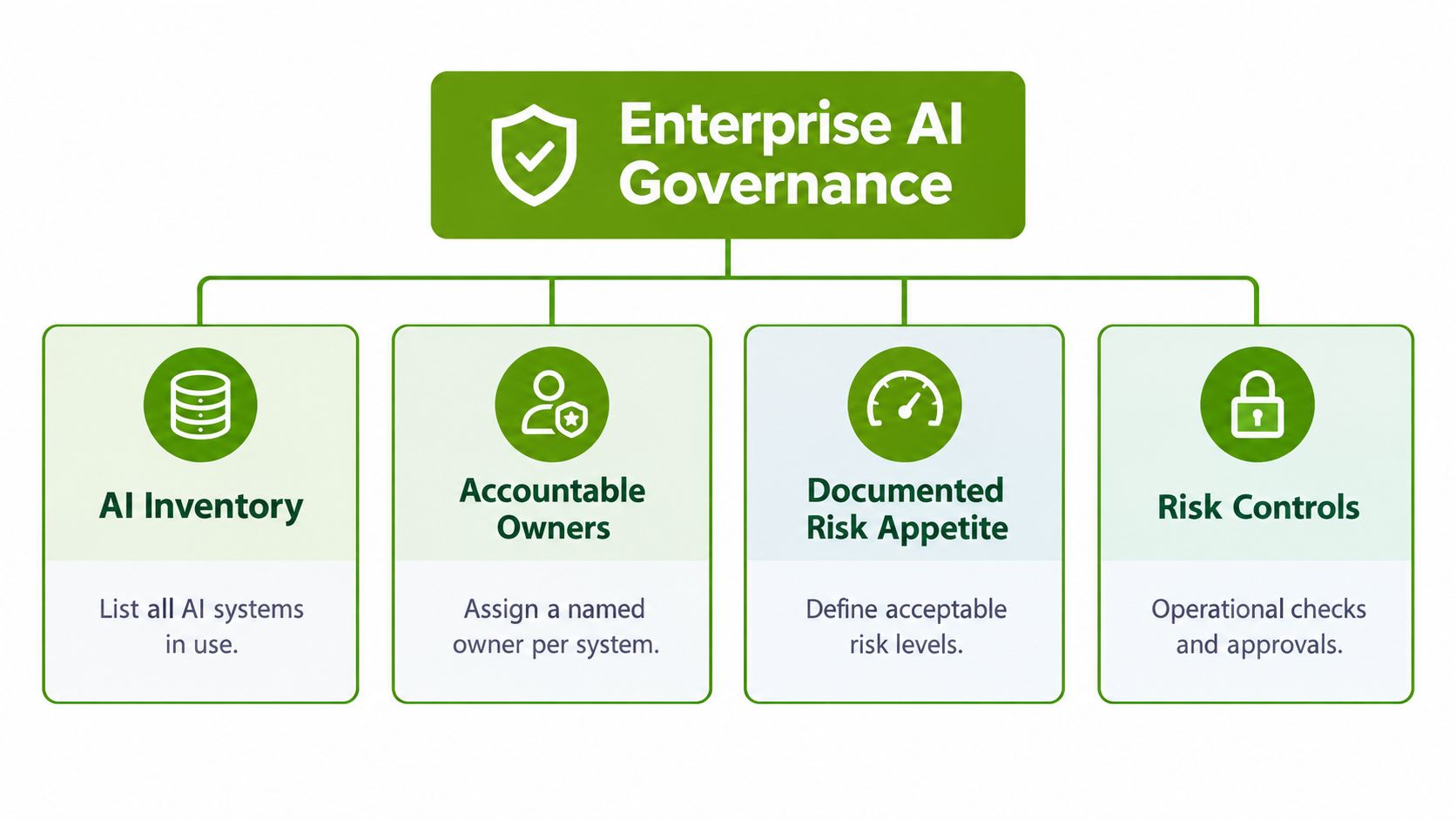
You can’t govern AI use that nobody has identified. Begin with an AI inventory covering internally developed systems, purchased capabilities and AI embedded within existing business applications.
For financial institutions, MAS’s AI risk management guidance identifies firm-wide inventories and risk-materiality assessments based on impact, complexity and reliance, alongside lifecycle controls. Those dimensions provide a useful structure for enterprise discussions about where scrutiny should be strongest.
Make the inventory useful for decisions
Give each system a distinct record that connects its purpose with ownership, dependencies and approval status. Include the people affected, information accessed, actions permitted and monitoring arrangements.
Risk appetite should describe boundaries that teams can apply. “We accept limited AI risk” is too vague; a statement that an assistant may draft correspondence but cannot send customer commitments without review is actionable.
Classification should happen before deployment. Evaluate:
-
Impact: What could happen to customers, employees or operations if the system fails?
-
Complexity: How difficult is it to understand, test and manage its behaviour and integrations?
-
Reliance: How dependent is the business process on its output, and is a workable fallback available?
Use the assessment to set approval thresholds, testing depth and monitoring intensity. A classification has little value if it doesn’t change what the team must do.
Connect approval with operation
Before release, examine data quality, known limitations, evaluation coverage and the human-review arrangement. Define what constitutes an unacceptable result and who decides whether an exception is permissible.
After release, monitoring should address the use case’s actual risks. Relevant signals might include incorrect outputs, differences in affected groups’ outcomes, reviewer overrides, incidents and material changes in system behaviour.
Change management matters because an approved configuration isn’t permission for unlimited expansion. New data access or permission to execute actions should trigger reassessment.
For another practical resource when designing these routines, consider Applied’s governance best practices, alongside your organisation’s applicable requirements.
Third-party assessment should establish what the provider tests, what it discloses and what your own team must verify. For financial institutions, the MAS-aligned explanation of FEAT responsibilities makes clear that firms remain responsible for models they use even when developed externally.
Contracting out development doesn’t remove the need for internal authorisation, oversight or a response when something goes wrong.
See Responsible AI in Everyday Workplace Decisions
Consider an illustrative employee-facing assistant that recommends how managers should allocate work. In a weak implementation, it has broad access to staff information, users receive the same short demonstration, and employees aren’t told how to question its recommendations.
A manager might accept an unsuitable allocation because it appears authoritative. An employee with lower digital confidence might struggle to challenge it, while another finds an alternative path around the system.

Change the working conditions, not just the guidance
In a more responsible implementation, leaders restrict access to necessary information and exclude sensitive decisions from automation. Managers learn how to examine recommendations, while employees receive an accessible explanation of the process and a clear challenge route.
Workforce readiness deserves deliberate attention. 82% of Singaporean workers expressed interest in additional training to use AI at work, according to the Singapore AI Opportunity report.
That interest should translate into role-specific practice rather than a generic awareness session:
-
Employees: Practise recognising limitations and raising concerns without needing technical vocabulary.
-
Managers: Rehearse rejecting an unsuitable recommendation and recording their reasoning.
-
Support teams: Learn how to distinguish a usability issue from an incident requiring escalation.
Check language, accessibility and digital-literacy barriers. Ask staff to demonstrate how they would question an outcome, rather than merely confirm that they attended training.
Raise the threshold when customers bear the risk
Now consider an illustrative fraud-detection workflow. Flagging a transaction for investigation differs from automatically restricting a customer’s access.
The latter demands stronger evidence and approval because the intervention itself can cause harm. Reviewers need relevant context, a route to restore access and authority to correct the outcome.
Training helps people use safeguards. It doesn’t replace permissions, testing or restrictions on what a system can do.
Monitor overrides and complaints as learning signals, not automatic evidence of employee resistance. They may reveal an unsuitable recommendation, unclear instructions or a process that doesn’t accommodate real working conditions.
Adopt AI Through Evidence-Based Delivery Cycles
Treat governance work as part of the product backlog. If testing, approval and handover sit in a separate workstream, teams can reach a delivery deadline without the evidence needed to release safely.
A short delivery cycle should produce both a useful capability and a defensible decision about its use. The sequence below is a practical starting point, not a claim that every use case needs identical documentation.
Define the decision before building the solution
Write a use-case record that identifies the problem, affected stakeholders, permitted purpose and accountable owner. Include exclusions so the team can distinguish a useful extension from an unauthorised change.
Then assess the data and any external dependencies. Produce a dataset limitations note and a record of unanswered provider questions, rather than hiding uncertainty in meeting minutes.
Translate the risk assessment into backlog items:
-
Design controls: Specify information access, permitted actions and required human involvement.
-
Evaluation report: Record test conditions, results, unresolved limitations and acceptance decisions.
-
Release evidence: Attach the approval rationale, operating boundaries and conditions that must remain true.
Acceptance criteria should describe observable behaviour. “The assistant handles sensitive information responsibly” is difficult to test; “the assistant cannot retrieve records outside the user’s authorised access” gives the team a concrete control to verify.
Release with an operational handover
An approval gate should answer whether the evidence supports the proposed scope. If uncertainty remains, reduce that scope, add safeguards or postpone release rather than treating approval as a formality.
Before handover, the receiving business team should demonstrate that it can:
-
Operate: Find monitoring information and recognise an unacceptable result.
-
Respond: Follow an incident routine, preserve relevant evidence and contact the decision-maker.
-
Recover: Suspend the affected function or use the agreed fallback.
-
Improve: Turn incidents and review findings into prioritised changes.
An incident record should capture what happened, who was affected, what action was taken and what needs to change. A short rehearsal can expose gaps that a written procedure doesn’t reveal.
AI strategy and advisory, enablement workshops, coaching and structured 90-day delivery cycles are options for teams that need support connecting leadership decisions with execution. The same connection underpins Agile thinking for AI adoption: work in manageable increments, inspect evidence and adjust deliberately.
The specialist project team shouldn’t remain the only group capable of operating the controls. Handover is complete when accountable business teams can sustain the practice themselves.
Build a Responsible AI Capability That Keeps Improving
Responsible AI maturity isn’t a certificate awarded when the policy is finished. A useful progression is from initial policy, to repeatable use-case controls, to monitored operations, and then organisation-wide learning.
At the earlier stages, teams establish expectations and apply them consistently. At later stages, leaders use operational evidence to revise training, delivery practices and investment decisions.
Choose a concrete next move
Bring your next AI use case to a leadership discussion and identify:
-
An inventory gap: A capability whose actual use isn’t clearly recorded.
-
An ownership gap: A consequential decision without an agreed accountable person.
-
An evidence gap: A safeguard described in guidance but not demonstrated in practice.
Choose the gap that most affects your ability to make a sound release or operating decision. Assign an owner and agree what evidence would show that it has been addressed.
Use the insights hub’s discussion of AI training and workforce capability to examine whether people can carry out the responsibilities you’re assigning. Governance, delivery and workforce learning need to reinforce one another.
The durable outcome is straightforward: fairness, transparency and accountability become visible in everyday choices, operating routines and retained evidence.
Ekipa offers AI strategy and advisory, training, coaching and delivery support to help teams turn governance expectations into working practices. Visit Ekipa to discuss a specific AI use case, identify the controls it needs and plan how your team will demonstrate that they work.