

Starting at the Edge
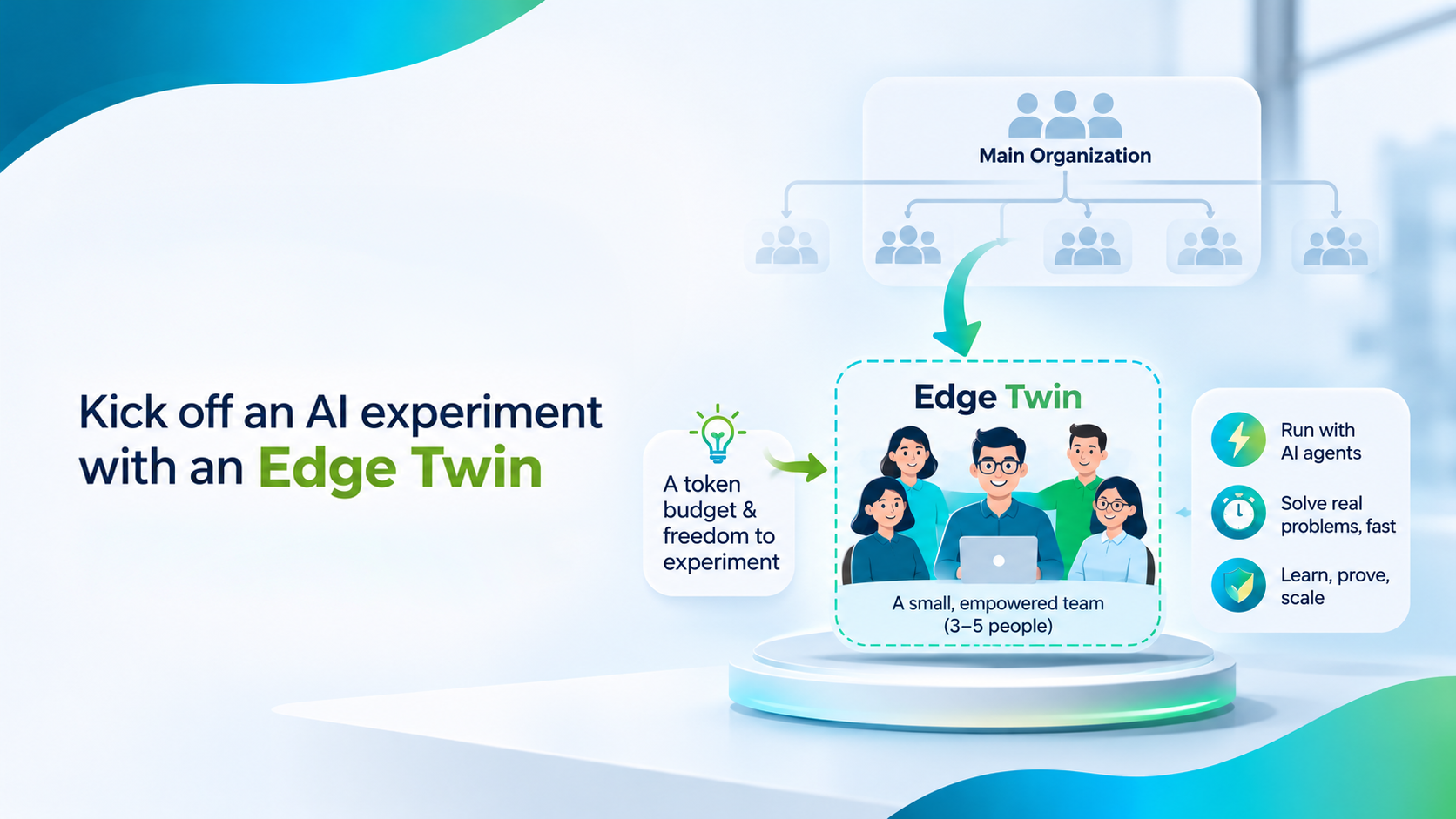
The book’s answer to where a large company should start is something it calls an Edge Twin.For a company with more than fifty people, you look for the function where the most time goes into passing work between people instead of actually making decisions. Then, you set up a team of three to five people at the edge of the organization. That team runs the function the new way - with agents doing the coordinating - and proves it works before any process moves over from the main company. I like this idea because a handful of people and a single function is an experiment I can actually imagine a director asking a board to fund.I am a strong believer in this kind of model. Give a company a small team of rebels with freedom, a token budget, and room to play, and let them try out new things. That team could take specific customer problems and use AI to solve them in hours or days. Or it could be an enablement team that figures out the tools first, then goes around the organization fixing things that are broken so people actually save time.Of course, a team like that also looks very familiar. During our years of agile consulting and team transformation work across Indonesia and Southeast Asia with Ekipa, we ran pilot teams, and the results were always mixed. The outcome usually depended on whether a senior leader actively protected the pilot. I see no reason an Edge Twin would escape that reality. In fact, it would probably need even more protection than an agile pilot did, because besides working faster than the teams around it, it quietly exposes which coordination roles the company might no longer need at all.
The Missing Pieces

I would also want to know who those five people are. In my last piece, I wrote that most companies here don't have people inside who can do the enabling. An Edge Twin needs people who are significantly further along than that. They need to work with agents every day and be able to explain to a risk team why an algorithm is allowed to make a certain call. Whether a bank's compliance and risk teams would let such a team run in the wild is another open question. The book has a detailed governance section, with every agent decision tracing back to a named human owner, and I suspect that part would interest a local bank a lot more than the grand vision does.I don't know whether companies here can skip a step.One version says you go through the slow work first: get people comfortable with AI one at a time, build the governance, learn where the work piles up, and only then redesign the organization around what you’ve learned.The other version, the one my belief in rebel teams pulls me toward, says that three years of enablement inside an unchanged structure just gives you fast people waiting on slow approvals, and the companies that started a small team working the new way will be miles ahead by then.What my years doing agile tell me is that whichever version a company picks, it will need a senior leader willing to protect the people trying it out. And looking at a book or a conference panel, I still can’t tell you how many of those leaders Southeast Asia has.