

Your service team built a chatbot on a free trial in March. It answers product questions well enough that the team lead wants it in production. Marketing has meanwhile bought its own writing assistant, finance is testing invoice matching, and nobody can tell the board which of the three matters most for revenue or risk.
That’s the situation behind most searches for AI strategy consulting. The tools aren’t the problem. The problem is that nobody owns the decision about which use case gets the next budget, who signs off when a model touches a customer, and what happens to the work when the adviser leaves.
The hard part of an AI strategy isn’t choosing models. It’s ownership, governance and handover after the roadmap is approved. What follows is what that work involves, the stages it runs through, the readiness checks that decide whether it holds, and one test you can run on your own plan before you spend another dollar.
What AI Strategy Consulting Covers and Why Leaders Need It

AI strategy consulting is the work of deciding where AI fits your business goals, what you need in place to run it safely, and how the chosen use cases reach the people doing the daily work. It’s done by an adviser, internal or external, who sits between the board’s priorities and the delivery team’s backlog.
The difference between a deck and something usable is unglamorous and decisive. A deck describes ambition. A usable strategy names a use case, an owner, a budget line, a risk tier and a date.
Being early is normal. Staying early is not. A 2025 survey of 350 Singapore business leaders found that 68% of businesses remained in the early stages of AI adoption, according to Milieu Insight. In practice, “early” usually means several experiments running at once with no shared decision about which one gets scaled.
Four kinds of people end up looking for this help: a founder with three stalled pilots and no spare hours, an HR or L&D manager asked to plan upskilling for a strategy nobody has written down, a product or operations leader already running AI in one workflow and asked to scale it, and a transformation lead who inherited someone else’s pilot.
What a clear strategy provides you:
-
Fewer overlapping pilots and licences. Two departments buying the same category of tool is a budget leak and a data-handling problem at the same time.
-
A shared view of which use cases matter. Revenue, risk or neither, written down once, so the argument happens in the right room.
-
Clearer ownership when something stalls. A named owner with a date beats a steering committee with a roadmap.
-
Budget decisions on evidence. A scored shortlist with baselines survives a CFO review better than a good demo does.
None of that appears if the strategy stays in slides. You get the cost of the exercise and none of the change. The stages, readiness checks, scoring and governance that follow all serve one purpose: making the ownership question answerable. For a wider view of how regional teams handle adoption, the Ekipa insights archive carries practical write-ups on the work after the plan is signed.
How AI Strategy Engagements Are Structured
Businesses buy AI strategy help in one of three shapes. Knowing which one you need saves a quarter of the budget and a lot of goodwill.
The diagnostic sprint
A few weeks of work. The adviser runs the business assessment, builds a long list of candidate use cases with the people who run the work, and returns a scored shortlist with a board-ready recommendation. This is the right purchase for a founder or CEO with several stalled pilots and no agreed priority.
The roadmap and governance engagement
This adds a phased roadmap, named owners, risk tiers, and the evidence each use case must produce before it scales. It suits a regulated firm that already has tools in use and needs the portfolio, the controls and the reporting to hold together. Risk and audit functions belong in the room from week one, not at sign-off.
The implementation partnership
The consultant works alongside your first delivery teams, mentors them through one or two 90-day cycles and then steps back. Buy this when the plan is approved, and the delivery capacity isn’t there yet.
Most engagements that hold together use both an internal and an external hand: an internal lead who owns the backlog permanently, and an adviser who brings pattern knowledge from other sectors and can say what usually goes wrong at stage four.
Before you sign anything: ask who owns the backlog on the day after go-live. If the answer is a role that doesn’t exist yet, you’re buying a dependency rather than a capability.
Three questions sort the good providers from the rest:
-
Who owns the backlog after go-live?
A name and a role, written into the statement of work.
-
What gets measured, against which baseline?
If the baseline isn’t captured before the build, the value conversation never happens.
-
How is handover written into the contract?
Documentation, a shadowing period and a named internal successor, not a closing workshop.
The Six Stages of an AI Strategy From Assessment to Evaluation
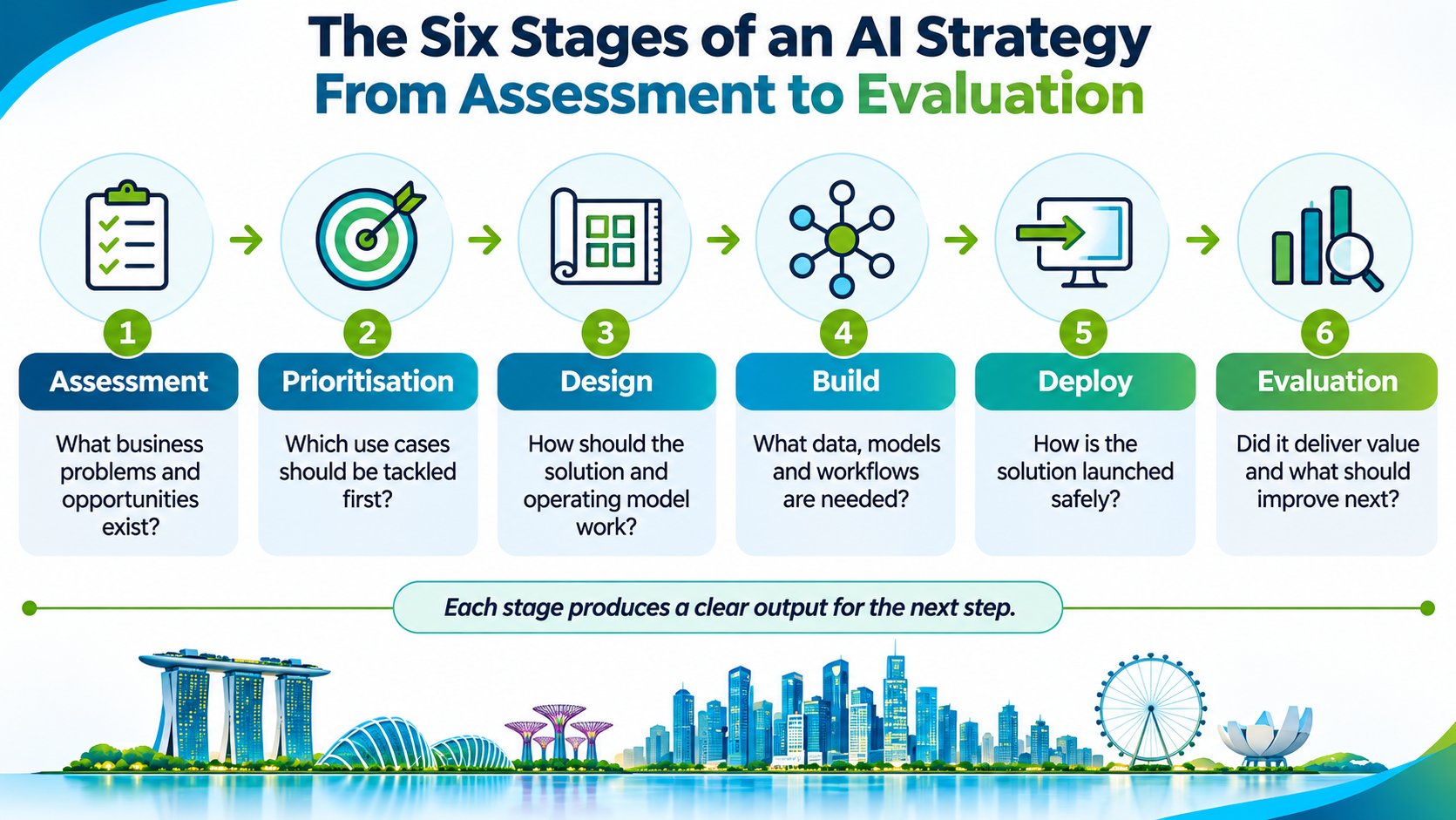
Six stages show up in almost every engagement. The order matters more than the labels, because each stage produces the evidence the next one needs.
Here’s the sequence as a leadership team should see it, with the artefact you should be holding at the end of each stage.
| Stage | Question it answers | Typical output |
|---|---|---|
| Business assessment | Where does the business hurt, and what AI is already in use? | Current-state review of processes, tools, data and skills |
| Opportunity identification | Where could AI change a metric or a workflow? | Long list of candidate use cases with business owners |
| Prioritisation | Which use cases deserve scarce time and budget first? | Scored shortlist on value, data readiness, risk and effort |
| Roadmap development | In what order, with which owners and what budget? | Phased roadmap with milestones and named owners |
| Implementation | How does a shortlisted use case reach production? | 90-day cycle, delivery backlog and a production path |
| Evaluation | Did it deliver, and should it scale, change or stop? | Results against baseline and a recorded decision |
Assessment and opportunity identification
The business assessment looks at four things: how work is done today, which tools are already in use, what the data can support, and who has the skills. Ask specifically about tools bought outside IT. Shadow purchasing is where most duplicate spend hides.
Opportunity identification builds the long list with the people who run the work. A two-week listening round that produces 30 candidates beats a facilitated session where five senior people invent five ideas. The long list is supposed to be untidy.
Prioritisation and roadmap
Prioritisation ranks that list against value, readiness and risk, and writes the reasoning down so it can be challenged later. Roadmap development then sets sequence, owners, budget and dependencies: data, integration, hiring and any regulatory sign-off. A milestone with no person beside it is a wish.
Implementation and evaluation
Implementation takes one use case through a 90-day cycle, with production acceptance metrics agreed before the build starts. Evaluation compares the result with the baseline and records one of three decisions: scale, change or stop.
Expect the loop to turn faster than the plan says. Evaluation results often reshape priorities within a quarter, which is why the roadmap should be re-scored quarterly rather than locked for two years.
The expensive mistake is skipping assessment and starting with tools. Teams that buy first end up with roadmaps built on data nobody has checked, and the failure surfaces at integration, months later, when the sponsor has already told the board it’s working.
The test: for each of the six stages, can you name a person, a date and a measure? A stage that can’t answer all three isn’t a stage; it’s a heading.
Checking AI Readiness Across Data, Infrastructure and Skills
Adoption data tells you where your organisation sits, not where the strategy says it sits. AI adoption among SMEs more than tripled from 4.2% in 2023 to 14.5% in 2024, while adoption among non-SMEs rose from 44.0% to 62.5% over the same period, according to the IMDA Singapore Digital Economy Report.
The same report describes a ladder rather than a single category: 84% of AI-adopting firms used off-the-shelf generative AI tools, 52% adopted domain-specific AI-enabled solutions, and 44% implemented customised or proprietary tools. Every rung up demands stronger data architecture, security, governance and measurement.
-
Data: The warning sign is that nobody in the room can name the owner of the customer table or say when it was last checked. Your one-week check: trace a single dataset behind your top use case from source to report, scoring telemetry completeness and freshness as you go, the way monitoring data quality sets it out. If the lineage breaks, fix that before any model work starts.
-
Infrastructure: The tell is that every pilot needs a custom integration and nothing gets reused. Ask the last delivery team how many systems it touched and whether any connector or pipeline became reusable. If the answer is no, you’re paying for the same plumbing twice.
-
Technology: Licence sprawl and no agreed way to evaluate a model. Pull every AI tool invoiced in the last 12 months and compare the list with what IT believes is in use. The gap is usually two or three tools wide.
-
Skills: The sign is that nobody can say who reviews model output, or on what grounds a manager overrides it. Ask three team leads to describe the last time they disagreed with a system and what they did next.
The people side is planned at scale, not left to chance. More than two-thirds of AI-adopting firms planned to prioritise workforce training and upskilling within one to two years, and 63% expected to redesign jobs to integrate AI into daily operations, the same IMDA report found. Value sits in workflows and capabilities, not in the model you licence.
Engagements that work begin by mapping the client’s own context instead of applying a template. A bank’s constraint is data lineage and model risk; a manufacturer’s is sensor data, shift patterns and a plant system nobody wants to touch. A structured AI readiness assessment is usually the cheapest way to find out which of the four gaps is yours. The decision that follows isn’t which gap is worst. It’s which gap, closed in a quarter, enables the most use cases.
Finding and Ranking AI Use Cases That Pay Off
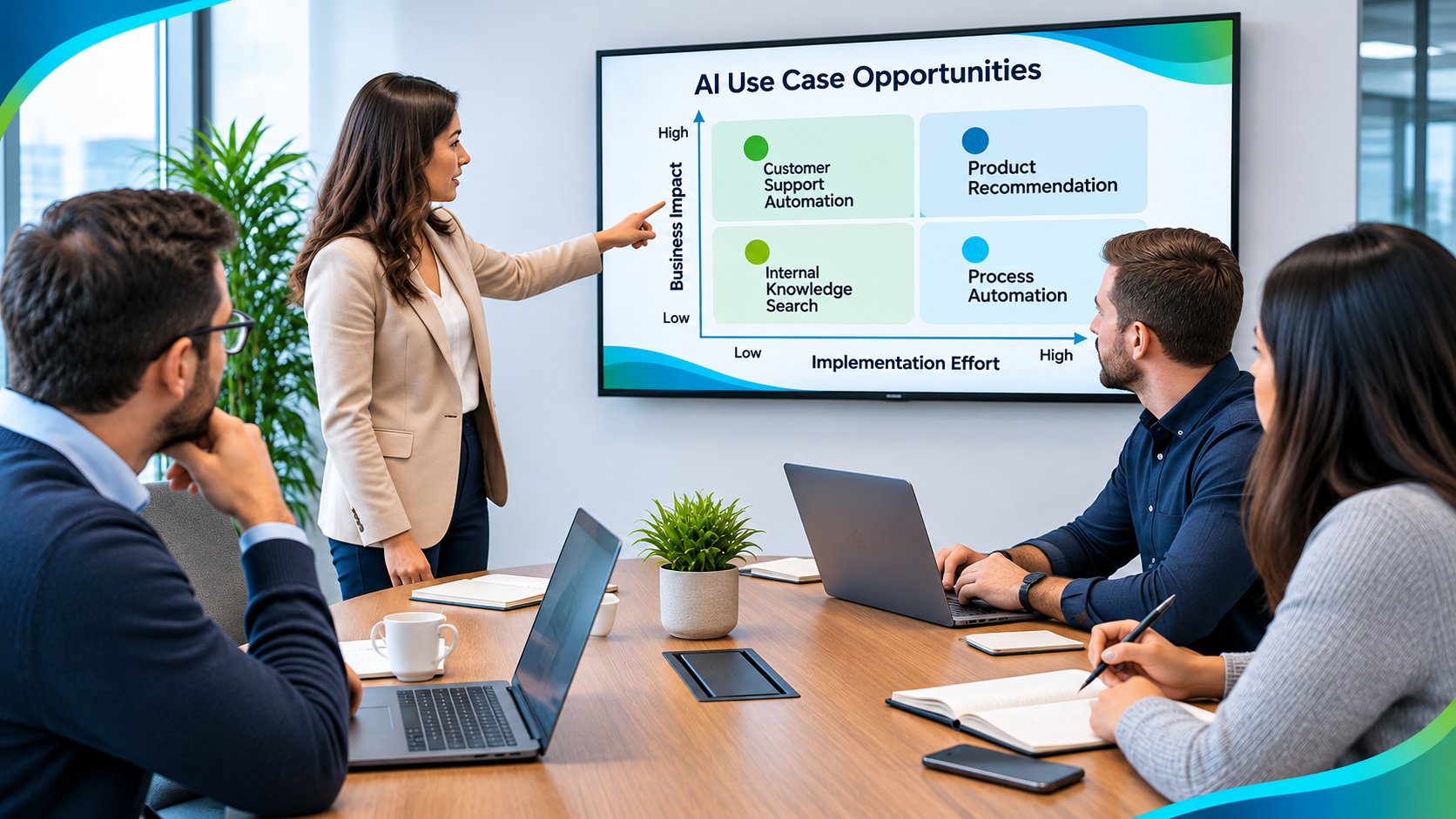
Use cases are not equal, and the exciting one is rarely the one that pays.
Four families of AI work
Generative AI drafts, summarises and answers. A customer service team uses it to produce first-pass replies that a person edits before sending, which cuts handling time without removing accountability.
Machine learning classifies, matches and recommends. An insurer uses it to route incoming claims to the right assessor queue, which reduces misrouting and shortens the queue for straightforward cases.
Automation removes repetitive steps between systems. Finance uses it to match invoices to purchase orders and route exceptions to a human, which is dull work that used to consume a week each month.
Predictive analytics forecasts demand, churn or equipment failure. An operations team uses it to plan stock for the next eight weeks, replacing a spreadsheet that was rebuilt by hand every quarter. Where the asset rather than the customer is the subject, the Ekipa notes on AI in manufacturing cover how forecasting and scheduling use cases are scoped and scored.
Score, then argue with evidence
Score each candidate from 1 to 5 on value, data readiness, integration ease, risk and reuse, then add the scores.
| Use case | Value | Data readiness | Integration ease | Risk (5 = lowest) | Reuse |
|---|---|---|---|---|---|
| Shared customer-data pipeline | 3 | 4 | 2 | 4 | 5 |
| Churn prediction model | 5 | 2 | 3 | 3 | 1 |
| Generative reply drafting | 4 | 3 | 4 | 2 | 2 |
The totals are 18 for the shared customer-data pipeline, 15 for generative reply drafting and 14 for churn prediction. The pipeline wins even though it’s the least exciting line on the page, because the same governed data serves service, IT and risk. Scores like these are illustrative; replace them with your own evidence before anyone signs a budget.
The case for shared foundations gets stronger as the portfolio widens. IMDA found that AI-using non-SMEs had implemented AI across an average of five business functions, against three for SMEs, in its Singapore Digital Economy Report. Five functions is a platform problem, not five separate projects.
Demand hasn’t peaked either. AI adoption among all enterprises rose from 14.7% in 2024 to 23.5% in 2025, according to IMDA, and the share of firms planning to adopt within 12 months more than doubled to 12.1% in 2025. Intent that grows without a delivery backlog becomes a queue of disappointed sponsors. If your use cases sit on a plant floor rather than in a browser, documented factory AI implementations are worth reading before you score, because they show what integration really costs.
An approved strategy turned into a prioritised plan a team can start on right away is the handover we aim for at Ekipa. The test is whether someone can pick the top item off the list on Monday and know what done looks like.
First cycle rule: no more than three use cases, each with a named owner and a delivery backlog. Anything more is a list, not a plan.
Governance, Privacy and Responsible AI for Regulated Firms
Scheduling governance for the end of the project puts it at the wrong end.
A drafting assistant used internally to tidy meeting notes is a low-risk productivity tool. The same assistant, once someone points it at customer correspondence, becomes customer-facing content with a conduct risk attached. Nothing about the model changed. The use did.
The proposed MAS Guidelines on Artificial Intelligence Risk Management would require financial institutions to treat AI governance as an ongoing management discipline rather than a one-off policy exercise. The proposal covers board and senior-management oversight, AI inventories, risk-materiality assessments, policies and procedures, lifecycle controls and organisational capabilities, and expects institutions to identify AI usage across the firm and assess risk by impact, complexity and reliance. It’s a consultation proposal, not yet in force, which is exactly why the inventory work is worth starting now.
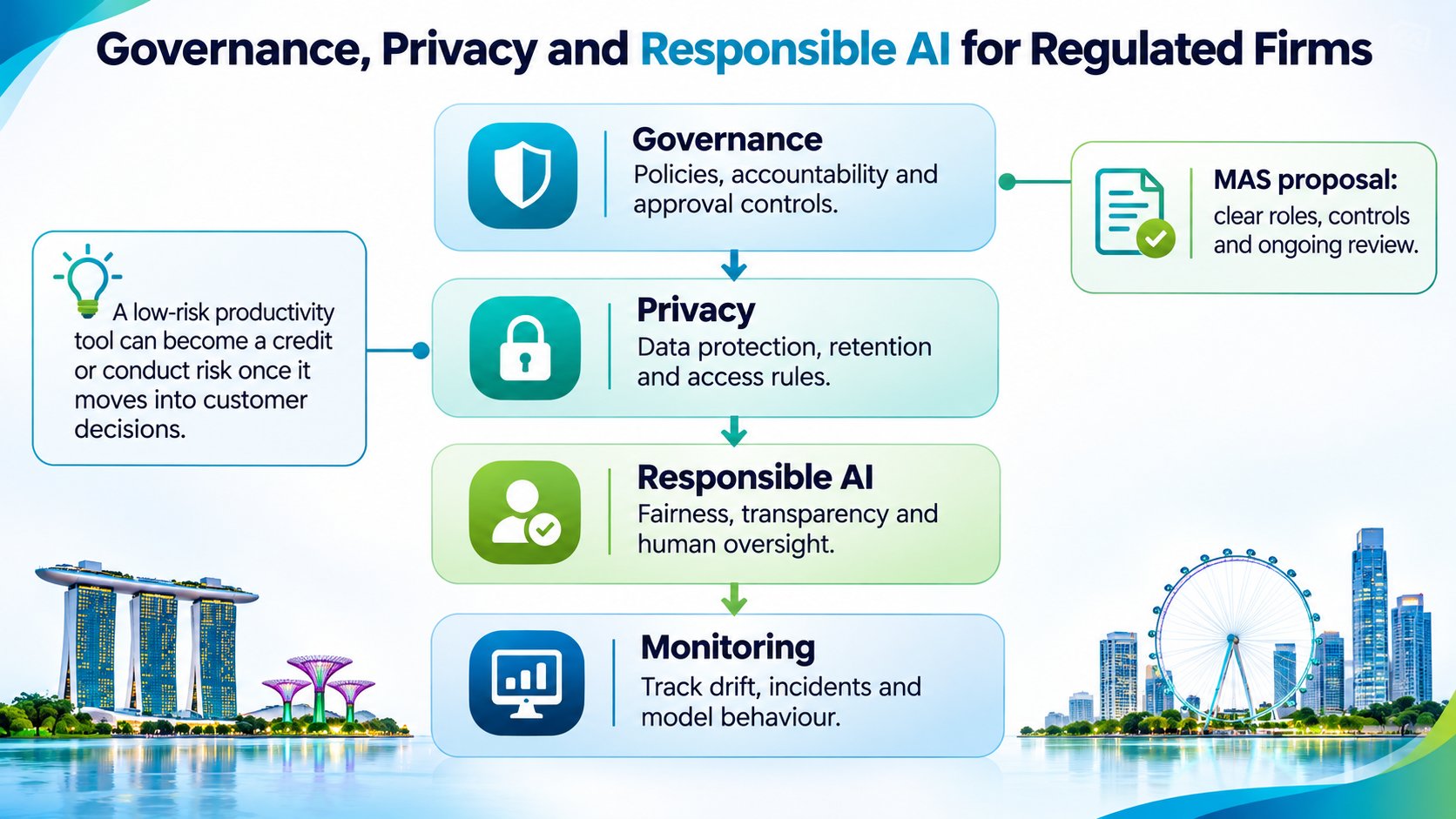
Risk tiering is what makes proportionality practical.
| Risk tier | Example use case | Controls and evidence | Sign-off |
|---|---|---|---|
| Low (internal productivity) | Drafting meeting notes with an approved tool | Approved tool list, data-handling rule, usage log | Team lead |
| Medium (customer-facing content) | Chatbot answering product questions | Pre-launch testing, human escalation path, live monitoring | Business owner and risk function |
| High (decision support) | Credit or claims decision support | Inventory entry, fairness and explainability tests, change control, human override | Senior management and risk committee |
Where the sequencing goes wrong
Inventory first, tier second, evidence third. Firms that write the policy first end up with a document that describes no system they run. The guidance names the control areas that matter: data management, fairness, transparency and explainability, human oversight, third-party risk, testing, monitoring and change management. Teams drafting their first version of those controls get further, faster, by starting with the practical guidance on responsible AI and adapting it to their own risk appetite.
A separate AI committee is often the wrong first move. MAS supervisory expectations on responsible AI adoption allow firms to use existing governance structures where those provide adequate oversight and cross-functional coordination. Add a layer only if the existing one can’t see the work.
What changes when a third-party model is involved
Concentration risk moves to versioning and change. Prompts, model versions and evaluation sets need the same change control as code, because a silent provider update can shift behaviour in a workflow nobody re-tested.
Keep one distinction clean in your own documents. The regulator’s expectations set a floor for how risk is identified and evidenced. Your firm’s risk appetite decides how much more you require, and that’s a board choice, not a compliance one.
One question to settle this week: which of your live AI use cases has no named owner and no inventory entry?
Adoption Challenges and What Worked in Practice
Plans rarely fail because the model was wrong. They fail on four ordinary things, and each one has a tell.
Cost shows up as pilots that never receive production budget. The team keeps the demo alive because stopping feels like waste, and nobody will fund the dull half: integration, monitoring, support. Tie every pilot to one business metric and a go or stop decision at 90 days, and funding becomes a conversation about evidence instead of faith.
Skills gaps show up as tools bought and barely used. A company-wide briefing on what AI is doesn’t change how a claims assessor handles a draft reply; role-specific training for daily users does. Participation in AI-related training programmes rose from 39.0% of digital-skills upgrading activity in 2024 to 58.1% in 2025, and mid-career residents aged 40 to 49 accounted for 35.6% of AI-related training participants, according to the Ministry of Manpower. That’s existing staff, which is where enablement budgets belong.
Privacy and security concerns stall projects in legal review because the data rules were never agreed. Settling retention, permitted data categories and what may never enter a prompt before the build starts. Legal then reviews a design instead of a surprise.
The people problem sits under all three. Managers are asked to lead a change they didn’t start, with no new decision rights. Coaching helps more than another licence, because someone has to show a team lead when to override the system and who to escalate to.
Take an illustrative composite. A mid-sized insurer has three pilots: a chat widget, a document summariser and a claims triage model. None has an owner below director level, each uses a different vendor, and all three have been nearly ready for six months. Give each one an owner, one metric and a 90-day review with three permitted outcomes: scale, change or stop. Two will stop. The third finally gets funded because someone can show a baseline.
Structures that survive handover look like the work Ekipa did with a Malaysian bank’s Strategic Management division, where three agile ways of working pilot teams were initiated and mentored rather than handed a document. Leadership alignment comes first, delivery second, then a defined handoff so internal teams keep momentum after the adviser exits.
What worked, in one line: small pilots, named owners, a written handover plan, and a senior person who agrees in advance to stop things.
Measure AI Results and Choose Your First Move
Tool counts and training completions prove people were busy. They don’t prove the business is better off.
| Measure | What it shows | How to measure it |
|---|---|---|
| ROI | Return on the money spent | (Benefit minus total cost) divided by total cost, over 12 months |
| Productivity | Output per person or per team | Volume or cycle time before and after, with the same team |
| Efficiency | Cost or effort removed from a process | Cost per transaction or hours per case |
| Business impact | Change in a metric the board tracks | Revenue, retention, error rate or loss linked to the use case |
| Adoption | Whether people actually use the tool | Active users and share of the workflow that runs through it |
Each measure needs a baseline captured before launch. A baseline reconstructed after go-live is a negotiation, not a measurement.
Say a claims team handles 40,000 cases a year and average handling time falls from 12 minutes to 9. That saving is three minutes across 40,000 cases, so 120,000 minutes, or 2,000 hours. At an illustrative loaded cost of $30 an hour, that’s $60,000 of released capacity. If the programme cost $45,000 across 12 months, the ROI is $60,000 minus $45,000, divided by $45,000, which is 33%. The arithmetic matters less than the discipline: baseline, benefit, total cost, same period.
Count the whole cost. Licences, integration, the internal time of the people building and reviewing, monitoring and support after launch all belong in the denominator. Teams that count only the licence fee report spectacular returns and then can’t explain why headcount never moved.
Before you pick the first 90-day priority, hold these five items:
-
A named business owner who attends the review and can stop the work.
-
A baseline metric captured this month, not rebuilt from memory later.
-
A risk tier with the evidence that tier requires attached to the backlog item.
-
A confirmed data source with an owner and a quality check.
-
A written handover plan naming who runs the use case when the build team moves on.
Ekipa’s AI Strategy & Advisory work exists for this exact step: a structured planning session with leadership to turn an approved plan into 90-day cycles with named owners, using a roadmap planning session to identify where delivery bottlenecks.
Common Questions About AI Strategy Consulting
What does AI strategy consulting cover?
It covers where AI fits your business goals, which use cases get funded first, whether data and skills can support them, and how risk is controlled through delivery. A good engagement ends with an owned backlog rather than a document.
How long does a first AI strategy take?
A diagnostic sprint usually runs a few weeks, and a roadmap plus governance engagement takes about a quarter. What stretches timelines is data access and risk sign-off, not analysis.
Does a small firm need a consultant?
Often not for the document, but yes for the second question: which single use case to fund. A small team can score three use cases in an afternoon; what it usually lacks is someone to say no to the other twenty.
Which of your current AI use cases has no owner?
If your plan is approved and the delivery has stalled, Ekipa works with leadership teams in Singapore, Jakarta and Kuala Lumpur to turn strategy into 90-day cycles with named owners, risk tiers and measurable milestones. The team is deliberately small: consultants, coaches and facilitators, with Bridge Global engineers joining when a use case reaches a build, and engagements run from leadership alignment through to handoff so your own people carry the momentum afterwards. Visit Ekipa to see how that works in practice.