

Say your claims team at a mid-sized Singapore insurer leaves a two-hour prompt session energised. People produce polished drafts and promise to use AI every day. Within three weeks, they’re back in their old spreadsheets because nobody defined where AI belongs in the claims workflow.
That’s the problem with generative AI training built around a workshop rather than a change in work. The useful question isn’t whether employees enjoyed the course. It’s whether they can perform an agreed task safely, consistently and independently after the trainer has gone.
Meta title: Generative AI Training That Sticks | Ekipa
Meta description: Design role-based generative AI training with practical labs, clear guardrails and a 90-day pilot that measures sustained workplace behaviour.
Suggested URL slug: generative-ai-training
Primary keyword: generative AI training
Related keywords: role-based AI training, enterprise AI adoption, AI workforce upskilling, AI workflow training
Why Generative AI Training Stalls After the Workshop
The claims team didn’t need another collection of clever prompts. It needed decisions about which documents employees could upload, who checked the draft and whether the spreadsheet remained the official record. Without those decisions, returning to familiar routines was sensible.
In a 2025 ABBYY survey of 1,200 senior managers and above at companies with at least 100 employees, 40% of Singaporean business leaders found training generative AI models harder than expected, the same proportion found integration into business processes difficult, 26% of Singapore respondents said employees had introduced GenAI for personal productivity rather than through management-led initiatives, and 47% said bring-your-own-software adoption influenced investment decisions.
Model training and workforce training solve different problems, but the integration gap carries over. Showing people what a tool can produce doesn’t settle how the organisation should use it.
The two mistakes to stop making
- Treating attendance as success: A full classroom proves participation, not that employees can complete a controlled task without help. The test is what happens on the third Tuesday back, when deadlines are tight and the trainer has gone.
- Teaching tools without a task: A demonstration leaves employees to invent their own workflow, approval rules and quality standards. Each person improvises differently, so output quality varies and nobody can say which version is right.
At Ekipa, we believe the technology is the easy part of AI adoption. Getting an organisation to work differently is harder because managers must change responsibilities, protect practice time and resolve competing priorities.
A good workshop ends with a convincing demonstration. A good training programme ends with a team that no longer needs the trainer.
Start with the workflow, then build the curriculum, practice labs, safeguards and measurement around it. Keep the initial commitment small enough to test through a pilot.
How to Design Generative AI Training in Six Steps
A team can leave a lively GenAI workshop, reopen the same inbox on Monday, and slide back into the old approval path within two weeks. The programme has failed before anyone touches a prompt. Design for the behaviour that must survive contact with normal workload, deadlines and review pressure.
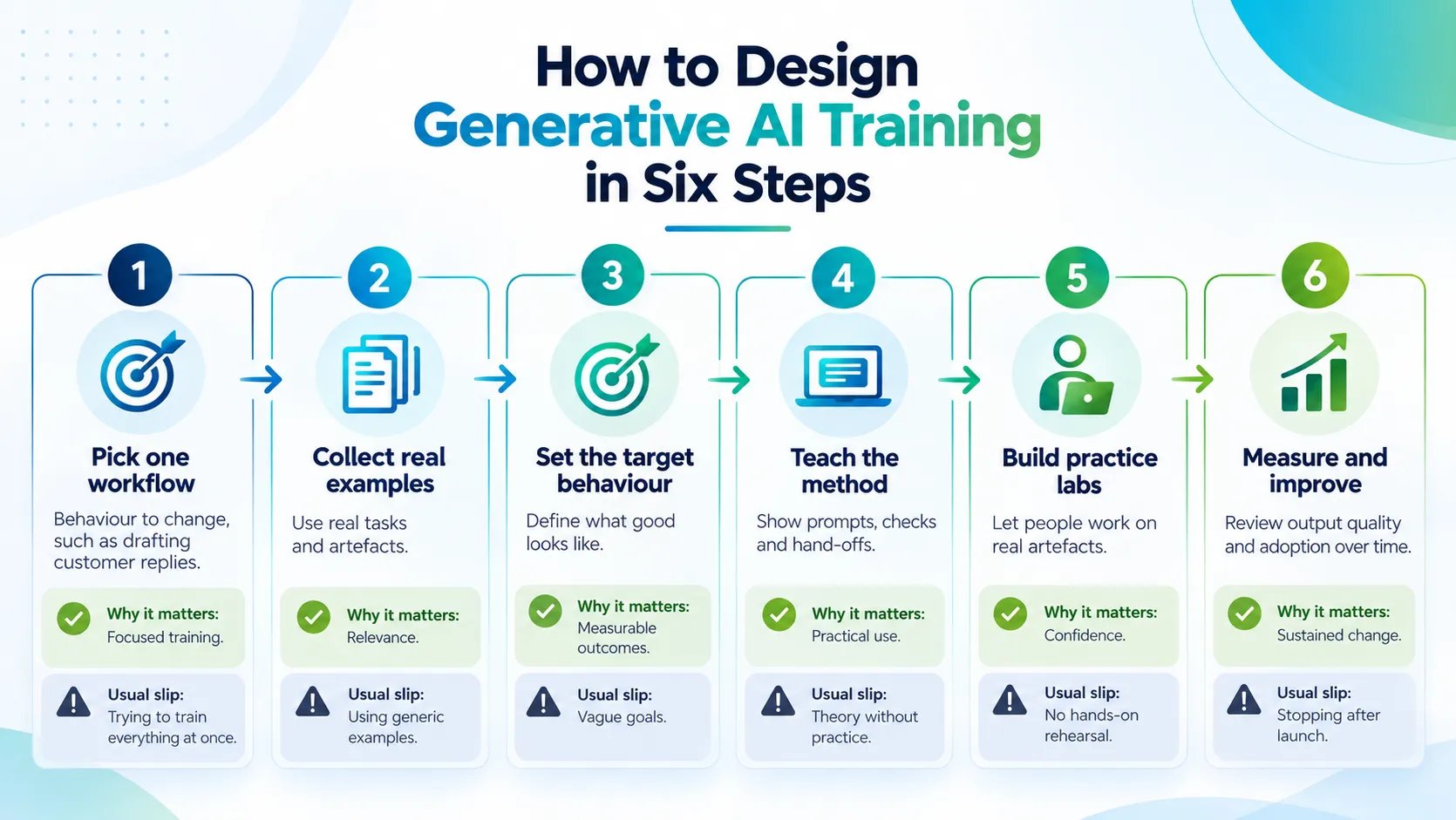
Turn the intention into a working programme
-
Choose one bounded workflow and name the behaviour. Pick a task with a clear owner, such as drafting customer replies or summarising supplier contracts. Define what “done” looks like in that workflow: the output produced, the check applied and the person who releases it.
-
Write objectives a reviewer can observe. “Drafts a reply, redacts restricted data and checks the AI output against the policy checklist before sending” can be inspected. “Understands generative AI” cannot. State the action, the conditions and the evidence.
-
Map responsibility before content. Separate executive decisions, daily use and technical delivery so each group practises the decisions it owns. The role-based curriculum map below turns that split into learning paths.
-
Build labs from anonymised work samples. Use real artefacts with messy exceptions, missing context and borderline cases. A tidy demo teaches recognition; an awkward sample teaches judgement.
-
Set guardrails before practice begins. Approve permitted data, tools, review gates and escalation routes while the lab is still on paper. Controls introduced after an incident feel optional to the people who have to follow them.
-
Capture the baseline before training. Record current task quality, cycle time and error rates once, so later checks have something honest to compare against. The 30, 60 and 90 day measurement approach is covered below.
These are shared design decisions that cut across departments. The sponsor chooses the business priority and clears obstacles. The team lead defines the task and protects practice time. The training lead turns that task into exercises and assessment, while risk or IT approves the operating boundaries and a named process owner signs off release into daily work.
Practical rule: If nobody owns the workflow after the course, delay the launch until they do.
Role-Based Curricula That Match Real Responsibilities
Singapore’s national AI skills framework distinguishes AI Users, who apply generative AI to workplace tasks, from AI Practitioners, who develop, deploy and manage AI solutions. That distinction provides a useful starting point for enterprise learning pathways.
Role mapping also helps employees understand what they need to learn: an AWS-commissioned Access Partnership survey of almost 15,000 employees and nearly 5,000 employers across nine Asia-Pacific economies, including Singapore and Malaysia, found that 71% of workers didn’t know which AI skills they needed.
Role-based curriculum map
| Role | Core focus | Lab example | Evidence it worked |
|---|---|---|---|
| Executives and boards | AI governance, investment priorities, approved tool policy | Score a use-case shortlist for value and risk | Approved roadmap and tool policy in place |
| Managers and team leaders | Workflow redesign, review rules, escalation paths | Re-plan a weekly report with an AI draft and review gate | Team runs the workflow without weekly coaching |
| Frontline staff (AI Users) | Safe prompting, output checking, data handling | Draft and check a customer reply using redaction rules | Reviewed outputs need fewer corrections over time |
| Product managers and analysts | Use-case design, evaluation criteria, workflow integration | Compare two prompt versions against a rubric | Use case moves from pilot to stable workflow |
| Practitioners (AI Practitioners) | Integration, evaluation, deployment controls | Build a retrieval-based FAQ tool and test it on a golden set | Evaluation results logged before each release |
| Data and IT teams | Data pipelines, access controls, monitoring | Connect a document source while enforcing permissions | Access rules enforced and logs reviewed weekly |
Executives shouldn’t spend their learning time completing the same prompt labs as frontline staff. Their exercises should expose investment trade-offs, accountability gaps and decisions about acceptable risk.
Frontline employees need repeated practice checking outputs against source material more than they need model theory. Practitioners need deeper evaluation and integration work because their decisions affect systems used by other people.
The table is a starting point, not a fixed organisational chart. A product manager approving financial recommendations may need stronger risk training than a technically proficient colleague building an internal drafting aid.
Ask the sponsor to adjust the pathways around regulated tasks, decision authority and workflow exposure. Assess people on what their role requires, not on whether they can reproduce the trainer’s best prompt.
Guardrails and Safety Checks in Every Lab
An overall accuracy score can hide a serious failure. A tool might improve across routine questions while becoming less reliable on local terminology, minority languages or high-risk exceptions.
The AI Verify framework pairs technical tests with process checks, including examples that assess factual correctness in a Singapore context. That gives a training programme a stronger basis than judging whether an answer sounds convincing.
Test the process as well as the answer
Create a versioned golden test set: representative cases with agreed reference answers or scoring criteria. Include local institutions, terminology and relevant regulatory material, with domain specialists validating the expected response.
Score the tool before and after changes. Run adversarial exercises for prompt injection and data leakage, review sampled failures, fix the cause and rerun the same benchmark before release.
Report results by use case and risk category. Keep failed prompts as regression tests so a later change can’t reintroduce a known problem.
Guardrails, training exercises and owners
| Guardrail | What it looks like in practice | Lab exercise | Owner |
|---|---|---|---|
| Confidential data handling | Rules on which data can enter which tool | Redact a claims file before prompting | Team lead |
| Human approval gate | Named reviewer signs off before output leaves the team | Approve or reject a draft client letter | Process owner |
| Audit logging | Record AI-assisted outputs with prompt and tool version | Trace a faulty answer to its prompt | Risk or IT |
| Prompt-injection awareness | Recognise hostile document text attempting to override instructions | Spot an injected instruction in a supplier PDF | Security team |
| Approved tool list | Permitted tools mapped to data sensitivity classes | Classify three sample tasks by sensitivity | Compliance |
| Failure register | Preserve failed prompts as regression tests | Add one failed case to the golden set | Training lead |
Every row needs a named owner, and the name matters more than the control itself. A guardrail assigned to a function rather than a person tends to survive the workshop and then disappear. Owners should rerun their check at set points in the 90 days after training, because the behaviour you are measuring is whether the check still happens when nobody is watching.
For assistants connected to systems, include permission boundaries in the exercise. The material on preventing agent privilege escalation is relevant when learners need to distinguish permission to read information from permission to take action.
Use responsible AI principles to connect these controls to daily decisions rather than leaving them in a policy document. Regulated firms should align the exercises with their supervisor’s expectations and internal requirements before any lab uses live data.
Hands-On Labs Built Around Real Work
Bring the work into the classroom, with sensitive fields removed. Last month’s customer emails, meeting notes and supplier summaries reveal ambiguities that polished demonstration examples leave out.
Removing names alone may not be enough. Check attachments, account references, distinctive circumstances and document metadata before adding an artefact to the training pack.

Use different labs for different capabilities
A task lab teaches draft, check and correct. Say a procurement team at an energy firm rewrites supplier evaluation summaries. Learners compare every AI summary with the source contract clauses and record each mismatch, including qualifications the summary omitted.
A workflow lab tests hand-offs. The team redesigns how a supplier assessment moves from analyst to procurement manager. Learners must decide where the AI draft enters the process, who checks contractual claims and what happens when the source documents disagree.
A failure lab builds judgement. Give learners incomplete meeting notes containing contradictory dates and an unsupported commitment. A successful response identifies the uncertainty and asks for clarification instead of producing a confident but invented action plan.
Don’t make the facilitator rescue every learner immediately. Let people attempt the task, explain their checking method and compare corrections before introducing a stronger approach.
Prepare a lab pack people can reuse
- Task brief: Define the user, intended output and decision the work supports.
- Source pack: Supply approved documents with sensitive information removed.
- Scoring rubric: Separate factual correctness, completeness, clarity and policy compliance.
- Expected pitfalls: Include likely omissions, misleading inputs and escalation triggers.
- Named reviewer: Assign someone with authority to accept or reject the result.
For example, a pilot could use two 90-minute labs a week for four weeks, each followed by a 15-minute debrief. Treat that as a proposed working rhythm, not a universal training prescription.
Record what failed during each debrief and change the next exercise accordingly. Practice time is only useful if the team learns why an output failed, rather than merely replacing it with a better prompt.
At Ekipa, our coaches work on how teams change their routines, while embedded experts build AI or data alongside them; we then hand over so client teams can operate independently. Where the task itself remains unclear, structured AI use-case discovery helps connect the learning exercise to a business decision worth testing.
Measuring Behaviour Change at 30, 60 and 90 Days
The Singapore AI Opportunity report reports that 82% of surveyed Singapore workers expressed interest in additional AI-use training, while far fewer have attended AI-related training in the preceding year. Interest creates an opening, but neither demand nor attendance proves that work has changed.
Start with a baseline task-quality score and cycle time captured before the first lab. Train on controlled cases, then run blind evaluations in which reviewers don’t know whether an output came from the baseline or the trained workflow.
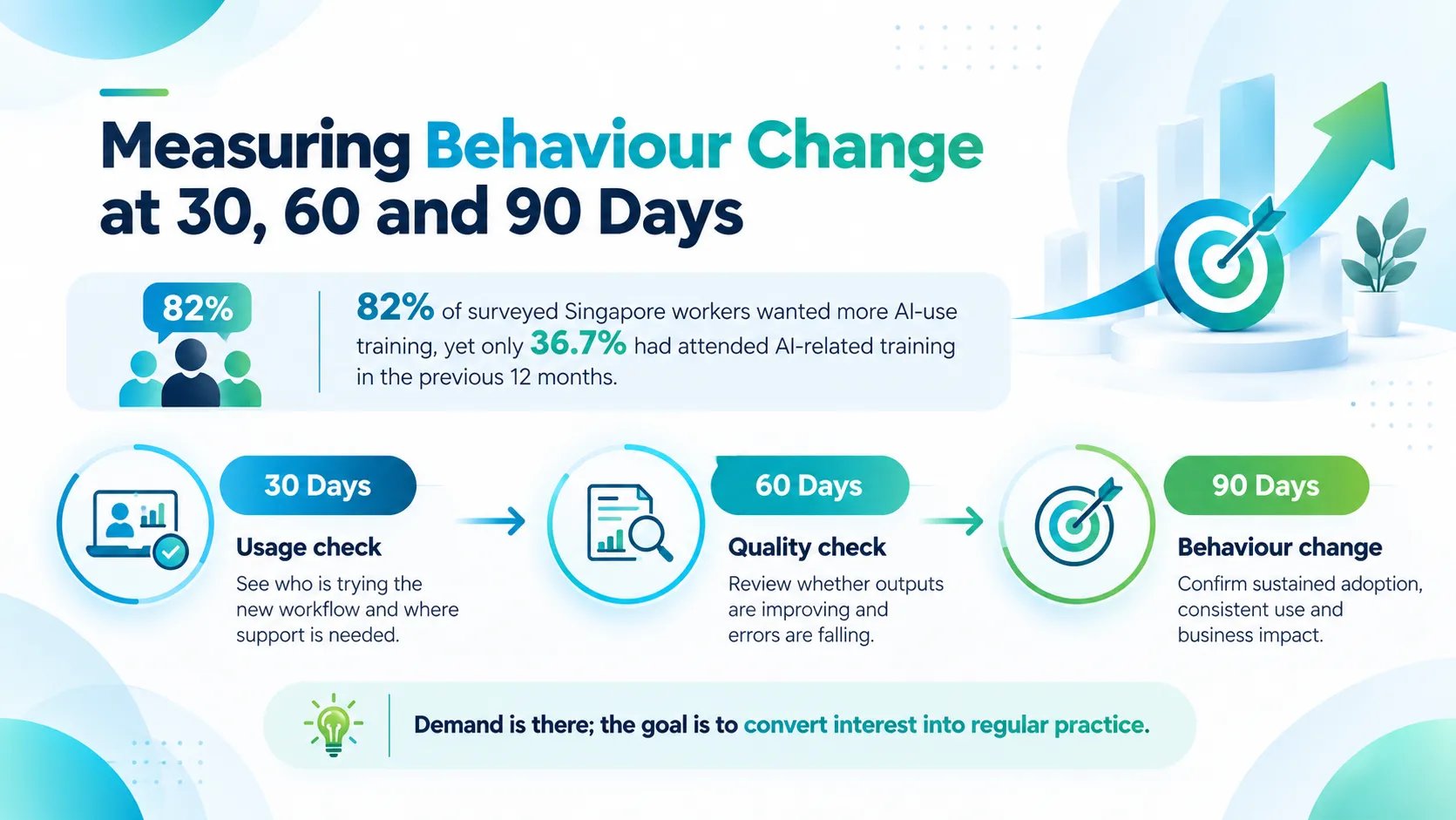
Behaviour metrics across the first 90 days
The scorecard below is a proposed pilot design, so adjust the rows to fit your workflow. Set acceptance criteria before looking at the results, because enthusiasm for the programme will otherwise shape the judgement.
| Metric | Baseline | 30-day check | 90-day check |
|---|---|---|---|
| Cycle time per task | Average time from a proposed sample of 20 tasks | Weekly average on the same task type | Sustained reduction without lower quality |
| Error rate on reviewed outputs | Share needing correction before training | Independent reviewer checks a sampled set | Stable or falling across two review cycles |
| Blind-scored output quality | Rubric score without knowing the source | Repeat scoring on comparable tasks | Scores hold as volume rises |
| Escalation frequency | Uncertain outputs passed to a senior reviewer | Compare reasons and frequency with baseline | Escalations match risk, not habit |
| Policy violations | Count from the pre-training audit log | Risk owner reviews logged incidents | Target no repeat breaches of the same type |
| Reuse of approved workflows | Share using a documented workflow | Check actual use against task records | Most routine tasks follow the approved workflow |
At the 60-day review, inspect exceptions and reviewer workload. Check whether people can handle unfamiliar cases and the harder end of the task range, since repeating the easiest exercise tells you little.
Read the measures together
A team lead might compare two weeks of baseline work with the first 30-day window, matching task complexity and counting review time. If drafting becomes faster while corrections increase, the speed gain has moved unfinished checking onto a reviewer.
A rising escalation count can also signal progress. Employees may be recognising uncertainty they previously missed, so inspect the reasons behind each escalation before rewarding a lower figure.
Don’t reward speed that transfers unfinished checking to somebody else.
For a lean pilot, give evidence gathering a clear owner and scope. A resource such as 1chat’s research support for small teams can inform supporting research activity, while your own task records remain the evidence that settles whether training changed performance.
Treat follow-up as organisational change management, with evidence drawn from daily work. Don’t borrow a placement or completion rate from another programme and present it as a generative AI success rate.
The 90-day view matters most because it tests whether employees maintain the behaviour after classroom support has ended. A metric that improves at day 30 and drifts back by day 90 tells you the training produced an event, while the routine stayed the same.
Pick One Team and Run a 90-Day Pilot
The first team you pick determines whether the pilot proves anything. Choose for the ability to run a fair test, not because a manager is the loudest AI enthusiast. A suitable workflow produces enough repeated work to reveal patterns without touching data your organisation hasn’t approved.
Choose a team with workable conditions
- Repeated demand: Enough similar tasks arrive each week that a 30-day window shows a pattern rather than a handful of anecdotes.
- Agreed quality: Reviewers can point to a shared standard for an acceptable result, so “better” is not renegotiated case by case.
- Protected time: The manager frees hours for practice and review instead of stacking labs on top of an unchanged workload.
- Permitted data: The source material sits inside rules the team already follows, so no new approval is needed before the first lab.
Keep the pilot to one workflow over 90 days, with the baseline captured before the first lab. Resist adding adjacent use cases just because the initial demonstration looks promising. A second workflow doubles the variables before you have a clean read on the first.
For outside support, we offer a Generative & Agentic AI Awareness course as a foundational, non-technical introduction to modern AI, and an AI Use-Case Discovery Workshop to identify and prioritise where AI is worth pursuing in a business. Choose the course when people need shared understanding first, and the workshop when leaders haven’t yet agreed which problem deserves attention.
Make handover part of the decision
Specify who will maintain the instructions, review failures and approve changes once external support ends. Name that maintainer before the pilot starts, and keep the prompts and review checks in documentation the team owns. A pilot that works only while a specialist sits beside the team isn’t ready to scale.
This week, choose the workflow, name its reviewer, pull the baseline numbers and book the first lab.
Common Questions About Generative AI Training
How long should a programme run?
Plan for 90 days of observed practice. If the 30-day check shows weak quality or skipped escalation, cut scope to one task type, retrain the reviewer and repeat the same workflow rather than adding new ones.
Does everyone need the same course?
No. Executives need governance and tool-policy decisions, AI Users need safe prompting and output checking, and AI Practitioners need integration and evaluation skills. Putting all three in one course wastes budget: leaders sit through prompting basics while practitioners wait for depth that never arrives.
Do we need a technical team to start?
Not for baseline measurement or frontline training using approved tools. Bring technical specialists in when the work involves building systems, connecting data or changing access permissions.
What if people already use AI tools without approval?
Publish an approved tool list organised by data class before the first lab, with a clear route to disclose existing usage. Treat disclosure as the start of adoption; punishing honest answers pushes the practice further underground.
How do we know it worked?
Look for sustained quality, appropriate escalation and independent use of the approved workflow. Failure signals matter just as much: unreviewed output sent as final, old habits returning under deadline pressure, and work that stops when the trainer leaves.
Where should we start?
Settle the data question before booking any training: which data classes approved tools may touch, and who answers when a case falls outside them. Every later decision about tasks, teams and tools works within that boundary.
Ekipa combines AI training, coaching and hands-on delivery to help teams turn learning into daily practice they can sustain independently. Visit Ekipa to discuss a focused pilot built around your workflow, review requirements and evidence of behaviour change.