

Your board has approved the transformation. The budget exists, the sponsors are named, and the kickoff date is on the calendar. Then the harder question lands on your desk. Do you hire broad strategy advice, a specialist delivery team, or an embedded partner who'll work inside your teams until the new way of working sticks?
That choice will shape what your organisation can do long after the final presentation. Choose management consulting firms as operating partners, not as prestige signals, and you'll make a far more defensible decision.
Why the Right Consulting Partner Changes Transformation Outcomes
A familiar scene plays out across Singapore and Southeast Asia. A bank, insurer, or energy company secures approval for AI adoption or a new operating model. Three task forces form, each with its own priorities. Nobody owns the delivery rhythm, and risk colleagues join late, asking questions the programme can't answer.
Six months later, the strategy still looks polished. The work hasn't moved. Teams have attended workshops, but they can't run the new process without outside help, and leaders can't point to a production outcome that justifies the next tranche of funding.

The real decision you're making
You're not buying analysis. You're buying whether strategic intent survives contact with your operating reality, your data quality, and your regulatory obligations. A useful partner connects four things that weak engagements keep separate.
Strategic intent: A clear hypothesis about which outcome matters and what you'll stop doing to fund it.
Delivery capacity: Named people who can build, coach, and transfer skills inside your teams.
Governance: Decision rights, escalation routes, and evidence that controls work in practice.
Capability transfer: Routines and artefacts your staff can run independently after handover.
Singapore's market shows why that connection matters. Business and management consultancy contributed approximately S$2.6 billion to GDP in 2020 and about S$2.9 billion in 2021 according to Singapore management consulting market data attributed to the Ministry of Trade and Industry. That's a mature, economically material sector, yet maturity doesn't guarantee fit for your brief.
If you're also weighing enterprise systems change, an ERP transformation guide can help you think through sequencing before you lock a consulting scope around it. Treat platform decisions, process redesign, and team capability as one decision, not three separate purchases.
Selection principle: Judge a firm by what your teams will be able to do on day 91 without them in the room.
Understand the Management Consulting Firm Landscape
Labels help you build a shortlist. They don't predict performance. Most capable firms work across more than one category, so use the map below to clarify what you actually need before you compare names.
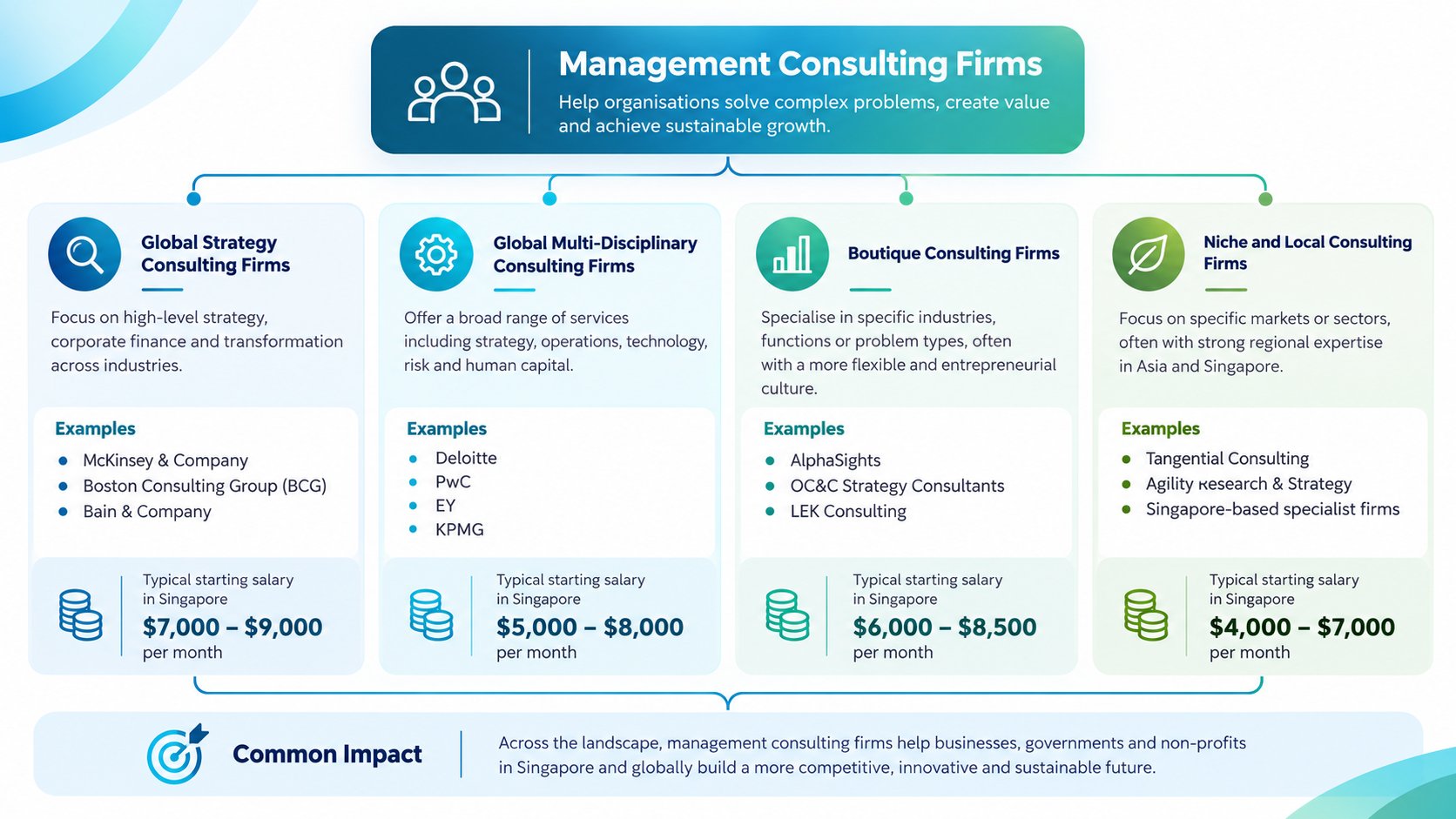
Six profiles you'll encounter
Broad strategy firms suit board-level choices about markets, portfolios, and growth. Transformation and operating-model specialists focus on how work flows, who decides, and how teams are structured. Digital and AI advisory firms concentrate on use case selection, data readiness, architecture, and governance. You'll find more detail on that specialism in this guide to AI consulting firms and what they should deliver.
Organisational change partners work on leadership behaviour, adoption, and communications. Talent and executive search businesses help you fill roles the transformation depends on. Boutique firms offer deep sector or functional expertise, often with senior practitioners doing the work rather than delegating it.
Singapore treats this activity as distinct and measurable. Management consultancy sits under SSIC code 70201, separate from related categories such as human resource consultancy at 70204, as set out in Singapore Department of Statistics classification materials. That separation matters because it stops you from confusing accounting, legal, or IT services with genuine management advisory capability when you scan the market.
Two dimensions that shape your shortlist
The transformation problem: Is it unclear strategy, a broken operating model, weak data, stalled AI pilots, or teams that can't adopt new routines?
The delivery model: Do you need advice only, advisory plus implementation, coaching and training, or an embedded team with a planned exit?
Write those two answers down before you speak to any firm. If you can't, you don't have a brief yet. You have a shopping list, and every firm will happily sell you its own version of it.
Compare Notable Consulting Firm Profiles
Don't chase a league table. No universal ranking can tell you whether a firm fits a regulated AI programme in Singapore, an Agile reset in a manufacturer, or a leadership capability build across three countries. Compare profiles instead, then test each firm against your brief.
Consulting firm profiles for transformation buyers
| Firm profile | Best-fit transformation need | Capability to verify | Engagement question |
|---|---|---|---|
| Global strategy firm | Board decisions on direction, portfolio, and major investment | Senior partner involvement and relevant sector judgement | Who stays after the recommendation to help us implement it? |
| Specialist transformation practice | Operating model, process, and performance improvement | Evidence of changing routines, not only redesigning structures | Which client roles will you coach, and how will you measure adoption? |
| Digital and AI advisory firm | Use case prioritisation, data readiness, AI governance, production delivery | Data engineering, MLOps, risk controls, and production track record | Show us a use case you took from pilot to controlled production. |
| Boutique sector or capability firm | Deep problem in one function or regulated domain | Named specialists and direct sector experience | Will the people in this room do the work, or supervise others? |
| Delivery-oriented regional partner | Strategy already approved, execution and capability transfer needed | Embedded delivery, coaching, training, and handover discipline | What will our teams run independently at handover, and by when? |
| Talent and search partner | Critical roles missing for the new operating model | Role design, assessment quality, and onboarding support | How will you test for delivery capability, not only credentials? |
What to probe in every profile
Ask about team composition first. A partner-led pitch followed by analyst-heavy delivery is a common disappointment. Insist on named individuals, their time commitment, and what happens if someone leaves mid-engagement.
Next, test sector relevance carefully. Experience in your industry helps, but vocabulary isn't evidence. Ask what surprised them in a similar programme, what failed, and what they'd refuse to repeat. Candid answers tell you more than a credentials deck.
Then examine how they work alongside client teams. Strong firms co-create backlogs, coach product owners, and sit in your governance forums. Weak ones interview your staff, disappear, and return with recommendations your teams don't own.
Finally, clarify whether the firm can support both advisory and implementation. Some shouldn't. A firm that's excellent at diagnosis may be the wrong choice to run delivery, and that's fine if you know it upfront.
The differentiator isn't the quality of the final deck. It's whether capability has moved into your organisation by the time the deck is presented.
Don't accept invented commercial terms or vague claims about being market leaders. You need evidence of relevant work, a credible team, and a handover plan you could defend to your CFO and your risk function.
Evaluate Fit for Your Transformation Brief
Start with a one-page brief. If it runs longer, you probably haven't made the hard choices yet.
Build the brief before you meet firms
Your brief should state the business outcome in measurable terms, the teams affected, the constraints you can't move, and the regulatory context. It should also name the decision rights the partner will and won't hold. Finish with one sentence describing what must work after the engagement ends.
Outcome: For example, one prioritised AI use case in controlled production, or a functioning backlog and sprint rhythm owned by internal product teams.
Constraints: Budget guardrails, data residency, audit requirements, union or workforce considerations, fixed launch dates.
Decision rights: Who approves scope changes, who can stop a release, who owns benefits realisation.
Exit condition: The specific routines, artefacts, and skills your staff must demonstrate without consultant support.
Send the same brief to every shortlisted firm. Different briefs produce incomparable proposals, and you'll end up choosing the best writer rather than the best partner.
Test proposals through working sessions
Require four things in each response. Ask for a hypothesis about your problem, a workplan with sequencing and dependencies, a named team with time allocations, and a handover plan with dates. Reject proposals that describe phases without naming who does the work in each one.
Then run discovery as a working interview, not a beauty parade. Give the proposed team a real, messy scenario from your programme. Watch whether they ask about data quality, decision rights, and operational risk, or whether they retreat into frameworks. If your transformation depends on platforms and infrastructure readiness, it's worth reviewing how Continuum Solutions IT consulting services frame technology advice alongside business outcomes, then hold every bidder to that same standard of joining up systems and operations.
Check references with specific questions. Did the named team really deliver? What did the client have to fix afterwards? Would they hire the firm again for implementation, or only for advice? Listen for hesitation. It's data.
The best management consulting firms for your situation will understand your operating reality, including informal power, legacy processes, and tired middle managers who didn't choose this change. If a firm only speaks your sector's vocabulary, keep looking.
Match Firm Models to Transformation Use Cases
The right model depends on the work, not on habit. Buying a long embedded engagement for a narrow diagnostic wastes money. Buying a short diagnostic for a complex, regulated change programme wastes time.
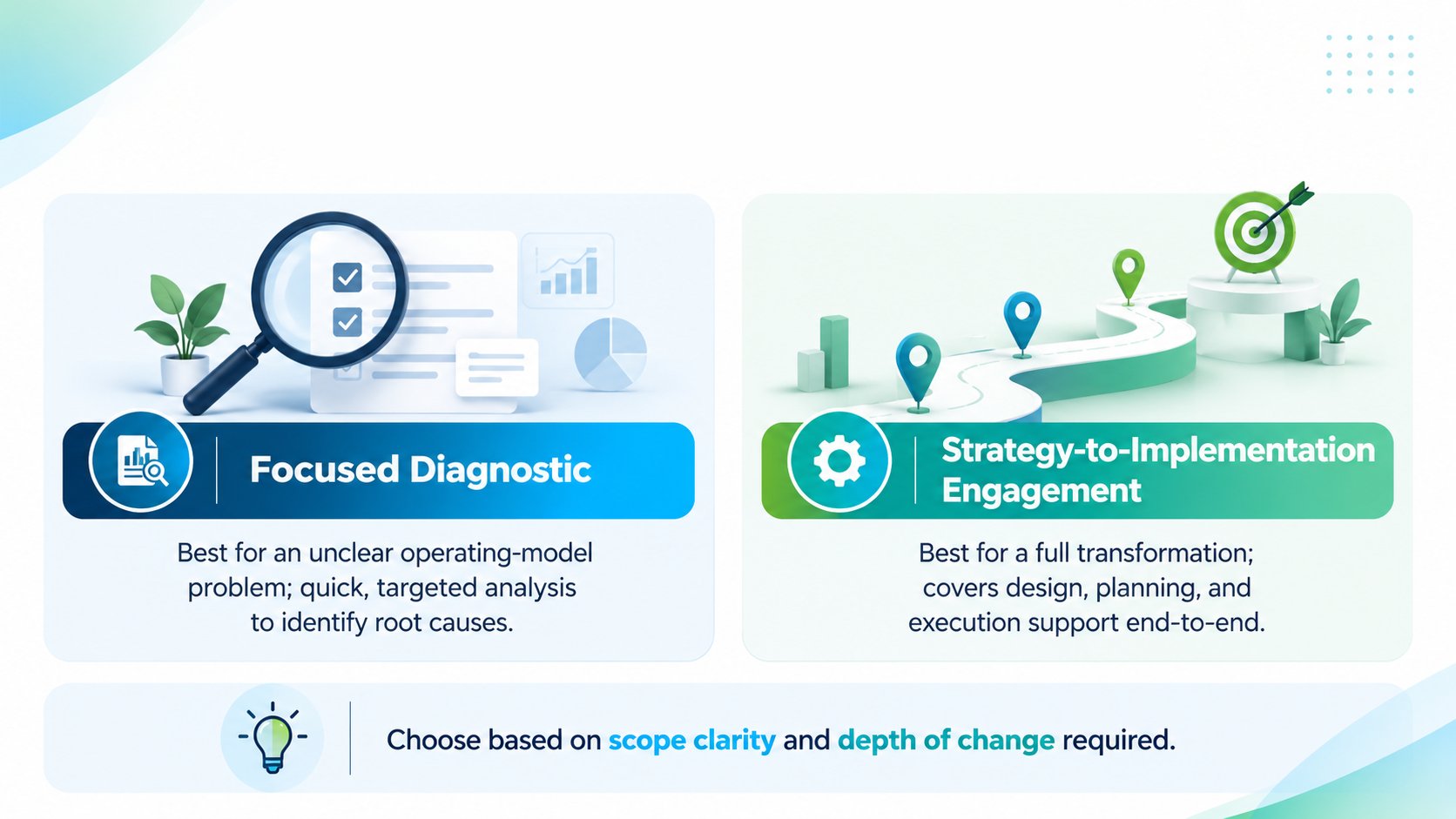
Five models and where they fit
A focused diagnostic suits an unclear operating-model problem. You suspect handoffs, decision bottlenecks, or duplicated governance are slowing delivery, but you don't yet know where. Keep it short, demand evidence from real workflows, and require a prioritised backlog rather than a maturity score.
A strategy-to-implementation engagement fits when leadership has approved a direction and needs it converted into roadmaps, backlogs, and working teams. With a disciplined digital transformation strategy that connects planning to execution, the work stops being a document and becomes a delivery system.
An embedded advisory team works for complex change across many units. Consultants coach leaders, run governance rhythms, and unblock delivery teams. The risk is dependence, so contract the exit from day one with named internal successors for every external role.
An AI governance and production-readiness engagement addresses Singapore's clearest current gap. Enterprise AI adoption rose from 14.7% in 2024 to 23.5% in 2025 according to figures cited in MAS reporting on responsible AI adoption expectations, yet adoption isn't the same as operational capability. A bank moving AI from pilots into controlled processes needs data controls, human oversight, testing, and monitoring designed into delivery, not bolted on before audit.
An Agile coaching or training partnership fits when the constraint is team capability. A manufacturer stabilising delivery while adopting new ways of working may need coaches embedded with product and operations teams, plus role-based training for managers who must evaluate different work than they're used to.
Commercial structures and their trade-offs
Fixed-scope project: Predictable cost, but brittle when discovery changes the problem. Use it for diagnostics and well-bounded deliverables.
Time-and-materials advisory: Flexible and fast to start, but it needs strong internal ownership or scope will drift.
Embedded team: Fastest capability build, highest dependence risk. Pair every consultant with an internal counterpart.
Blended model: Advisory, coaching, delivery, and recruitment support combined. Powerful when governed tightly, confusing when boundaries blur.
Choose based on ownership, pace, and cost predictability. Then ask one blunt question. If this firm left tomorrow, what would stop working? The answer reveals whether you're buying capability or renting it.
Compare Cost, Governance and Capability Transfer
Never compare firms on headline fee alone. Two proposals with similar totals can hide very different assumptions about team seniority, travel, specialist input, and who does the unglamorous work.
Build a like-for-like commercial comparison
Scope and assumptions: What's excluded, what depends on your staff, and what triggers a change request?
Named team and rate structure: Who is billed at which level, and can the firm substitute people without your approval?
Additional costs: Travel, workshops, third-party tools, data work, and specialist reviews.
Boundaries: Where does advisory end, delivery begin, and recruitment support sit?
If your programme needs senior AI leadership without a permanent hire, a Head of Agents cost guide can help you sanity-check how fractional leadership compares with consulting day rates before you negotiate. Use it as context, not as a substitute for testing the actual team being proposed.
Governance that survives scrutiny
Good governance names decision rights, escalation routes, and reporting rhythms that match how your organisation decides. It also covers data access, confidentiality, quality standards, and how exceptions get resolved. For regulated work, those controls aren't paperwork.
The Monetary Authority of Singapore expects financial institutions to maintain clear board and senior-management accountability for AI risk, with accurate AI inventories and risk materiality assessed by impact, complexity, and reliance, as set out in MAS guidelines on artificial intelligence risk management for financial institutions. Your consulting contract should map directly to expectations like these, with proportionate controls for each use case.
Capability transfer deserves the same rigour. Strong organisational change management that builds internal ownership treats handover as a designed outcome with metrics, not a closing workshop.
Measure what matters. Track production deployment, process cycle time, human override rates, unresolved security or privacy exceptions, and the proportion of client staff independently operating the new process. Also track benefits realised against the approved investment case. If a firm resists those measures, ask yourself why.
Demand is also shifting toward selective, defensible initiatives. The Singapore Business Federation found four in five businesses actively engaged in digital transformation, while the share calling it a top priority fell from 71% in 2024 to 58% in 2025, as reported in its 2025 National Business Survey digitalisation supplement. Your scorecard should reflect that discipline.
Choose and Launch the Right Consulting Engagement
Turn the comparison into action with a short, disciplined sequence.
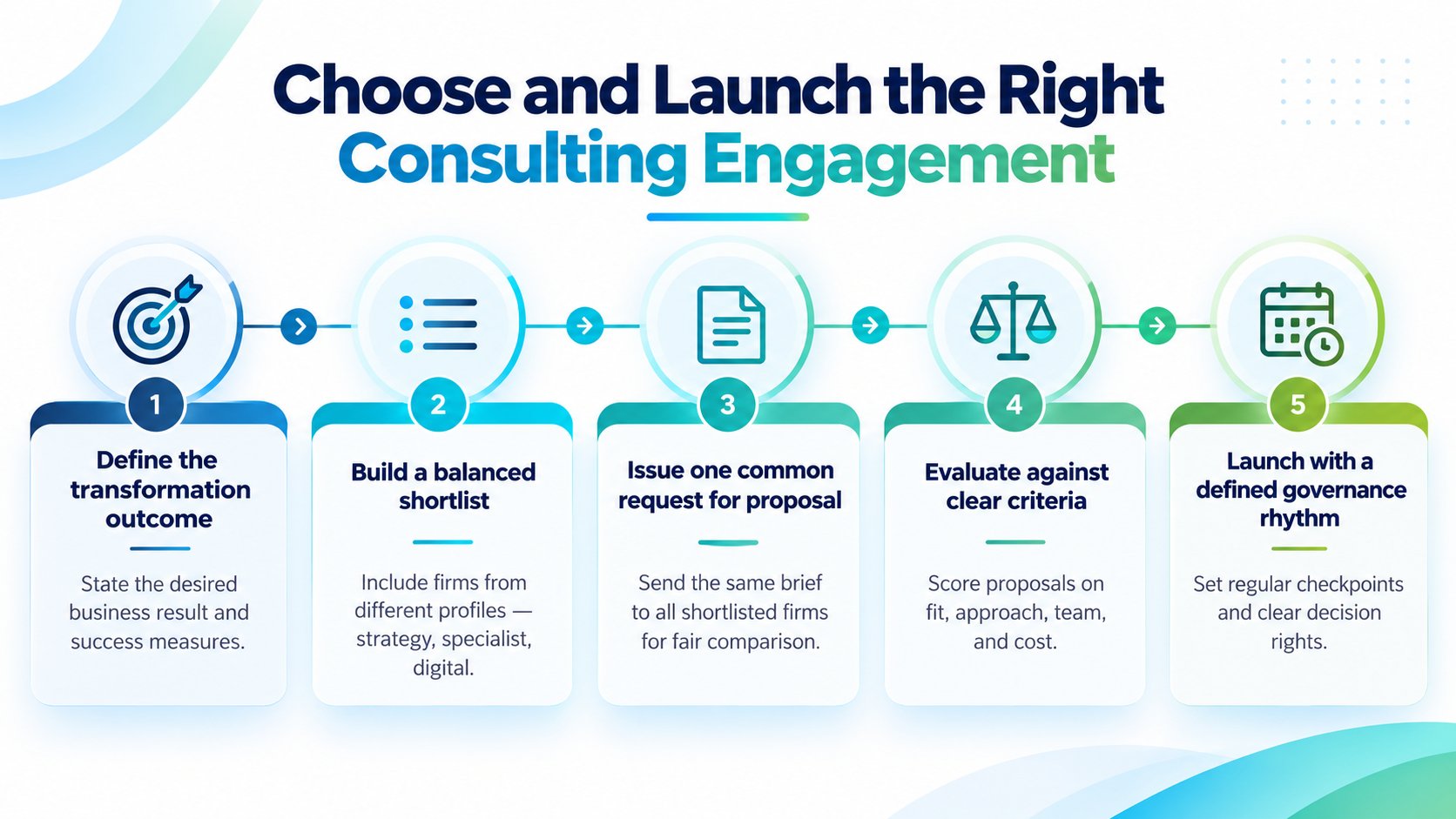
A selection sequence you can defend
Define the outcome: One measurable result, one accountable internal owner, one exit condition.
Build a balanced shortlist: Include different firm profiles so you're comparing models, not just brands.
Issue one common brief: Same scope, same questions, same deadline for every firm.
Interview the proposed team: Work a real scenario together and check references with specific questions.
Negotiate handover commitments: Put capability transfer, governance rhythms, and measurable milestones in the contract.
Score each firm on problem diagnosis, relevant capability, delivery and coaching strength, team quality, governance, commercial clarity, and fit with your operating model. Weight capability transfer heavily. It's the criterion buyers most often underweight and most often regret.
For Southeast Asian enterprises that need strategy converted into running teams, Ekipa.co is a regional option to include on that balanced shortlist, particularly where Agile coaching, AI and data advisory, training, and delivery need to sit in one engagement with a planned handover.
Choose the partner who makes your organisation less dependent on partners.
The right choice among management consulting firms isn't the most established name in the room. It's the firm whose evidence, team, and commercial model match your specific transformation, and who'll leave behind people and routines that keep working without them.
If your transformation has board approval but lacks a delivery system your teams can own, Ekipa can help you turn that strategy into executable backlogs, coached teams, and measurable 90-day outcomes across Agile, AI, and data work. Visit us to discuss your brief, test our thinking against your toughest constraints, and design an engagement built around handover from the start.