

A CIO at a regulated Singapore enterprise has one afternoon to defend the consulting shortlist. Procurement likes the lowest day rate. The board recognises the biggest logo. The delivery team keeps asking the harder question: who will build this, who will govern it, and who will still be accountable when the slides are archived?
The market is expanding quickly, but more providers do not necessarily make the decision clearer. Among technology consulting firms, the useful differences sit in how work is staffed and controlled. Look past the pitch to the delivery model, the depth of governance, and how deliberately skills are transferred into your teams. That is what separates working outcomes from a polished deck, and it should drive the match to the work your organisation needs.
Why Choosing a Technology Consulting Firm Feels Harder Than It Should
Three proposals can look interchangeable because the visible parts are easy to compare: brand, day rate, service list and case studies. The risky parts are harder to see in a deck. Who is staffed on the work? How do delivery decisions get escalated? Which controls are built into the work? Can your people run the result after the consultants leave?
A polished pitch can hide a weak delivery model. A firm may advise well but depend on scarce specialists for build work. It may bring senior partners to kickoff, then hand daily decisions to a rotating team. It may define a target architecture while leaving product owners unsure how to release, audit and operate it.
The market growth noted earlier explains the crowding, not the fit. In Southeast Asian regulated enterprises, the harder test is whether a provider can work inside approval paths, risk reviews, data controls and business-unit politics without slowing delivery to a halt.
Ask each bidder to name the people who will own delivery decisions, the controls they will implement, and the evidence that your teams can maintain the result after handover. Push for specifics: weekly decision rights, escalation routes, release and audit checkpoints, paired-delivery arrangements, runbooks, handover criteria and what happens if a key person leaves.
Practical rule: Judge the proposal by the operating model it creates after the consultants leave, not by how complete it sounds during procurement.
Strong answers name accountable people and show working artefacts. Weak answers stay at methodology, certifications and confidence. That difference is why selection feels difficult: similar claims can cover very different exposure.
What Technology Consulting Firms Do and the Main Types
Technology consulting firms help organisations decide what to change and, increasingly, deliver the change itself. An engagement may cover a strategy, a cloud or data platform, an AI use case, or changes to the way teams plan and deliver work. Many providers bundle several disciplines, but their practical strengths still differ.
A helpful first distinction is whether a firm mainly advises, mainly builds, or combines advice with hands-on implementation and organisational change. That distinction matters more than a long list of services. In a regulated enterprise, a technical team may need to coordinate with risk and compliance colleagues, while a transformation team may need to change how product owners, engineers and leaders make decisions.
Four common firm profiles
| Firm type | Typical strengths | Watch-outs | Best fit |
|---|---|---|---|
| Global generalists | Broad strategy and technology capabilities, experience coordinating across markets and business units | Delivery may depend on which specialists are staffed; senior pitch teams may not stay close to execution | Multi-country programmes or complex enterprise change |
| Big Four advisory and technology arms | Familiarity with audit, risk, governance and large organisational programmes | Advisory, implementation and assurance roles need clear boundaries; delivery depth can vary by team | Regulated organisations combining technology change with controls or operating-model work |
| Regional specialists | Local market knowledge, proximity to regional teams and familiarity with local working contexts | May have less capacity for large, multi-continent programmes | Southeast Asian execution where local coordination and context matter |
| Boutique or niche firms | Focused expertise, direct access to specialists and a narrower delivery scope | A specialist may not cover connected disciplines or long-term programme coordination | Clearly bounded problems that need deep expertise in a specific capability |
These are profiles, not guarantees. A regional specialist can have strong engineering capability; a global firm can have an excellent local team. Assess the actual people and delivery plan rather than assuming the category tells the whole story.
Why integration has become the buying question
Enterprise demand increasingly involves several capabilities at once. In 2025, 96.4% of Singapore enterprises had adopted at least one of six digital domains tracked by IMDA, while the average enterprise had adopted 2.5 domains, up from 2.3 in 2024. Those domains include cloud computing, data analytics and AI. The figures come from IMDA’s enterprise digitalisation data.
That breadth changes what good looks like. A cloud project that doesn’t account for data access, security and operating ownership may leave another team to solve the hardest connections later. When evaluating the firm’s transformation approach, a successful digital transformation strategy should connect capabilities to business workflows, accountable owners and outcomes the organisation can track. First, place each shortlisted firm in a profile. Then ask whether its strengths cover the dependencies in your actual problem.
How to Compare Technology Consulting Firms Beyond the Pitch
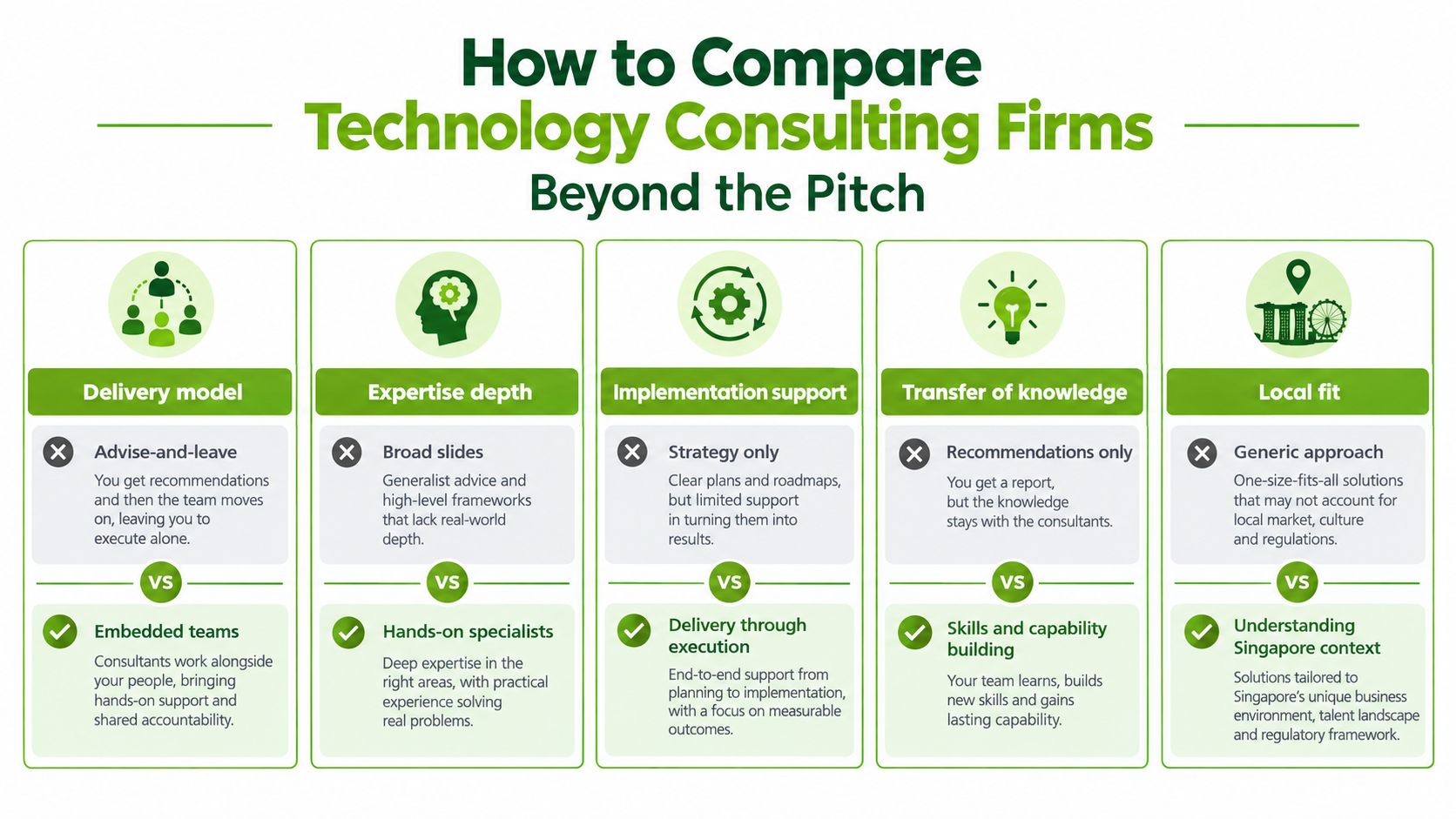
A polished presentation can demonstrate that a firm understands your language. It can’t, by itself, show you how the firm will work once the engagement begins. Compare the proposed team and delivery method across five dimensions, and ask for evidence that fits your problem.
Five dimensions that expose the real differences
-
Delivery model: An advise-and-leave engagement can be appropriate when leaders need an independent assessment or a clear recommendation. It’s a poor fit when the organisation needs people alongside its squads to refine backlogs, resolve delivery obstacles and test solutions. Ask how often the proposed team will work with yours, and who owns day-to-day decisions.
-
Expertise depth: Broad coverage is useful when a programme crosses business and technology, but breadth on a slide isn’t proof of hands-on capability. Ask who will design the architecture, build the data pipeline or prepare the AI use case for production. If a firm proposes modernisation work, it can also help to compare cloud modernisation partners against the specific delivery scope you need, rather than comparing general claims.
-
Implementation support: Some firms finish at the roadmap; others stay through execution. Neither model is automatically better. The fit depends on whether your organisation already has the team, technical capacity and authority to turn recommendations into working services.
-
Governance depth: For regulated buyers, a governance policy is only useful if teams can apply it during delivery. MAS’s proposed AI Risk Management Guidelines point to expectations such as an accurate AI inventory, risk materiality assessments and lifecycle controls. Ask the firm to show how those become backlog items, named owners, release gates, testing evidence and ongoing monitoring. A deck that describes principles without showing the operating mechanics leaves the delivery risk with you.
-
Skills transfer and commercial structure: A good partner should explain how your people will learn to maintain the new process or system, not just how the firm will staff the work. Also inspect the contract: milestones and acceptance criteria should reward usable outcomes, not merely time spent or documents delivered. The best AI consulting firms are worth comparing on delivery evidence and capability transfer, not brand recognition alone.
Use the infographic as a quick prompt for a shortlist discussion. It summarises the differences to test, not a substitute for reference checks.
Matching Technology Consulting Firms to Real Business Situations
The right provider depends on what’s blocking progress. A bank trying to release a customer-facing AI service has a different problem from a manufacturer trying to repair fragmented data or a leadership team trying to make agile ways of working stick. Start with the constraint, then choose the profile that can address it.
When governance, engineering or change is the constraint
A bank or insurer moving an AI pilot into production needs more than model expertise. MAS’s FEAT principles call for regular review and validation of data and models, internal approval for AI-driven decision-making, ongoing checks that models behave as designed, and a route for affected individuals to request a review. The FEAT principles for financial institutions make the operating needs concrete. A firm with regulated delivery experience is more likely to connect approval authority, monitoring and human review to the work teams do. A partner that only supplies a policy or model may leave the client with controls that nobody owns in production.
A manufacturer or telecom business preparing for AI may have a different bottleneck: fragmented data, inconsistent definitions or pipelines that aren’t reliable enough to support new workloads. Here, engineering depth matters more than a polished advisory story. A specialist who can assess architecture and build the required platform components may suit better than a strategy-led team without implementation capacity. Choosing the latter can produce an attractive target-state design while leaving the engineering backlog unresolved.
When teams need new ways of working
An enterprise running an Agile transformation at scale may already have technology teams, but still struggle with decision rights, portfolio priorities or leadership habits. A partner with coaching and change capability can work with leaders, product teams and managers to make changes part of day-to-day practice. Firms focused mainly on large programme controls may be less suited if the main constraint is how teams work together. Organisational change management is relevant when adoption depends on leadership behaviour and team routines, not just a new delivery process.
A government-linked enterprise may need consultants who understand the local regulatory and operating context as well as the technology. A regional team with relevant sector experience can help connect enterprise controls, internal stakeholders and implementation planning. A distant team without local familiarity may underestimate review processes or rely on assumptions that don’t match how the organisation works. That doesn’t rule out a global provider, but the actual regional delivery team should be able to demonstrate how it will work within the client’s context.
Questions to Ask Before You Sign a Consulting Agreement
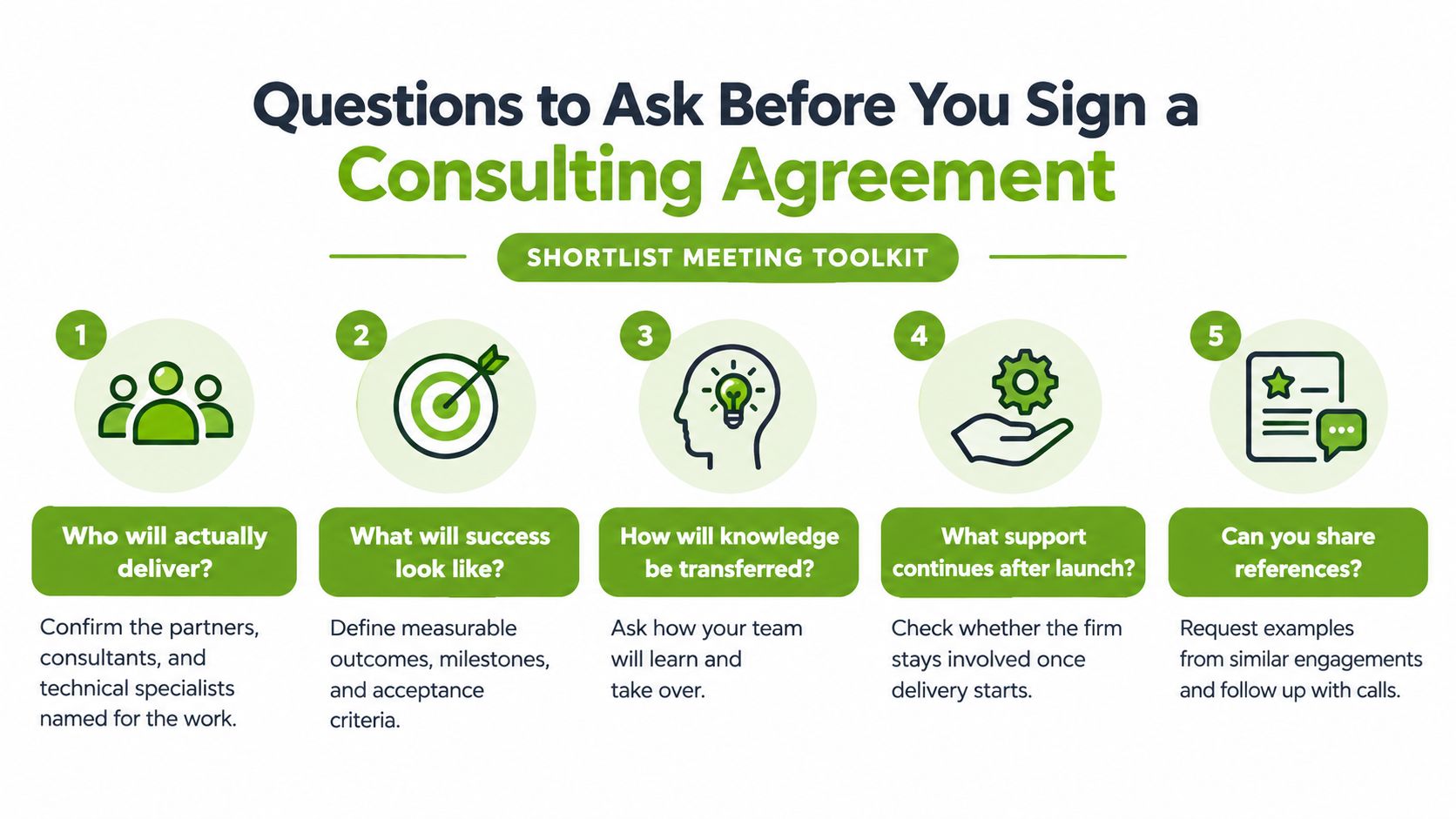
The pitch meeting tests how a firm sells. The shortlist meeting should test how its people deliver. Ask the same core questions of each candidate, record specific answers, and follow up where the response is vague.
Questions that reveal delivery capability
-
Who will deliver?
Confirm the names and roles of the partners, consultants and technical specialists assigned to the work. Ask who will lead daily decisions, and what happens if the proposed team changes.
-
What will success look like?
Agree on observable outcomes, milestones and acceptance criteria. “Improve AI readiness” isn’t enough; the proposal should say what evidence will show the organisation is ready.
-
Can you show a working governance artefact?
Ask for an example of an AI inventory, risk assessment or delivery control, with confidential details removed if needed. A methodology slide doesn’t show how the firm records owners, decisions, tests or monitoring.
-
How will knowledge transfer work?
Find out which client roles will work alongside the consultants, what they’ll learn, and how the client will take over. A handover meeting isn’t the same as building capability throughout the engagement.
-
What support continues after launch?
Clarify whether the firm will help resolve early issues, and who owns ongoing operations when its team steps back.
-
Can you share relevant references?
Request examples from similar regulated or regional work and speak directly with the client if possible. Ask what changed after the engagement ended, not just whether the final presentation was well received.
The checklist infographic offers a handy prompt for vendor meetings and reference calls.
Warning signs worth taking seriously
Be cautious if no consultants based in the region will work on the engagement, or if the firm can’t provide references from comparable regulated work. A pitch team that disappears after signature is another concern, particularly when the replacement team has different expertise. So is proprietary tooling that leaves your organisation dependent on the consultancy to operate, access or interpret its own work.
If your scope includes a website move, it can also help to distinguish a specialist technical migration plan from the broader transformation engagement. WebinOne’s guide to migration services provides context for that narrower workstream. Keep the consulting agreement focused on named owners, handover, acceptance criteria and what happens when the firm leaves.
Where a Regional Partner Like Ekipa Fits
A Jakarta bank wants its AI pilot in production within two quarters, with its own analysts running the backlog once the consultants step away. That kind of brief suits a regional partner better than a programme built for coordination across many continents. The model is practical: coaches and technical experts work inside client teams, turn approved priorities into executable backlogs, and support delivery while client colleagues learn the new routines.
Skills transfer matters because technology capability now sits across industries, not only inside technology companies. Singapore had 214,000 tech professionals in 2024, up from 208,300 in 2023, and technology professionals represented 5.3% of total employment. Growth was 3.9% in non-ICT sectors, compared with 1.1% in the ICT sector, according to IMDA’s technology workforce data. The same source reports that 73.8% of surveyed workers in Singapore used AI tools at work. Demand for these skills is spreading faster than the specialist talent pool, which strengthens the case for delivery models that build capability inside client teams rather than lend it temporarily.
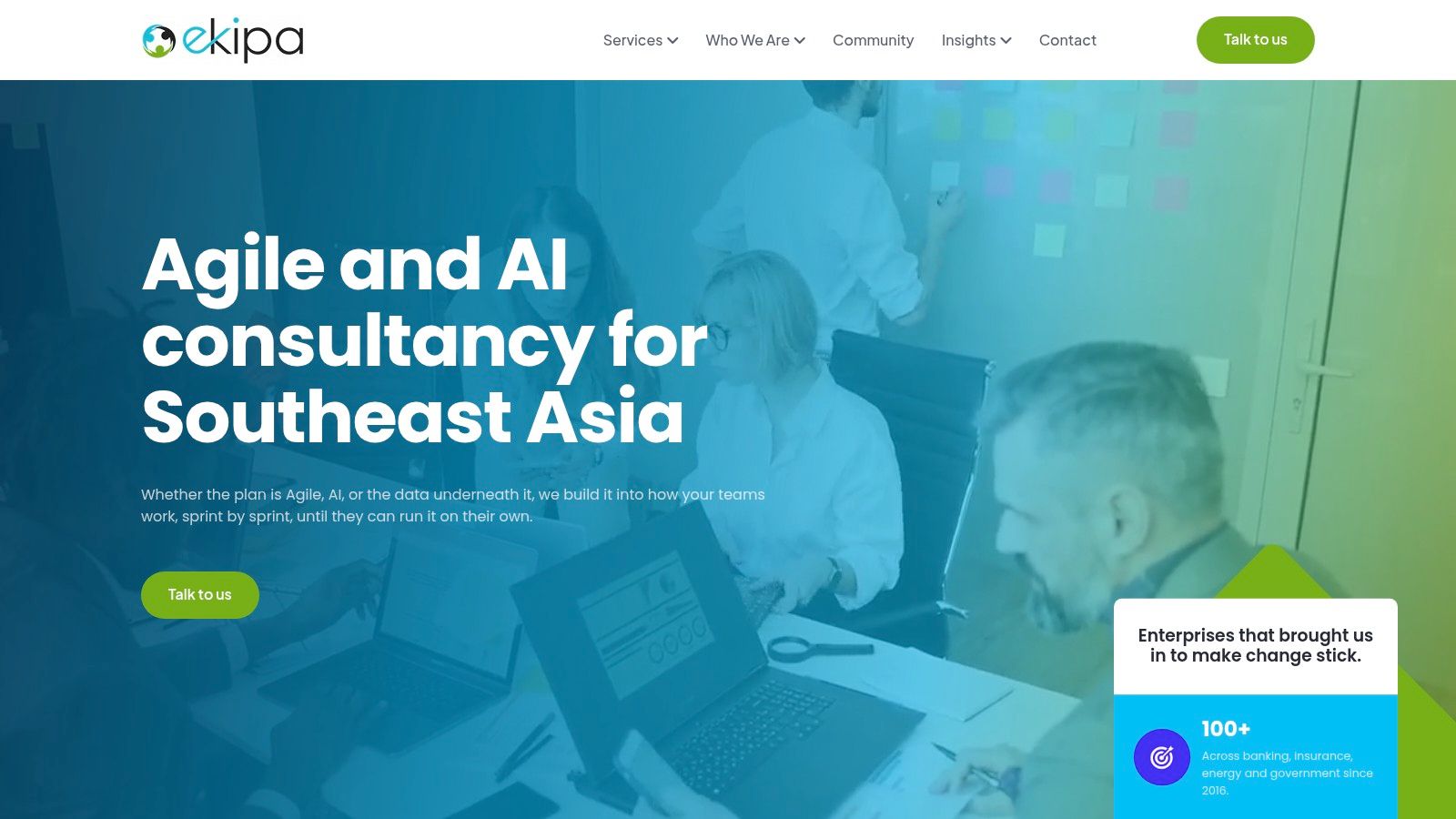
Ekipa works across Agile, AI and data through training, coaching, advisory and delivery. Its structured 90-day sprint cycles translate approved strategy into backlogs and working teams, and its engineering build-out combines platform, pipeline and systems expertise to carry work from approved priorities through implementation. Consultants and facilitators are based in Jakarta, Singapore and Kuala Lumpur, with working familiarity of regional regulatory contexts such as OJK and MAS. Governance depth matters in this setting: in regulated financial services, controls have to live inside the sprint itself rather than arrive as a follow-up memo.
That model will not suit every programme. Standardised delivery across multiple continents, or substantial global programme capacity, may call for a global generalist instead. The useful test is whether the proposed team can deliver at the scale and in the context your work requires, and whether your own people can sustain the outcome when the engagement ends.
Choosing With Confidence and Taking the Next Step
Choose against the problem you need to solve. For regulated AI moving into production, look for governance fluency and proof that controls are part of delivery. For capability-building, prioritise embedded teams and a credible plan to transfer skills. For a multi-continent programme, assess scale and regional coverage. For execution in Southeast Asia, test local presence and familiarity with the regulatory context.
Then keep the first commitment manageable. Shortlist two or three firms, use the questions above in structured calls, and compare their answers against the people and outcomes named in their proposals. Rather than signing a broad transformation contract immediately, test the relationship with a scoped, time-bound engagement, such as a readiness assessment or a single delivery cycle with agreed, measurable outcomes.
That approach gives your leaders a chance to see how the consultancy works with your teams before you deepen the commitment. The best technology consulting firm isn’t necessarily the one with the loudest brand. It’s the one whose delivery model fits your situation and leaves your organisation able to sustain the outcome.
Ekipa helps Southeast Asian enterprises turn strategy into execution through Agile, AI and data training, coaching, advisory and delivery, with embedded teams and structured sprint cycles. If you’re weighing a transformation or AI initiative, visit Ekipa to explore an approach that fits your organisation and regional context.