 Singapore | English
 .png) Worldwide
Worldwide Indonesia
 Malaysia
During 2020, I’ve been engaged in several larger agility transformations in Indonesia. Most companies focus on creating digital innovation. To achieve this, they create new ways of working and structures to become more agile. Agile is the ‘engine’ to create new products on services.
One of the biggest challenges I see in all these agility transformations is bureaucracy and policies. Over time, enterprises build all sorts of control mechanisms. I’m always wondering why they need them, but the unfortunate thing is: most people don’t wonder about that. Maybe because it creates work for them, because they like checking boxes or they’re afraid to touch them?
Some policies are in place because of government regulations. It’s tempting to state: it’s the regulation, so we need to stick to them. But do you? Although it might take lots of sweat and pain to challenge OR try to change them, if we’re on a mission, we can’t blindly accept them.
The biggest hurdle to a successful transformation are these policies, rules, habits that limit agility. It takes some very strong and audacious leaders to address them.
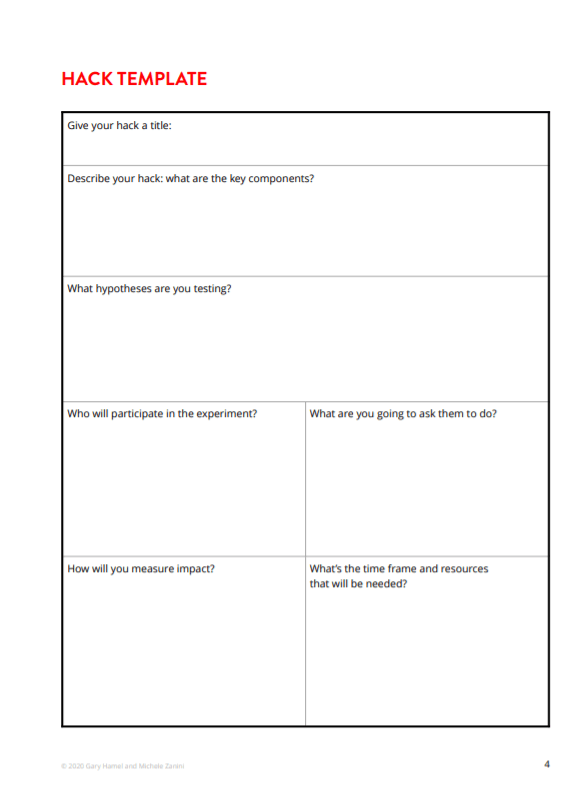
My colleague Ranco shared a book by Gary Hamel, who has been writing management content for decades. The concept he shares is the ‘management hackathon’. It’s a workshop format to address the above hurdles, come up with solutions which are then run in experiments. I especially like the experimentation approach. Changing or challenging policies seems like a daunting task to most people. If we reduce the change to a simple experiment, run in a short period, during which we learn what the impact is, we can iterate and then expand it. An experiment is relatively ‘safe’. It is small. We accept that it might fail. The worst case is we learn something and need to re-define the experiment.
This short video explains the concept and workshop format. You can also download the workshop pdf. There are 3 key questions that you discuss with your team:
QUESTION 1: PROBLEMS Where do you feel we may be suffering from “bureausclerosis”— waste, friction, insularity, autocracy, conformity, timidity, politicking, or other related ailments? Pick one malady and be prepared to illustrate how it impairs effectiveness. (Be as concrete as possible.)
QUESTION 2: PROCESSES AND POLICIES What management policies or processes—including planning, goal setting, budgeting, staffing, job design, product development, performance management, hiring, promotion, training, development, and compensation—are most to blame for this problem? Pick one process and be prepared to describe how it contributes to the malady.
QUESTION 3: PRINCIPLES Which post-bureaucratic principle—ownership, markets, meritocracy, community, openness, or experimentation—would be the most helpful in overcoming this disorder? Pick one principle and describe how it could be applied in a way that would help counter the negative effects of bureaucracy.